Start from the job. Then read the numbers properly.
The right tool is a job first and a specification second.
Pick what you are trying to do and we will tell you which single number actually decides it — and which ones are noise. We are researchers and hobbyists, not tradespeople, and we have not tested these tools.
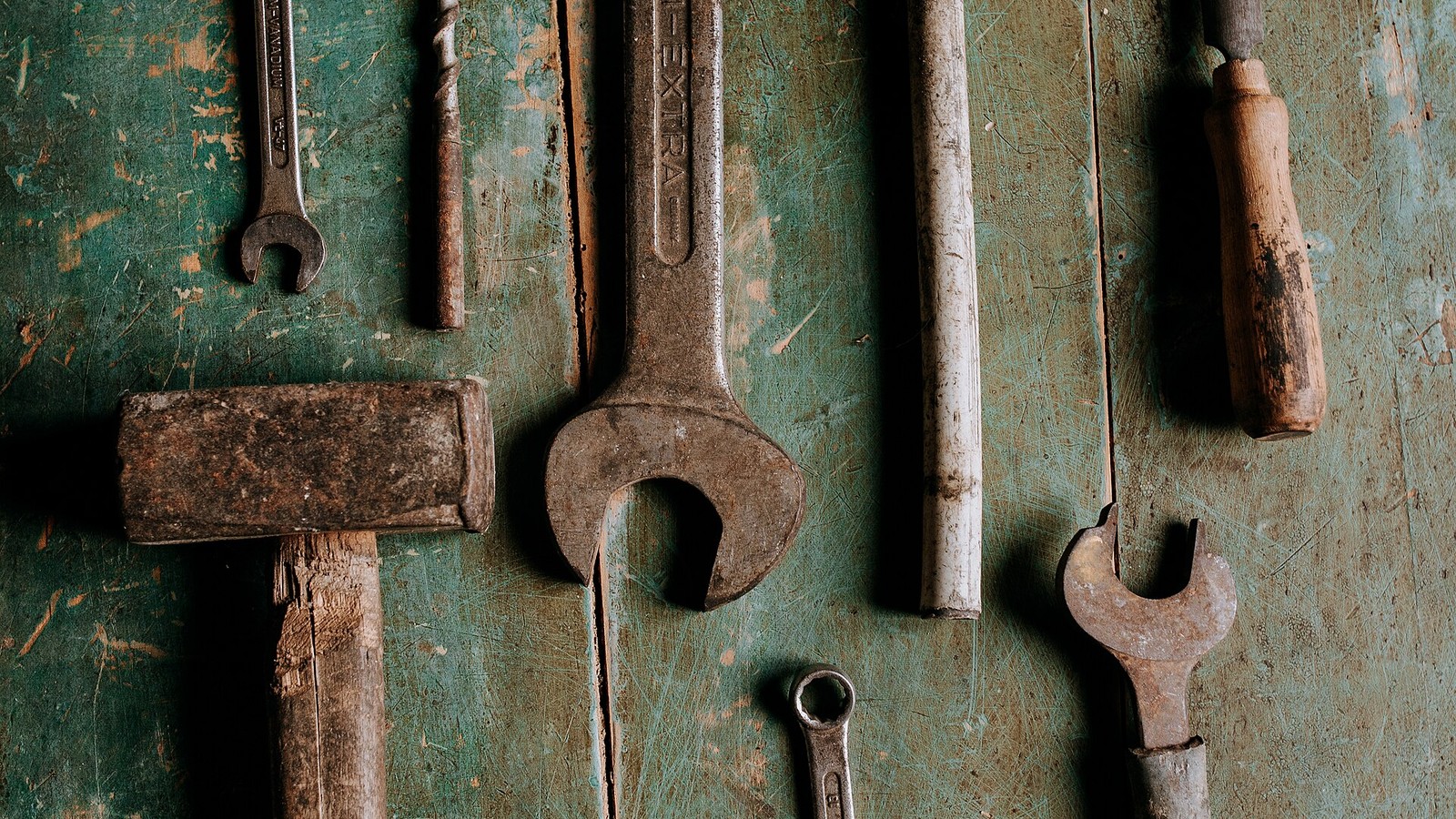
Photo by Shixart1985, Wikimedia Commons, CC BY 2.0 — cropped.

Describe the hole, the cut or the joint before you pick up a tool
Most tool questions get easier once the task is described precisely. “I need a drill” can mean boring a clean hole in hardwood, sinking a long screw into a joist, or getting through brick, and each of those favors a different machine. Tool families exist because no single mechanism does every job well. A spinning chuck, a hammering anvil and a sliding piston all make holes, but each trades control, force and finish in its own way. Knowing which trade a tool makes tells you more than any figure on the box.
That is why the site is organized around what you are trying to do. The tool guide maps the main families by job, and choosing a tool covers the purchase. Two ideas run through both: every tool has things it is bad at, and much of what is printed on packaging describes the tool rather than your task, which is the point of specifications that are marketing, not information.
Five jobs and the tool families built for them
Drilling and driving
Three tools look alike and do different work. A drill driver spins a chuck and has a clutch that slips at a chosen resistance, so it can bore holes and seat small screws without stripping them. An impact driver takes hex-shank bits and adds rapid rotational blows once a screw resists, which makes long fasteners easy and delicate work harder to control. A hammer drill adds a forward pounding action for masonry. Drill vs impact driver vs hammer drill sets out the split. For concrete, a rotary hammer strikes with a piston and hits much harder. When a hole has to be square and repeatable, a drill press fixes the geometry a wrist cannot.
Cutting
Saws divide by what moves. With a miter saw and a table saw, the first brings the blade down onto fixed stock for crosscuts and angles, while the second has you feed stock past a fixed blade for long rip cuts. A circular saw carries the blade to the board, and running it along a rail turns it into a track saw with a straighter, cleaner edge. For curves, the choice between a jigsaw and a bandsaw depends mostly on thickness, since a thin jigsaw blade flexes in deep stock. An oscillating multi-tool handles flush and plunge cuts in awkward places, and an angle grinder works metal and masonry.
The blade matters as much as the saw. Tooth count on a saw blade trades cutting speed against finish, and a dull blade does more than leave a rough edge: it makes the motor work harder and the cut more likely to bind.
Fastening
Nails and screws hold in different ways. A nail resists sideways loads and goes in fast; a screw draws parts together, resists pulling out and can be backed out later. What decides between nails and screws sets out when each is right. A nail gun’s trigger mode matters for safety as well as speed, because it decides whether the tool fires only in a set sequence or whenever the nose is bumped with the trigger held. For bolts, the question is controlled force. What a torque wrench measures is the twisting force at the fastener, and the setting always comes from the vehicle or equipment manual.
Measuring and layout
A mistake made at the marking stage is carried into every cut that follows. Three words are used loosely here: accuracy, precision and resolution mean closeness to the true value, repeatability, and the smallest step a tool can show, and a tool can have plenty of one and little of another. A tape measure’s loose hook is deliberate: it slides by its own thickness so inside and outside readings both come out true. A combination square marks, measures and checks right angles. A laser level’s real limits are worth knowing before you trust a line across a room. Finer work moves to calipers and micrometers.
Sanding and finishing
Sanders differ in how the pad moves. A random orbital sander spins and orbits at once so the scratches never line up, which makes it the usual general-purpose choice. A belt sander removes material fast and can dig in just as fast. A card scraper shaves difficult grain that sandpaper would tear. Sanding is also where dust becomes a health question, because fine dust matters more than sawdust: the particles you cannot see stay airborne longest. Capture it at the tool first; a dust extractor and a shop vacuum differ mainly in how fine a particle they are built to hold.
Cordless platforms: the battery is the real purchase
Batteries from one maker generally fit only that maker’s tools within a voltage line, so a first cordless tool is really a choice of system. What a battery platform commitment costs you is mostly lock-in: which tools the range includes, whether batteries stay available, and what switching later would mean. For stationary work or long, continuous runs, corded versus cordless is still a live choice.
Voltage roughly sets the class of work a tool is built for; amp-hours describe capacity, which in practice means runtime, as what volts and amp-hours tell you explains. A brushless motor switches current electronically instead of through carbon brushes that rub and wear. Batteries age through heat, charge cycles and time, so how lithium-ion tool batteries age is worth reading before a pack spends a summer in a hot garage.
Comparing tools without being sold to
A good comparison asks which numbers describe your work. A tool’s duty cycle, meaning how long it can work before it needs to rest, says more about who it was built for than peak output does, and it is the real line between DIY, prosumer and trade tools. None of this says what to buy; it says what to compare against the jobs on your own list.
A tool needed only occasionally may be better rented rather than bought. A used one can be sound if you know what to check on a used power tool: guards present and working, a switch that turns on and off cleanly, no burnt smell, no play in the chuck or arbor. Starting from nothing, the order a first toolkit is bought in matters more than any single purchase.
Safety principles that hold for every tool
Guards and safety features stay in place, always. A blade guard, a riving knife, an anti-kickback pawl and a dead-man switch each answer a specific, well-understood way people get hurt. The best known on saws is kickback: when wood pinches the back of a spinning blade, the saw or the workpiece is thrown toward the operator faster than anyone can react. If a guard makes a cut awkward, the answer is a different technique, a jig or a different tool, and a push stick keeps hands clear of the blade while still controlling the stock.
Protection should match the hazard. Eye protection belongs on anything that throws material: saws, grinders, nailers, a struck chisel. Hearing protection belongs on anything loud and sustained, such as saws, routers and planers; when ear protection becomes necessary depends on loudness and time, which OSHA’s guidance on occupational noise exposure sets out. Fine dust calls for protection that actually seals and filters, which is the difference between a dust mask and a respirator. That matters most with MDF, hardwood and silica dust from cutting concrete, brick, stone or tile, which OSHA regulates under its crystalline silica rules.
The rest is habit. Loose sleeves and gloves can be caught by a spinning chuck and pull a hand in after them. A burnt smell is a reason to stop, not to push on. In the garage, a car should never rest on a jack alone: a jack lifts, and axle stands hold. Two limits frame everything above. The manual for your own machine outranks any general article on speeds, settings and blade choice. And workshop wiring, whether a dedicated circuit, a sub-panel or anything behind a cover, is a licensed electrician’s job; understanding what a residual-current device does helps you know what to ask for. OSHA’s overview of hand and power tool safety is a sound next step.
Start here
What are you trying to do?
Six jobs cover most of a home workshop, a garage and a garden shed. Each one hangs on a different specification — which is why a single “best tool” answer never survives contact with an actual task.
The decoder
What each specification actually tells you
Every number on a tool box is true, and most are close to useless alone. The third column is the one nobody prints.
Recently
Newest on the bench
- What Is a Biscuit Joiner and What Does It Join?
- Portable Workbench: What It’s Good For and Its Limits
- How Should a Small Garage Workshop Actually Be Laid Out?
- What Is the Point of a Torque Wrench’s Storage Case?
- What Is a Magnetic Parts Tray and Why Mechanics Trust It?
- What Does Workshop Temperature Do to Tools and Materials?
Everything, by subject
Where things live
Where this site stops
We explain how tools work and what their specifications mean. We never describe removing or working around a guard, we do not publish speeds, feeds or torque settings — those belong to the manual for your machine — and anything involving fixed wiring, gas or structural work is a job for a qualified tradesperson.
- Guards stay onBlade guards, riving knives, interlocks and anti-kickback pawls. No exceptions, no workarounds.
- The manual outranks usSpeeds, torque and depth of cut are specific to your machine. We explain what they do, not what to set.
- No fixed wiringWorkshop circuits, sub-panels and anything behind a cover are a licensed electrician’s work.
- No ranked picksWe do not publish “best of” lists and we have not tested these tools.