A rotary hammer is a drill built around a piston-driven hammer mechanism that delivers real striking force, not just vibration. A hammer drill is enough for occasional holes in brick or block for plugs and fixings. A rotary hammer is what you need for repeated holes in concrete, larger diameters, or chiselling and chasing work.
How does a rotary hammer actually work?
Inside a rotary hammer, a small piston is driven back and forth by the motor, and that piston compresses air in a closed cylinder to strike a “flying” hammer piece. That impact is transferred straight into the bit through the chuck, independent of how hard the user pushes on the tool.
This matters because it means the hammering energy comes from the mechanism, not from arm pressure. A hammer drill, by contrast, uses two ridged discs (a cam mechanism) that clatter against each other as the chuck spins, and the force of that clattering depends heavily on how hard the tool is pushed into the work. Push a rotary hammer gently and it still hits hard. Push a hammer drill gently and it barely hammers at all.
Many rotary hammers also let the hammer action run without rotation, which is what allows them to be used as a light chisel or scraper for tasks like removing old tile adhesive or cutting a shallow channel for a cable or pipe.
How is that different from a hammer drill?
A hammer drill is a standard drill with a cam-action hammer bolted on, aimed at occasional masonry holes. A rotary hammer is a purpose-built impact tool with a separate piston mechanism, aimed at repeated or larger holes in concrete and at light demolition work.
The two tools also usually take different bits. Hammer drills use standard round-shank masonry bits held in a conventional keyed or keyless chuck. Rotary hammers use SDS-style shanks that lock into a quick-change chuck without being clamped tight, which lets the bit move slightly in and out to receive the piston strikes cleanly. Trying to fit a round-shank bit into an SDS chuck, or vice versa, simply does not work — they are different systems for a reason.
For a side-by-side look at where hammer drills sit next to plain drills and impact drivers, see Drill vs Impact Driver vs Hammer Drill: The Difference.
What jobs actually need a rotary hammer?
A rotary hammer earns its place when the material is solid concrete rather than brick or block, when the hole diameter or depth is larger than a hammer drill handles comfortably, or when the job involves many holes in one session, such as anchoring a run of shelving brackets or a stud wall track into a concrete floor.
- Drilling anchor holes for heavy fixings — railings, brackets, machinery bases — into poured concrete.
- Repeated holes for conduit clips, cable tray, or fixings along a long concrete or block run.
- Light demolition: breaking up a section of screed, chipping out old mortar, or removing tile.
- Core-style holes for pipework or vents where a standard masonry bit would take a very long time or wander off line.
If a job involves cutting through structural concrete, altering a load-bearing wall, or coring through a slab that might contain post-tensioning cable or embedded services, that is a point to bring in a structural engineer or licensed contractor rather than working it out on site. The tool is capable of the cut; whether the cut is safe to make is a different question entirely.
What do SDS and SDS-Max chucks mean for bit choice?
SDS and SDS-Plus describe a shank and chuck standard sized for smaller rotary hammers and everyday masonry bits. SDS-Max is a larger, more robust version of the same idea, used on heavier tools for bigger holes and sustained chiselling. The two are not interchangeable without an adaptor, and adaptors trade away some of the shock transfer that makes the system work well.
When choosing bits, the manufacturer’s documentation for the specific tool is the reliable source for which shank size it takes, the maximum bit diameter it is rated for, and which chisel attachments (point, flat, spade) are compatible. A bit that is too large for the tool’s rated capacity can overload the mechanism and produce a poor, slow result even if it physically fits.
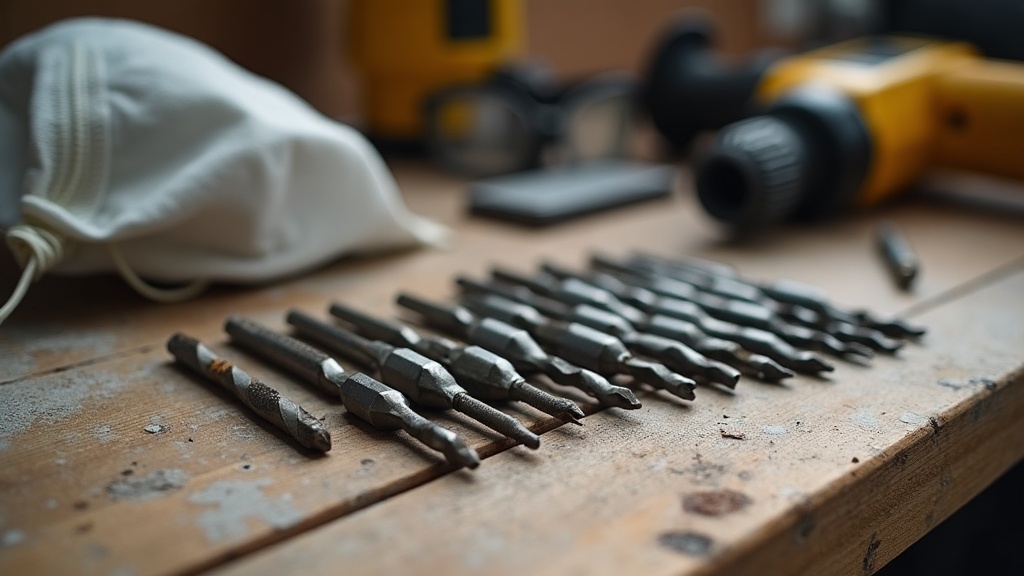
Is a hammer drill enough for drilling into a wall for small jobs?
For a handful of holes in brick, block, or mortar joints — hanging a shelf, fitting a curtain pole bracket, mounting a small item — a decent hammer drill with a sharp masonry bit is usually enough. The line moves once the material is dense poured concrete, the hole is wide or deep, or there are more than a few holes to get through.
A useful test in practice: if a hammer drill is struggling, slowing right down, or the bit is getting hot and glazing rather than cutting cleanly, that is a sign the material or the job size has moved past what the tool is designed for, not a sign to push harder.
What PPE and dust precautions does rotary hammer work need?
Drilling and chiselling concrete and masonry throws chips and produces fine dust that contains crystalline silica, a recognised respiratory hazard when inhaled over time. This is not a job to do without proper protection, and it is not optional protection either.
- Eye protection rated for impact, since concrete and masonry chips are ejected forcefully and can travel some distance.
- Ear protection for any sustained drilling or chiselling session — rotary hammers are loud enough, for long enough, to matter.
- Respiratory protection suited to fine silica dust, not a basic disposable mask meant for larger wood particles. Where possible, use dust extraction attached at the point of drilling rather than relying on a mask alone.
- Vibration awareness — sustained rotary hammer use transmits real vibration to hands and arms, so taking breaks and swapping tasks over a long job is worth building into the plan.
For more on matching protective equipment to a specific hazard rather than treating PPE as an afterthought, see the Safety & PPE section.
What should you compare when choosing between a hammer drill and a rotary hammer?
The honest comparison is about the kind and volume of work, not which tool sounds more capable. A hammer drill that also does ordinary drilling and driving covers most homeowner tasks with one tool in the case. A rotary hammer is a specialist for concrete and heavy masonry, and it is a poor substitute for everyday drilling and driving in wood or metal.
- Material — brick, block and mortar favour a hammer drill; poured concrete favours a rotary hammer.
- Hole count and diameter — occasional small holes vs. repeated or larger holes.
- Chisel function — needed for demolition-type tasks, irrelevant for pure drilling.
- Weight and handling — rotary hammers are heavier and bulkier, which matters for overhead or awkward-position work.
- Bit system cost — SDS bits are a different (and often pricier) ecosystem than round-shank masonry bits, worth factoring into the overall cost of owning the tool.
The general framework for weighing specifications against actual use, rather than chasing numbers on a box, is covered in the buying tools guide and the wider buying guides archive.
What about corded vs cordless rotary hammers?
Corded rotary hammers give consistent power for long sessions of drilling or chiselling without needing to manage batteries, which suits a fixed workshop or a job where the tool runs for extended periods. Cordless versions have closed the gap for most homeowner-scale tasks and add the freedom to work away from an outlet, at the cost of battery weight and monitoring charge through a longer job.
Where a cordless rotary hammer is on the table, the motor type and battery platform behave the same way they do across other cordless tools — see what brushless actually means in a power tool motor and what volts and amp-hours tell you about a tool for how those specifications translate into real runtime and power rather than marketing numbers.
Any job that touches fixed household wiring — for instance, drilling near a wall where cable routes are unknown, or chasing a channel for new cabling — is a point to stop and think about what’s behind the surface, and to bring in a licensed electrician for anything involving the actual wiring itself. A rotary hammer will happily drill straight through a cable it cannot see.
Where does a rotary hammer sit alongside the rest of a workshop kit?
A rotary hammer is a specialist tool that earns a place in a home workshop only if concrete or heavy masonry work comes up regularly enough to justify it — otherwise, renting one for a specific job is often the more sensible route than owning a tool that sits idle. For a broader look at how drills, drivers and impact tools divide up ordinary workshop tasks, the power tools archive and the tool guide hub cover how these mechanisms actually work, and cordless drill vs driver: what’s the real difference is a useful companion for sorting out which everyday tool covers which task before reaching for something heavier. Comparisons between related tools, including drills and hammer drills, are gathered in the comparisons archive.
Find Tool publishes general information, not professional advice. Power tools, mains electricity and workshop machinery are genuinely dangerous, and the safe settings, guards and procedures differ between models — always follow the manual and the markings on the tool in front of you rather than a general guide. Never remove or defeat a guard or safety feature. Anything involving fixed wiring, gas or structural work belongs to a qualified tradesperson. Wear the eye, ear and respiratory protection the task calls for.
Related reading
What Is Soft Start, and Why Do Bigger Tools Have It?.
Featured image: Photo by Mark Hunter, source, CC BY 2.0
