A dust extractor is built to capture fine dust at the point a power tool creates it, usually connected directly to the tool and matched to it for suction and airflow. A shop vacuum is a general-purpose wet/dry vacuum for cleanup afterward. Extractors are made for continuous, tool-triggered fine-dust capture; shop vacuums are made for picking up debris, chips and spills.
What does a dust extractor actually do?
A dust extractor pulls air and fine particles away from a cutting or sanding operation as it happens, usually through a hose connected straight to the tool’s dust port. It is designed around sustained airflow at a specific tool, not general cleanup.
Most dust extractors used in home workshops are built around a few features that shop vacuums typically lack:
- A power take-off socket that lets the tool switch the extractor on and off automatically
- Filtration rated for very fine dust, not just visible debris
- A design intended to run for long stretches while a tool is in use, rather than short bursts
- Hose diameters and fittings sized to match sanders, routers, planers and saws
The goal is to stop dust becoming airborne in the first place, at the tool, rather than sweeping it up once it has settled everywhere.
What does a shop vacuum do differently?
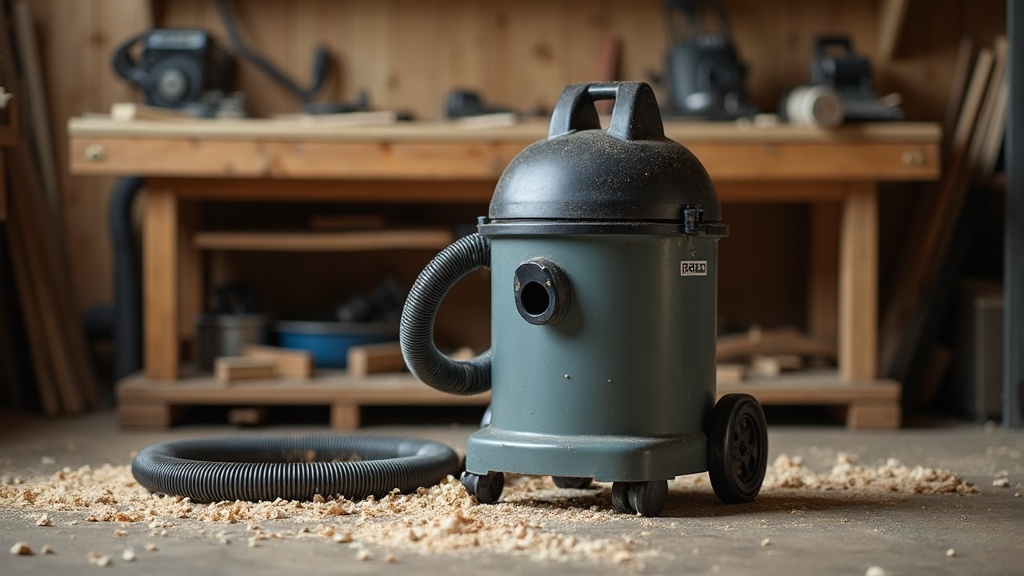
A shop vacuum is a general-purpose vacuum built to lift chips, offcuts, spilled liquid and coarse debris from floors and benches. It is a cleanup tool, not a source-capture tool, and its filtration is usually not matched to fine wood or mineral dust.
Shop vacuums are genuinely useful and belong in most workshops. They handle wet spills, larger debris like screws and wood chips, and general floor cleaning that a dust extractor is not built for. Many have a wide, flexible hose meant for sweeping up material rather than sealing tightly onto a tool’s small dust port.
The filter is the key difference underneath the hood. A standard shop vacuum filter is often designed to stop clogging on larger particles and coarse dust, not to trap the very fine particles produced by sanding or cutting manufactured boards. Fine dust can pass straight through, or clog the filter quickly and reduce suction.
Why does fine dust matter more than it looks like it should?
The dust that causes the most concern is the fraction fine enough to stay suspended in air and reach deep into the lungs. This is a genuine respiratory hazard, and it is worth taking seriously rather than treating as a nuisance to sweep up later.
Materials that produce particularly fine or hazardous dust include MDF, many hardwoods, and anything containing silica such as certain masonry products. Respiratory protection rated for fine dust is appropriate whenever these materials are being cut or sanded, regardless of which extraction equipment is in use. A dust extractor connected at the tool reduces how much fine dust becomes airborne, but it does not eliminate the need for a properly fitted mask or respirator when working these materials, and it does not replace eye protection for operations that throw chips or debris.
Hearing protection matters here too. Both dust extractors and shop vacuums can run loud for extended periods, and if a tool and its extractor are both running continuously, the combined noise exposure over a working session adds up. Ear protection for sustained loud work is a sensible default, not an afterthought.
For a broader look at what PPE a given task actually calls for, the Safety & PPE archive covers this in more depth than a single comparison article can.
Can a shop vacuum be used for dust extraction instead?
A shop vacuum can be connected to some tools and will pick up a portion of the dust, but it is generally a weaker match for sustained fine-dust capture than a purpose-built extractor. Filtration, hose fit and airflow characteristics are usually the limiting factors.
Three things commonly cause a mismatch:
- Filter rating. If the vacuum’s filter is not rated for fine dust, particles pass through and are simply redirected into the room instead of being captured.
- Hose fit. Many shop vacuum hoses are wider than a tool’s dust port, so an adapter is needed and the seal is often imperfect, letting dust escape at the joint.
- Airflow behaviour. Extractors are generally set up to sustain airflow at the smaller diameter a tool needs; a shop vacuum built for wide-hose pickup may not perform the same way through a narrow adapter.
None of this means a shop vacuum is the wrong tool to own. It means the two machines are solving different problems, and using one for the other’s job is a compromise rather than a straight swap.
Does the power take-off socket actually matter?
Yes, for anyone who wants extraction to run automatically with the tool rather than being switched on and off separately. A power take-off (sometimes labelled auto-start) lets a compatible tool control the extractor, so suction starts the moment the tool is triggered and stops shortly after.
This matters in practice because extraction that has to be switched on manually tends to get skipped, especially for short cuts or quick sanding passes. Automatic start removes that friction. It is worth checking compatibility between a specific tool and a specific extractor rather than assuming any combination will pair, since this is exactly the kind of detail the manufacturer’s documentation for each machine should confirm.
What should be compared when choosing between them?
The honest answer is that most home workshops eventually want both, used for different jobs. When comparing specific machines, the comparison should focus on what each is actually built to filter and move, not on marketing language.
Points worth checking against the manufacturer’s own specifications rather than a general guide:
- What particle size the filtration is actually rated to capture, and whether that rating is meaningful for the materials being worked
- Whether the machine has a power take-off socket and which tools it is documented to work with
- Hose diameter and whether it matches the dust ports on the tools already owned, or what adapters are needed
- How filters are emptied and cleaned, since a system that is a hassle to maintain tends to get bypassed
- Noise level during sustained use, since this affects how long a session is comfortable to run
The buying tools hub covers how to weigh specifications like these against real workshop needs rather than headline numbers, and the buying guides archive has more comparisons in the same practical style.
Does extraction change how a power tool should be used?
Connecting extraction does not change the fundamentals of safe operation, and it is not a substitute for the guards, riving knives or other safety features built into a tool. Extraction manages dust; it does not manage kickback, blade contact or workpiece control.
For anyone still building an understanding of how these hazards arise on tools like table saws, the article on what kickback is and what actually causes it is a useful starting point, alongside the explanation of what a table saw riving knife does. Extraction sits alongside these protections, not in place of them.
For a wider look at how tools like sanders, routers and saws work and where dust extraction fits into each, the tool guide hub and the power tools archive are good places to keep exploring.
Where does storage fit into the decision?
Both dust extractors and shop vacuums take up floor space and need somewhere sensible to live between uses, along with their hoses, filters and any spare bags. A cramped workshop often ends up with hoses coiled awkwardly or left connected permanently, which can get in the way of other work.
Thinking through where a hose will route from tool to extractor, and how the unit itself will be stored without blocking a bench or walkway, is worth doing before buying rather than after. The workshop & storage archive has practical ideas for keeping equipment like this organised in a small space.
The short version
A dust extractor captures fine dust at the tool, continuously, and is built around filtration and airflow suited to that job. A shop vacuum cleans up debris and spills after the fact, and is not generally built to filter the finest dust a sanding or cutting operation produces. Most home workshops benefit from having access to both, used for what each is actually designed to do, alongside proper respiratory and hearing protection whenever fine dust or sustained noise is part of the job.
Find Tool publishes general information, not professional advice. Power tools, mains electricity and workshop machinery are genuinely dangerous, and the safe settings, guards and procedures differ between models — always follow the manual and the markings on the tool in front of you rather than a general guide. Never remove or defeat a guard or safety feature. Anything involving fixed wiring, gas or structural work belongs to a qualified tradesperson. Wear the eye, ear and respiratory protection the task calls for.
Related reading
What Is a Chalk Line, and Where Does It Beat a Laser?.
Featured image: Photo by Becky Stern, source, CC BY-SA 2.0
