A torque wrench is a wrench that measures rotational force, not just applies it. Instead of tightening a bolt until it “feels right,” it lets you tighten to a specific, checkable number. On a car, that matters because wheels, engines and brakes rely on fasteners clamped to an exact tension — not guessed at.
What does a torque wrench actually do differently from a normal wrench?
A standard wrench or ratchet only tells you whether a bolt turns. A torque wrench tells you how much twisting force you applied before it stopped turning, usually shown on a dial, digital display, or by a click and a slight release in resistance at a pre-set value.
That number is what a manufacturer’s specification is actually written against. Service manuals and workshop guides give torque figures because they’ve tested how much clamping force a particular bolt, in a particular material, at a particular thread size, needs to do its job safely — no more and no less.
Why does “tight enough” not work on a car?
Because a fastener that’s under-tightened and one that’s over-tightened fail in different, both serious, ways — and neither is obvious just by looking at it or feeling the wrench in your hand.
A bolt tightened by feel might be fine nine times out of ten. The problem is the tenth time, and the fact that there’s no way to check afterwards whether you got it right.
- Under-tightened fasteners can work loose under vibration, especially on rotating or vibrating parts like wheels and suspension components.
- Over-tightened fasteners can stretch or shear a bolt, strip a thread, or crush a gasket or bearing that was never meant to take that much clamping force.
- Uneven tightening across multiple bolts — a wheel with five nuts, a cylinder head with a dozen — can warp a component even if every individual bolt is within range.
A torque wrench turns “tight enough” into a number you can repeat, check, and defend if something is ever questioned.
Where does this actually matter most on a car?
It matters most anywhere a fastener holds something safety-critical in place, or where a specific clamping force is needed for a part to seal or seat correctly.
- Wheel nuts or bolts — under-torqued wheels can work loose while driving; over-torqued ones can stretch studs or distort brake discs.
- Cylinder head and manifold bolts — these are often tightened in a specific sequence and to a specific figure because uneven clamping can warp the gasket surface.
- Suspension and steering fasteners — these see constant vibration and load reversal, and rely on correct torque to stay put.
- Anything with a stated torque figure in the vehicle’s own service documentation — if the manual gives a number, that’s the number, not an estimate.
This is also why torque wrenches sit in the hand tool category rather than the power tool one — they’re a hand-operated measuring instrument first, and a wrench second. You can browse how other hand tools work, torque wrenches included, in the hand tools archive, and see how measuring tools generally are covered in the measuring and layout archive.
Where do the torque figures actually come from?
They come from the vehicle manufacturer’s own testing and documentation, not from a general rule of thumb that applies across cars.
The figure for a given bolt depends on its thread size, its material, whether it’s dry or lubricated, and what it’s clamping. A wheel bolt on one car and a superficially identical one on another can carry different figures. This is why this article won’t state a number — the reader’s own vehicle handbook, workshop manual, or a sticker under the bonnet is the only source that should be trusted for a specific car.
If a fastener uses a metric thread on one car and an imperial one on an older model, the torque figure and the socket size both change accordingly — worth checking rather than assuming, and covered in more general terms in this piece on metric vs imperial tools.
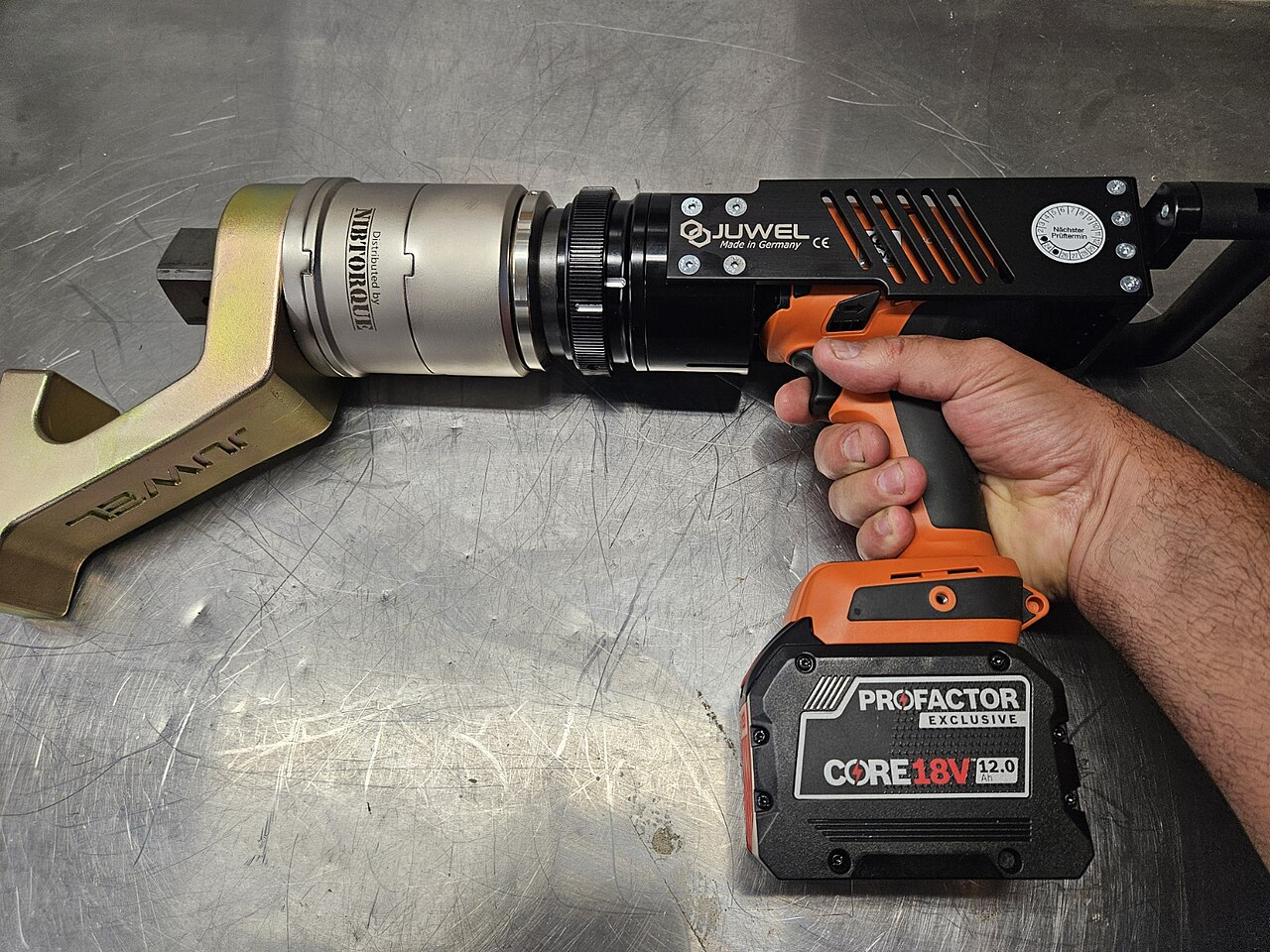
What types of torque wrench are there?
The three most common designs work on different principles, but all aim to give the same result: a repeatable, checkable torque value.
- Click-type wrenches are set to a target figure and give a distinct click and a small drop in resistance once that figure is reached. They’re mechanical and don’t need a battery.
- Beam-type wrenches use a pointer and a scale that flexes with applied force — simple and durable, but the reading has to be watched as you tighten, not felt.
- Digital/electronic wrenches display the torque figure directly and can often beep or vibrate at the target, which suits users who find a small dial harder to read at an awkward angle.
None of these is universally “better” — the right one depends on how it will be used, stored, and how often it’s checked for accuracy, which is a genuine trade-off rather than a marketing distinction. The general question of what to compare when buying any tool is covered in the buying tools guide.
Does socket size or drive size matter here too?
Yes — the drive size on a torque wrench (commonly a fitting that sockets clip onto) has to match the sockets being used, and the right drive size for automotive work is usually dictated by the size of fastener being turned.
A wrench with too small a drive for a large wheel bolt risks flex and an inaccurate reading; too large a drive on small fasteners is just cumbersome. What a socket set’s drive size is actually telling you is explained in more detail in this guide to socket drive sizes.
What actually gets measured by a torque wrench?
A torque wrench measures the rotational force being applied at the moment of tightening — not the tension left in the bolt afterwards, which is the thing that actually matters for clamping. The two are related but not identical, and the difference is worth understanding before relying on a reading. A fuller explanation of what the tool is measuring and where its limits are sits in this dedicated piece on torque wrench measurement.
How do you keep a torque wrench accurate?
A torque wrench that hasn’t been checked or serviced for a long time can drift from its stated accuracy, which defeats the entire point of owning one.
- Click-type wrenches are usually stored at their lowest setting, not left wound up to a high figure, to avoid weakening the internal spring over time.
- Dropping a torque wrench can knock its calibration off even if it still clicks normally — treating it as a precision instrument rather than a general workshop wrench matters.
- Wrenches used often or relied on for safety-critical work benefit from periodic calibration checks, the same way any measuring tool does.
Whether an older or drifting torque wrench is worth calibrating and keeping, or worth replacing, is really a version of a broader question covered in this guide to when a tool is worth repairing.
Is a torque wrench worth having for occasional home use?
For anyone doing their own wheel changes, brake work, or basic servicing, yes — it turns a job with a real safety margin into one with a checkable result, for a modest one-off cost.
It’s one of the few hand tools where the case for owning one isn’t really about convenience or speed. It’s about having a number to check against, rather than a feeling to trust. The vehicle’s own manual should always be the final word on what that number is for any specific bolt.
Find Tool publishes general information, not professional advice. Power tools, mains electricity and workshop machinery are genuinely dangerous, and the safe settings, guards and procedures differ between models — always follow the manual and the markings on the tool in front of you rather than a general guide. Never remove or defeat a guard or safety feature. Anything involving fixed wiring, gas or structural work belongs to a qualified tradesperson. Wear the eye, ear and respiratory protection the task calls for.