A tool is genuinely worth repairing when the fault is specific and fixable, the parts or labour cost meaningfully less than a comparable replacement, and fixing it does not mean patching around a safety feature. If the fault is a worn motor, a cracked casing near moving parts, or unknown internal damage, replacement is usually the safer and cheaper path.
What actually decides whether repair makes sense?
Three things matter more than sentiment: what is actually broken, what it costs to put right, and what the tool is worth once it is fixed. A five-minute part swap on a tool that still has years of working life left is an easy yes. A repair that involves guesswork, second-hand parts of unknown quality, or a labour bill close to the price of new is a much harder sell.
It also matters what kind of tool it is. A hand plane or a good chisel can outlast several owners if it is looked after, because the thing doing the work — a flat sole, a straight edge, a hardened bevel — can be restored almost indefinitely. A cordless drill built around a battery pack and a small motor has a much shorter natural ceiling, and no amount of careful repair changes that.
Is it worth repairing a corded power tool?
Often yes, if the fault is mechanical and the tool was a reasonable quality one to start with. Bearings, brushes, drive belts and switches are wear items on many corded tools, and replacing them is a known, bounded job rather than a guess.
The picture changes once the motor itself is the problem. A motor that has been run hot, run on a blunt blade or bit, or run through repeated stalls can suffer damage that is not obvious from the outside. What a blunt blade does to a motor is worth reading before assuming a “weak” saw or drill just needs a service — sometimes the tool has been quietly overworked for a long time before it finally gives up. Brushed motors in particular have a known wear pattern, covered in why brushed motors eventually fail, and once that wear has gone past a certain point, a repair only buys a short reprieve.
Anything involving the tool’s internal wiring, its switch assembly, or the cord where it enters the housing touches mains electricity. That is a job for a qualified repairer or the manufacturer’s service centre, not a kitchen-table fix — not because it is always difficult, but because a wiring fault that is missed does not announce itself until something goes wrong.
Is it worth repairing a cordless tool?
Usually only if the fault is in the tool itself and the battery is otherwise healthy. Cordless tools age on two separate clocks — the motor and gearbox on one, the battery on the other — and it is worth being honest about which one has actually failed before spending money.
Batteries degrade gradually through normal chemistry, not through a single fault, which is explained in how lithium-ion tool batteries actually age. A pack that has simply lost capacity is not “broken” in a repairable sense — it is doing exactly what lithium-ion cells do over time, and no repair restores lost capacity. How the pack was stored plays a part too, covered in what storing a battery at full charge does.
If the tool itself has a genuine fault — a chuck that won’t grip, a switch that sticks, a gearbox that grinds — and the platform’s batteries are still good, repairing or replacing just the tool body can make sense, especially within a battery system the household has already invested in.
What about hand tools — chisels, planes, saws?
Good-quality hand tools are almost always worth repairing, because most of what goes wrong with them is restorable rather than terminal. A pitted sole, a dull edge, a loose handle or a rusted surface are all things that respond to proper technique rather than replacement.
- A chisel that has gone blunt or chipped needs sharpening, not swapping — see why chisels need a flat back and honing versus sharpening for what actually restores an edge.
- Surface rust on a plane sole or a saw plate is very often cosmetic rather than structural, and what rust actually does to a tool explains when it has gone further than that.
- A saw that “doesn’t cut like it used to” may just be dull rather than damaged — what actually dulls a saw blade is worth reading before writing one off.
The exception is a tool that has been ground away to a wafer of its original steel, or cracked through a stress point. At that stage the tool has genuinely reached the end of what sharpening or cleaning can do, and no amount of care brings back metal that is no longer there.
When does rust or cosmetic damage mean replace, not repair?
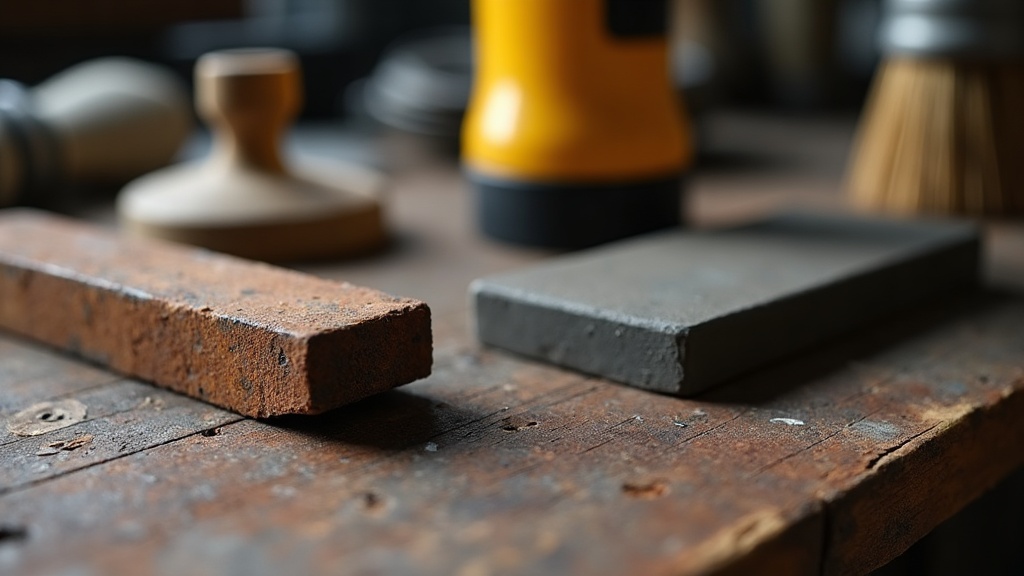
Surface rust that has not pitted the metal is almost always worth cleaning up rather than replacing the tool — a light abrasive and oil will usually bring it back. Pitting that has eaten into a cutting edge, a reference surface, or a threaded fitting is a different matter, because that lost metal cannot be put back.
A flat reference surface — the sole of a plane, the face of a square, the bed of a table saw — needs to actually be flat to do its job. Once corrosion has left it uneven, no amount of polishing restores the geometry, and the tool’s accuracy is compromised even if it still looks serviceable. The same logic applies to storage: a tool that keeps rusting despite being wiped down is usually telling the reader something about the environment it lives in, not just the tool. How to store tools so they don’t rust and what workshop humidity does to tools and timber cover the causes worth fixing at the source.
Cleaning rust off a blade, a chisel or a vice throws fine grit and metal dust — eye protection matters here, and a dust mask is worth wearing if the work is prolonged or done with a powered wire wheel.
When should a repair be left to a professional?
Anything touching the tool’s internal wiring, its motor windings, or its plug and cord where it meets the mains supply belongs with a qualified repairer or the manufacturer, not a home fix. This is not about difficulty so much as consequence — a wiring fault that looks fine from the outside can fail badly under load.
Structural repairs to stationary machinery — a cracked table saw table, a bent mitre saw fence, anything affecting how the workpiece sits against a blade — also warrant professional assessment before the machine goes back into use. A tool that is slightly out of alignment does not just cut inaccurately; it can bind, grab or throw the workpiece back at the operator, which is part of what causes kickback in the first place.
If a repair would involve removing, bypassing or reworking a guard, a riving knife, an interlock or any other safety feature to make it fit again, that is a sign the part needs proper replacement rather than a workaround. The fix in that situation is the correct replacement part, a different jig or technique for the cut in question, or professional servicing — never leaving the feature off.
Is the repair worth the safety trade-off?
Not if the repair leaves any doubt about how the tool will behave under load. A tool that has been fixed but still runs hot, vibrates differently, or needs “a bit of extra pressure” to work properly has not really been repaired — it has been made usable in a way that quietly shifts risk onto the person operating it.
A genuinely successful repair returns the tool to behaving the way the manufacturer intended, with guards, interlocks and safety features doing exactly what they did when the tool was new. If that is not achievable, the honest answer is that the tool needs replacing, not patching.
A simple way to decide
Weigh the fault against three questions: is the cause clearly identified, does the repair cost meaningfully less than a like-for-like replacement, and does the tool come back to full safe function afterwards? If the answer to all three is yes, repairing is usually the sensible choice — and often the better one for a workshop’s budget and its footprint in workshop storage.
If any answer is no — the cause is unclear, the saving is marginal, or the fix compromises how the tool is meant to work — replacement is the more honest option. For guidance on comparing a repaired tool’s real value against buying new, the buying tools guide covers what actually matters in a specification versus what is just marketing, and tool care and maintenance covers the routine upkeep that keeps a repair from being needed again so soon.
Find Tool publishes general information, not professional advice. Power tools, mains electricity and workshop machinery are genuinely dangerous, and the safe settings, guards and procedures differ between models — always follow the manual and the markings on the tool in front of you rather than a general guide. Never remove or defeat a guard or safety feature. Anything involving fixed wiring, gas or structural work belongs to a qualified tradesperson. Wear the eye, ear and respiratory protection the task calls for.
Related reading
What Is Camellia Oil and Why Do Woodworkers Use It?.
Featured image: Photo by Rosser1954, source, CC BY 4.0
