A socket is a hollow, six or twelve-sided sleeve that fits over a bolt head or nut and is turned with a separate ratchet handle. A spanner is a fixed hand tool with a shaped jaw at one or both ends. A ratchet ring is a spanner-shaped tool with a ratcheting mechanism built into the ring end, so it turns a fastener without being lifted off between strokes. All three do the same basic job — gripping a fastener to turn it — but they solve different access and speed problems.
What exactly is a socket?
A socket is a short metal sleeve, usually hexagonal on the inside, that slips over a nut or bolt head and is driven by a separate handle. On its own it does nothing — it needs a ratchet handle, a breaker bar, or a power tool to turn it.
Sockets are sold in sets because a workshop needs a range of sizes, and each socket has a square drive hole on the back that connects to the handle. That drive size — commonly a small, medium or large square — determines how much turning force the assembly can handle before something gives. A detailed look at what that drive size is actually telling you is worth reading before buying a set, since it affects both the torque a set can handle and how bulky it is in a tight engine bay or cabinet.
Because the handle stays separate from the socket, the same handle works with every socket in the set. That’s the main practical advantage: one ratchet, one extension bar, and a wide range of sizes, rather than a drawer full of individual fixed tools.
What exactly is a spanner?
A spanner is a single fixed piece of steel with a shaped jaw at one or both ends, sized to fit one specific fastener width. There’s no separate handle and, on a basic open-end or ring spanner, no ratcheting action — each stroke has to be lifted clear and repositioned.
Spanners typically come in three basic jaw styles:
- Open-end — a U-shaped opening that slides onto the fastener from the side, useful where a nut sits on a threaded rod or where there’s no room to drop a socket down over the top.
- Ring (or box) end — a closed loop that fully surrounds the fastener, giving more contact area and less risk of the jaws slipping off a tight or worn nut.
- Combination — one open end and one ring end of the same size on a single tool, which is what most home workshops end up buying because it covers both situations without doubling the tool count.
A plain spanner has no moving parts, which is part of its appeal: nothing to wear out, nothing to jam, and it fits into spaces a bulkier ratchet handle can’t reach.
What exactly is a ratchet ring?
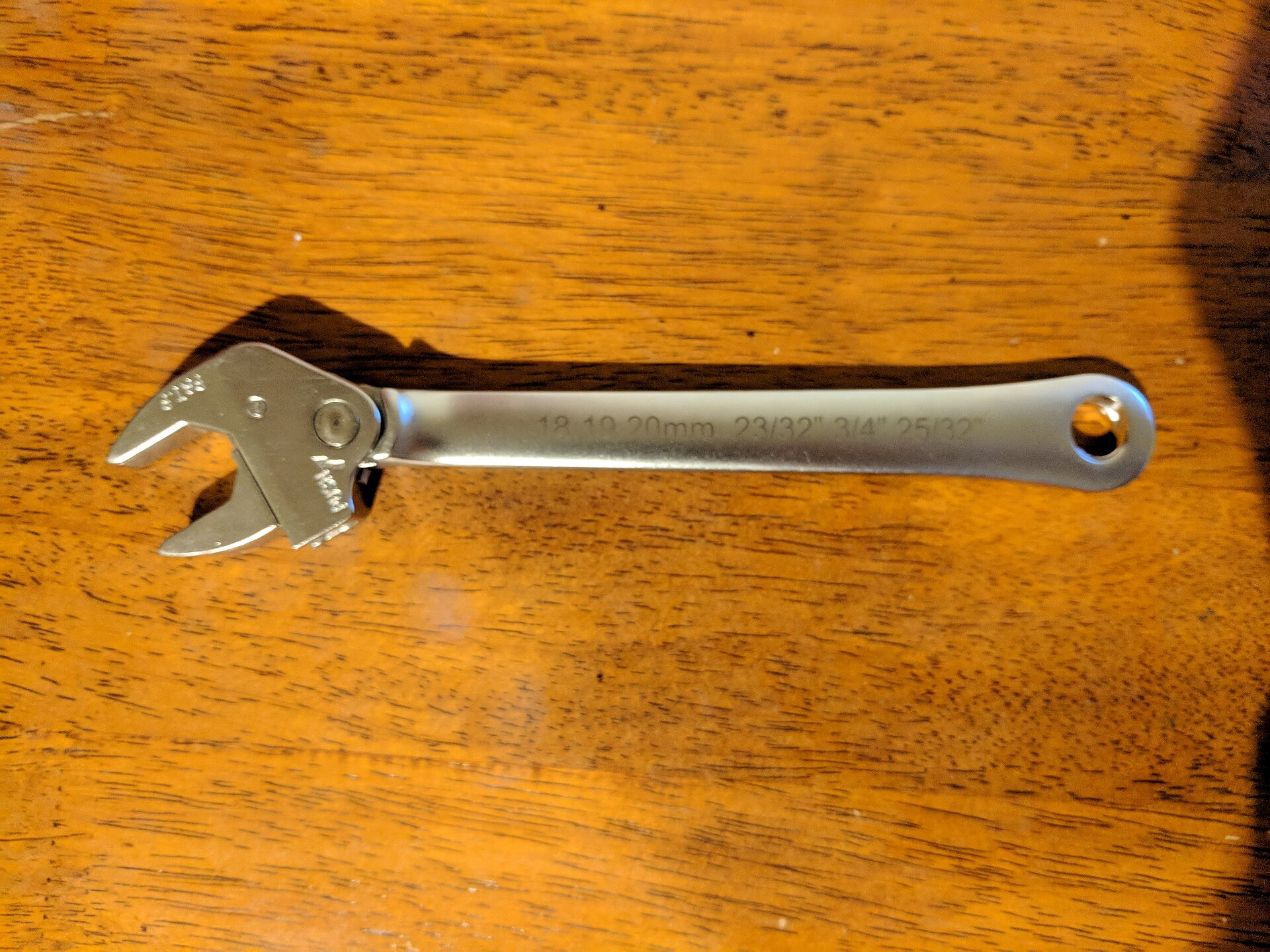
A ratchet ring is a ring-ended spanner with a ratcheting mechanism built into the ring itself, so the tool can be rocked back and forth in a confined space without lifting it off the fastener between turns. It combines the low profile of a ring spanner with some of the speed of a socket set.
This matters most where there’s room to swing a spanner through only a small arc — behind a pipe, close to a bracket, or inside an engine bay where a socket and extension simply won’t fit at the right angle. Instead of removing the tool, repositioning it, and re-engaging the fastener for every partial turn, the ratchet mechanism lets the handle sweep back freely and grip again on the return stroke.
Most ratchet ring spanners have a small lever or reversible mechanism to switch the direction it grips, so the same tool loosens and tightens. Cheaper versions sometimes have a coarser ratcheting action, meaning a wider minimum swing arc before the mechanism engages — worth checking if the intended job is genuinely tight for space.

Which one should be used for which job?
The honest answer is that most home workshops end up with all three, because each solves a different access problem rather than one simply being better than the others.
- A socket and ratchet handle is usually fastest for repeated work with clear overhead access — wheel bolts, engine covers, anything where the tool can drop straight down onto the fastener.
- A plain spanner earns its place where the fastener is on a threaded rod with nothing above it, or where the space is too tight for even a compact ratchet handle.
- A ratchet ring covers the middle ground — confined spaces where a socket won’t seat properly, but where lifting a plain spanner off and repositioning it dozens of times would be slow and awkward.
None of the three is a universal answer, and buying a large socket set does not replace the need for a couple of good ring or combination spanners for the fasteners a socket simply can’t reach square-on.
Does drive size or jaw size matter more?
They’re measuring different things, and mixing them up is a common source of confusion. A socket’s drive size describes the square fitting that connects it to the handle — it has nothing to do with the size of the nut or bolt the socket fits over. A spanner or ratchet ring’s jaw size is the actual fastener width it’s cut to fit, usually stamped on the tool itself.
Both also come in metric and imperial (AF) measurement systems, and a metric tool will not fit an imperial fastener cleanly even when the numbers look close — it tends to round the corners of the fastener rather than grip it properly. The practical differences between metric and imperial tools are worth understanding before assuming a set covers everything a job needs, and the specific gap between metric and AF spanner sizing is covered in more depth on its own.
What should be compared when buying a set?
Beyond size range, a few things genuinely change how a set performs day to day, and a few marketing claims don’t matter much at all.
- Drive size range for sockets — a set that only offers one drive size limits the torque it can safely handle and the bulk of the handle needed for tight spaces.
- Chrome vanadium or similar alloy construction versus unspecified “hardened steel” — the alloy affects how well the tool resists rounding off under load over time.
- Ring versus open-end balance in a combination set — a set weighted too heavily toward one jaw style leaves gaps for common access problems.
- Ratchet mechanism fineness on ratchet rings — a finer mechanism needs less swing arc to engage, which matters directly in confined spaces.
A wider general look at which listed specifications are genuinely useful versus which are marketing noise is available on the site, and the broader question of what to compare before buying any tool is covered on the buying tools hub.
Does torque matter when choosing between them?
Some fasteners — wheel nuts, cylinder head bolts, and many others on a vehicle — have a specified tightening torque set by the manufacturer, and none of a plain spanner, socket or ratchet ring measures that on its own. Getting a fastener to a specific torque needs a torque wrench, not judgement by feel.
What a torque wrench measures and why it matters on a car is explained in detail elsewhere on the site, and it’s worth reading before assuming any hand tool with a long handle is an adequate substitute for one.
What safety points actually apply here?
Hand tools like these seem low-risk compared with powered equipment, but a few real hazards apply. A spanner or ratchet ring that slips off a rounded or corroded fastener under load can send knuckles into whatever is nearby, and a seized bolt breaking free suddenly can throw off flakes of rust or scale — eye protection is a sensible precaution whenever real force is being applied to a stubborn or corroded fastener.
Where a socket is driven by a power tool such as an impact driver rather than a hand ratchet, loose sleeves, rings and gloves become a genuine hazard around the spinning drive — the reasoning behind that caution is covered in the article on loose sleeves and gloves near rotating tools, and applies just as much to a spinning socket as to a drill.
Beyond that, a tidy, well-lit space to work in front of a vehicle or vice reduces the chance of a slipped tool causing an awkward fall or catching an edge — a point covered more generally in the article on why a tidy workshop cuts injuries.
Where to look next
For a broader look at how hand tools in general are built and chosen, the hand tools category and the tool guide hub cover related basics, from square drives to jaw geometry. Anyone assembling a first set of hand tools may also find it useful to read what order a first toolkit is usually bought in, since sockets, spanners and ratchet rings tend to earn their place at different stages rather than all at once.
Related reading
choosing a tool, what the specs mean, and what to compare, how power tools, hand tools and measuring kit actually work, What Is a Torque Wrench and Why It Matters on a Car, Metric vs Imperial Tools: What Actually Matters?, Nail Gun vs Screws: What Decides the Fixing?.
Find Tool publishes general information, not professional advice. Power tools, mains electricity and workshop machinery are genuinely dangerous, and the safe settings, guards and procedures differ between models — always follow the manual and the markings on the tool in front of you rather than a general guide. Never remove or defeat a guard or safety feature. Anything involving fixed wiring, gas or structural work belongs to a qualified tradesperson. Wear the eye, ear and respiratory protection the task calls for.
Featured image: Photo by ChristianLeigh1982, source, CC BY-SA 4.0