A bench vice holds a part still so both hands are free to work on it. In automotive jobs that means gripping bolts to break them loose, holding brackets and fittings for filing or drilling, pressing bushes in and out, and doing any job that would be unsafe or impossible to do while a part is loose on the bench or dangling from the car.
What does a bench vice actually do in a car project?
It replaces a hand as the thing holding the workpiece. Anything that needs two hands to work on — a hacksaw, a file, a drill, a hammer and punch — needs the part clamped somewhere that will not shift, twist or roll. A bench vice does that job for the parts small and rigid enough to come off the vehicle and onto the bench.
This matters more in automotive work than it might sound. A huge amount of car maintenance is not spanner work at all — it is fettling. Cleaning up a threaded stud, opening out a hole, cutting a stuck bolt free, straightening a bracket, pressing a bearing race out of a hub. None of that happens safely with the part held in a gloved hand.
What automotive tasks actually call for a vice?
Most uses fall into a small number of repeat jobs:
- Holding a seized bolt or stud so it can be cut, drilled out, or gripped with mole grips without spinning.
- Clamping a bracket, hinge or mount for filing, deburring or re-drilling.
- Supporting small components — calliper slide pins, control arm bushes, exhaust clamps — while they are cleaned up or pressed apart.
- Holding a part steady while a hub puller or bearing separator is worked, where the puller needs something solid to react against.
- Providing extra leverage on a stuck fitting when combined with a breaker bar — the part in the vice, the bar on the fastener.
None of these are glamorous jobs, but they are exactly the ones that stall a project when there is nowhere secure to hold a part.
What features actually matter for automotive use?
Automotive parts are heavier, oilier and often harder than the woodwork and general DIY tasks a vice is also asked to do, so a few things matter more here than they would in a hobby workshop used mainly for wood.
- Jaw width and opening decide what will actually fit — a wide bracket or a large housing needs more capacity than a small vice offers. The relationship between jaw width and what it can hold is worth understanding before buying, and it’s covered in more depth in what a bench vice’s jaw width is telling you.
- Jaw type — smooth jaws protect finished surfaces, serrated jaws bite into rough or rounded parts. Some vices take swap-in soft jaw inserts, which matter for anything plated, painted or otherwise easily marked.
- A rotating base lets an awkward part be angled toward good light or a comfortable filing stroke instead of forcing the user to work at a bad angle.
- Clamping force and rigidity — automotive work often involves real leverage from a breaker bar or hammer blows, so a vice that flexes or lifts off the bench under load is working against the user rather than for them.
Does a bench vice replace a workbench, or work with one?
A vice is only as useful as what it is bolted to. It needs a bench heavy and rigid enough to absorb hammering and leverage without rocking, and it needs to be mounted where there is room to swing a hammer or lean on a breaker bar without hitting a wall or a shelf. What actually separates a serviceable workbench from a poor one is covered in what actually makes a workbench good, and it is worth reading before assuming any flat surface will do.
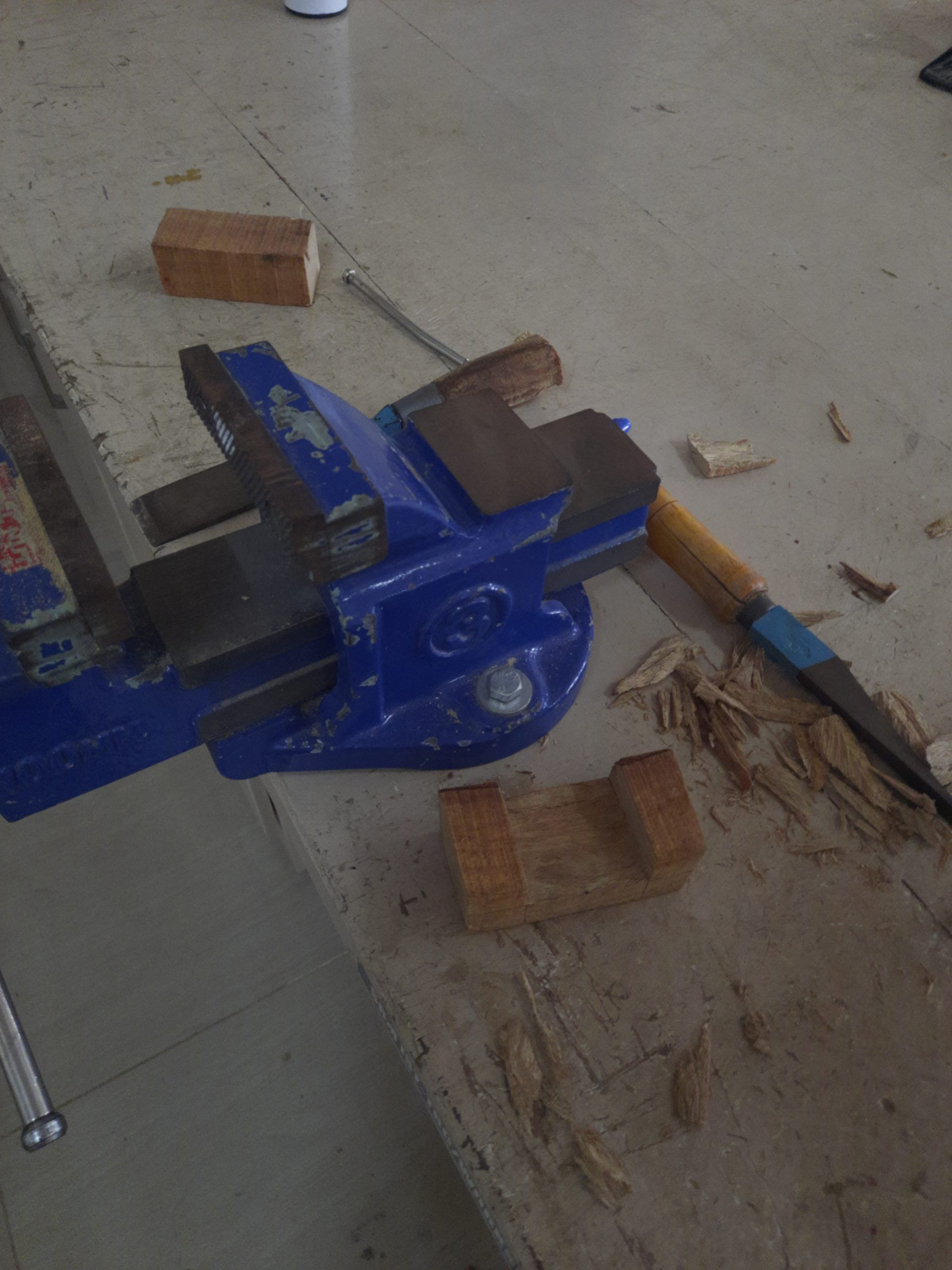
Bench vice or vehicle-mounted clamping — what’s the difference?
A bench vice only works on parts that have already come off the car. It has no role holding the vehicle itself up, and it should never be treated as one. Supporting the vehicle is a completely different job with completely different tools — a trolley jack to lift, and axle stands to actually bear the weight while anyone works underneath. What each of those is for, and why a jack alone is never enough, is explained in trolley jack and axle stands: what are they actually for and why a car should never be supported by a jack alone.
Confusing the two roles — treating a bench vice as something that can hold vehicle weight, or treating vehicle support equipment as a substitute for a proper vice — is a mistake worth avoiding from the start.
How is a bench vice mounted for automotive-weight work?
A vice used for car parts needs to be through-bolted to the bench, not just screwed down. Automotive work brings real shock loads — a hammer on a punch, a sharp wrench-off on a seized bolt — and a vice that shifts under that load is both frustrating and unsafe, since a part can jump free unpredictably. The mounting bolts, the bench thickness underneath, and the positioning relative to the bench edge are all things the vice’s own instructions will speak to; that documentation is the starting point, not a guess based on what looks about right.
Positioning also matters for automotive parts specifically. Long items — brake lines, control arms, exhaust sections — need to overhang the bench edge cleanly rather than foul a shelf or another tool, and there needs to be clear space to swing a hammer or a breaker bar without a wall or a machine in the way.
What PPE does bench vice work call for in automotive jobs?
Filing, cutting, drilling and hammering all throw off small fragments of metal, rust and grit, so eye protection is not optional for any of these tasks — what a genuine eye protection rating actually covers is explained in what an eye protection rating actually means, and it is worth checking a pair actually meets it rather than assuming any clear glasses will do.
Gloves help against sharp edges and grime, but they need to be snug — loose gloves around anything spinning, including a hand drill chucked into a part, are a genuine snagging hazard rather than a safety measure. Sustained grinding or power filing that runs for any length of time also warrants hearing protection, since the noise adds up over a session even when no single moment feels loud.
What else sits alongside a vice on an automotive bench?
A vice rarely works alone. It is usually paired with hand tools for the actual cutting, filing and measuring — the kind covered across the site’s hand tools archive — and with the wider run of automotive-specific gear such as torque tools, pullers and diagnostic equipment in the automotive category. Deciding what to add to a home workshop, and in what order, is its own question, addressed generally in the buying tools guide and specifically for a first toolkit in what order a first toolkit should actually be bought in.
For anyone building out a home workshop with automotive work in mind, the safety and PPE archive is worth a look before the first project starts, not after something goes wrong.
Find Tool publishes general information, not professional advice. Power tools, mains electricity and workshop machinery are genuinely dangerous, and the safe settings, guards and procedures differ between models — always follow the manual and the markings on the tool in front of you rather than a general guide. Never remove or defeat a guard or safety feature. Anything involving fixed wiring, gas or structural work belongs to a qualified tradesperson. Wear the eye, ear and respiratory protection the task calls for.
Featured image: Photo by SamuelDutta, source, BY