A shop vacuum is built to pick up bulk debris — chips, offcuts, general mess — and is rated on suction and tank size. A dust extractor is built around filtration and airflow at the tool itself, and its filter media is the part that decides whether fine dust actually leaves the workshop air or just gets moved around in it.
What is a shop vacuum actually built to do?
A shop vacuum is designed for bulk pickup: spilled screws, wood chips, water, plaster dust from a wall chase. It prioritises suction power and tank capacity, and its filter is usually a pleated cartridge or foam sleeve chosen to stop clogging, not to trap the smallest particles.
That filter can let a meaningful share of very fine particles pass straight through and back out of the exhaust. For sweeping up after a job, that is rarely a problem. For catching what a sander throws off continuously, it can be.
What is a dust extractor actually built to do?
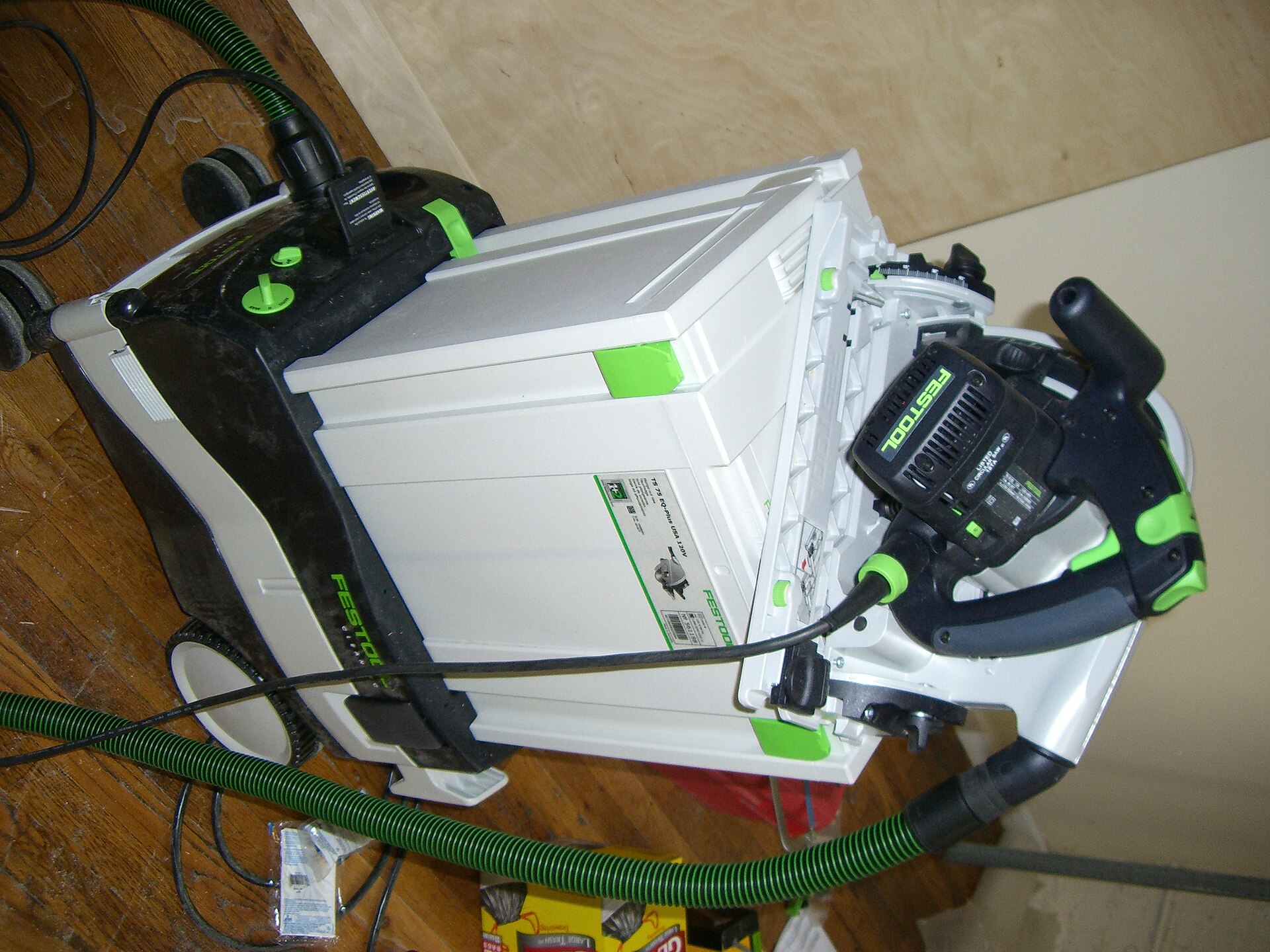
A dust extractor is designed to run attached to a power tool for the length of a task, pulling air and fine particles away from the point of cutting or sanding as they are created. Filtration is the headline spec, not just suction, and many models use graded filter classes intended specifically for wood dust.
Extractors are also commonly built with a power take-off socket that starts the extractor automatically when the connected tool switches on, and stops it a short interval after. That matters for fine dust because the gap between “tool running” and “extractor running” is exactly when the worst of it becomes airborne.
Why does fine dust behave differently to shavings and chips?
Bulk debris falls under gravity almost immediately. Fine dust, by contrast, stays suspended in the air long after the tool stops, and the smallest fraction is invisible in normal light. What you can see settling on a bench is the coarse end of what a sander or router actually produces.
A machine that captures visible dust well can still be doing a poor job on the fraction that matters most for the lungs. The article on what fine dust actually is and why it matters more than sawdust covers why particle size, not volume, is the relevant measure.
Does filter rating actually matter for fine dust?
Yes — filter class is the single biggest difference between a general shop vacuum and a purpose-built extractor, more than motor power or hose diameter. A filter graded for fine wood dust is doing a fundamentally different job than a filter graded to stop grit and chips.
Manufacturers publish these ratings in their documentation, and the classification systems vary by market. Treat the filter class the manual quotes as the figure that matters, not a headline suction number on the box — that comparison is covered in more depth in which tool specifications are marketing, not useful.
A second, easily missed detail is what the machine does with the air it draws in. Some vacuums recirculate exhaust straight back into the room; some extractors are designed to be run with ducting to outside air or with a sealed bag system that avoids disturbing captured dust on emptying. Check what the manual says about exhaust and bag changing before assuming either is dust-tight.

Can a shop vacuum be used safely with power tools that make fine dust?
A shop vacuum can be connected to a sander or router and will genuinely reduce the mess on the bench. Whether it protects the air being breathed depends on its filter rating for fine particles, which is model-specific and stated in its own documentation — not something this article can put a number on.
Where a tool produces a steady stream of fine dust over a long session — sanding MDF, routing hardwood, sanding a painted surface — the gap between what a general shop vacuum filters and what a dust-rated extractor filters is where the real difference shows up. A general comparison of the two categories, without the fine-dust angle, is covered in dust extractor vs shop vacuum: what’s the difference.
Fine, dry dust in a vacuum hose and canister can also build a static charge, particularly with plastic hoses and fittings. Some systems address this through grounding straps or conductive hose as part of their design. Follow what the manufacturer’s documentation says for the specific machine rather than assuming any hose or fitting is safe to substitute.
What about MDF and hardwood dust specifically?
MDF dust and some hardwood dusts are treated more cautiously than general softwood sawdust because of what is in the material and how fine the particles run. Extraction habits that are fine for a rough softwood cut are not automatically fine for a session of MDF sanding, and the reasons are explained in why MDF dust is treated differently from softwood dust.
Silica is a separate concern again, relevant mainly where masonry, stone or some engineered boards are involved rather than plain timber. What silica dust is and why it is regulated and what is silica dust and why is it regulated set out why that particular dust is handled under stricter rules than ordinary wood dust.
Does a shop vacuum or dust extractor replace a respirator?
No. Extraction reduces how much fine dust becomes airborne in the first place; it does not guarantee the air around the tool is clean enough to breathe unprotected, especially in an enclosed garage or shed. Respiratory protection rated for fine dust is still the right call for sanding, routing and cutting MDF or hardwood, regardless of what extraction is running.
A basic dust mask and a proper respirator are not interchangeable, and the difference matters more with fine dust than with chips — see dust mask vs respirator: what’s the real difference and what an FFP or N95 rating actually covers. Eye protection is worth keeping on too whenever a tool is also throwing chips or debris, and hearing protection matters on anything, extractor included, that runs loud for a sustained stretch — see what noise level makes ear protection necessary.
What should shape a buying decision?
The honest comparison is not “which sucks harder” but which job each machine is being asked to do most of the time.
- Mostly bulk cleanup, occasional light sanding: a general shop vacuum with a reasonable filter is a fair fit, and its versatility for water, chips and general mess is a real advantage.
- Regular sanding, routing or sawing indoors, especially MDF or hardwood: a dust extractor with a graded fine-dust filter and power take-off earns its price in what stays out of the air, not in raw suction.
- Filter maintenance: a fine-particle filter clogs faster and needs more careful cleaning or replacement than a general-purpose one — factor that ongoing cost in rather than just the purchase price.
- Hose and fitting compatibility: extractors are often designed around a specific hose diameter matched to particular tools; check this before assuming a vacuum hose and an extractor port are interchangeable.
Price differences between the two categories mostly track filtration and duty cycle, not brand marketing — the broader question of what actually drives cost on a power tool is covered in what actually drives the price of a power tool, and the general framework for comparing specifications rather than headline numbers sits in the buying tools hub.
For the mechanics of how extraction, filtration and airflow work across power tools generally, the tool guide hub and the safety and PPE archive are the places to check next, and the wider set of tool comparisons sits in the comparisons archive.
Find Tool publishes general information, not professional advice. Power tools, mains electricity and workshop machinery are genuinely dangerous, and the safe settings, guards and procedures differ between models — always follow the manual and the markings on the tool in front of you rather than a general guide. Never remove or defeat a guard or safety feature. Anything involving fixed wiring, gas or structural work belongs to a qualified tradesperson. Wear the eye, ear and respiratory protection the task calls for.
Featured image: Photo by Becky Stern, source, CC BY-SA 2.0