A circular saw is a general-purpose cutting tool guided by hand or a clamped fence, good for framing, rough breakdown and site work. A track saw is a circular saw designed to run in a fixed rail, which changes the accuracy, the finish, and the way the blade meets the workpiece. Neither replaces the other in every job.
What is actually different between the two tools?
Both use a spinning circular blade and a base plate, and both can crosscut and rip wood. The difference is in what controls the direction of the cut. A circular saw relies on the user’s hand steadiness, a straightedge, or a fence clamped to the work. A track saw locks onto a rail that sits on the material, so the blade follows a straight line the user has already set, not one being tracked in real time by eye and hand.
That single change affects three things in practice: how straight the cut comes out, how clean the edge is (especially on sheet material), and how the saw behaves at the start and end of the cut.
Which one gives a straighter cut?
A track saw gives a more consistently straight cut because the rail removes the steering work from the user’s hands. A circular saw can cut just as straight against a good clamped guide, but the accuracy depends on the guide and the setup each time, not the tool itself.
With a hand-guided circular saw, the base plate rides against a fence or a straightedge that has to be set up correctly for every cut. Any flex in that fence, or any drift in hand pressure, shows up as a wander in the line. A track saw’s rail is rigid and the saw’s base has a slot that runs along it, so once the rail is aligned to the marked line, the saw has very little room to wander off it.
This matters most on long rips and on sheet goods, where a small drift compounds over the length of the cut. On short crosscuts of solid timber, a decent circular saw and a square guide will get a reader most of the way there.
Why does edge quality change with a track saw?
Track saws typically leave a cleaner edge on sheet material because the rail’s edge sits directly against the cut line and many rails include a splinter guard that supports the surface fibres as the blade exits. A circular saw’s wider base plate and looser guide contact make tear-out on the top face more likely, especially in veneered plywood or melamine.
Tear-out happens when the blade’s teeth lift fibres on the exit side of the cut faster than they can shear cleanly. A splinter guard strip, kept snug against the cutting line, backs those fibres up so they shear instead of tearing. Blade choice matters here too — a fine-tooth blade designed for clean crosscuts behaves very differently from a coarse rip blade, and what tooth count on a saw blade changes is worth understanding before assuming the saw itself is at fault for a rough edge.
Does a track saw change how kickback works?
A track saw doesn’t remove the risk of kickback, but the rail changes how the workpiece is supported and how the blade engages material, which can reduce some of the conditions that cause it. Understanding what kickback is and what causes it matters whichever saw is in use.
Kickback happens when the blade binds in the cut and the spinning blade throws the saw or the workpiece back toward the user. Binding is usually caused by the workpiece closing in on the blade, an unsupported offcut sagging into the cut, or the saw’s path drifting off line so the blade is forced sideways. A rail-guided saw reduces the drifting-off-line cause, but it does not stop wood from closing up on the blade if it isn’t supported properly, and it does not remove the need for the workpiece to be stable on a bench or on foam supports rather than sagging mid-cut.
Both circular saws and track saws are built with a riving knife or splinter guard behind the blade for a reason — it’s there to stop the cut from pinching the blade as the wood relaxes. What a riving knife is and why it isn’t optional applies to both tool types, and neither tool should be run with that guard removed or defeated to make an awkward cut easier. If a cut seems to need the guard out of the way, the better answer is a different support setup, a jig, or a different saw for that particular job.

Which one is more portable?
A circular saw on its own is more compact and quicker to grab for a single rough cut. A track saw needs its rail set up and clamped or positioned before every cut, which adds a step but removes the need for a separate straightedge and clamps once the system is in place.
For site work, framing, or cutting studs and joists to length, the circular saw’s speed advantage is real — there’s no rail to lay down and align. For breaking down full sheets of plywood or MDF in a home workshop, the track saw’s setup time is offset by not needing a table saw or a large flat surface with a separate fence clamped down each time.
Which suits sheet goods better?
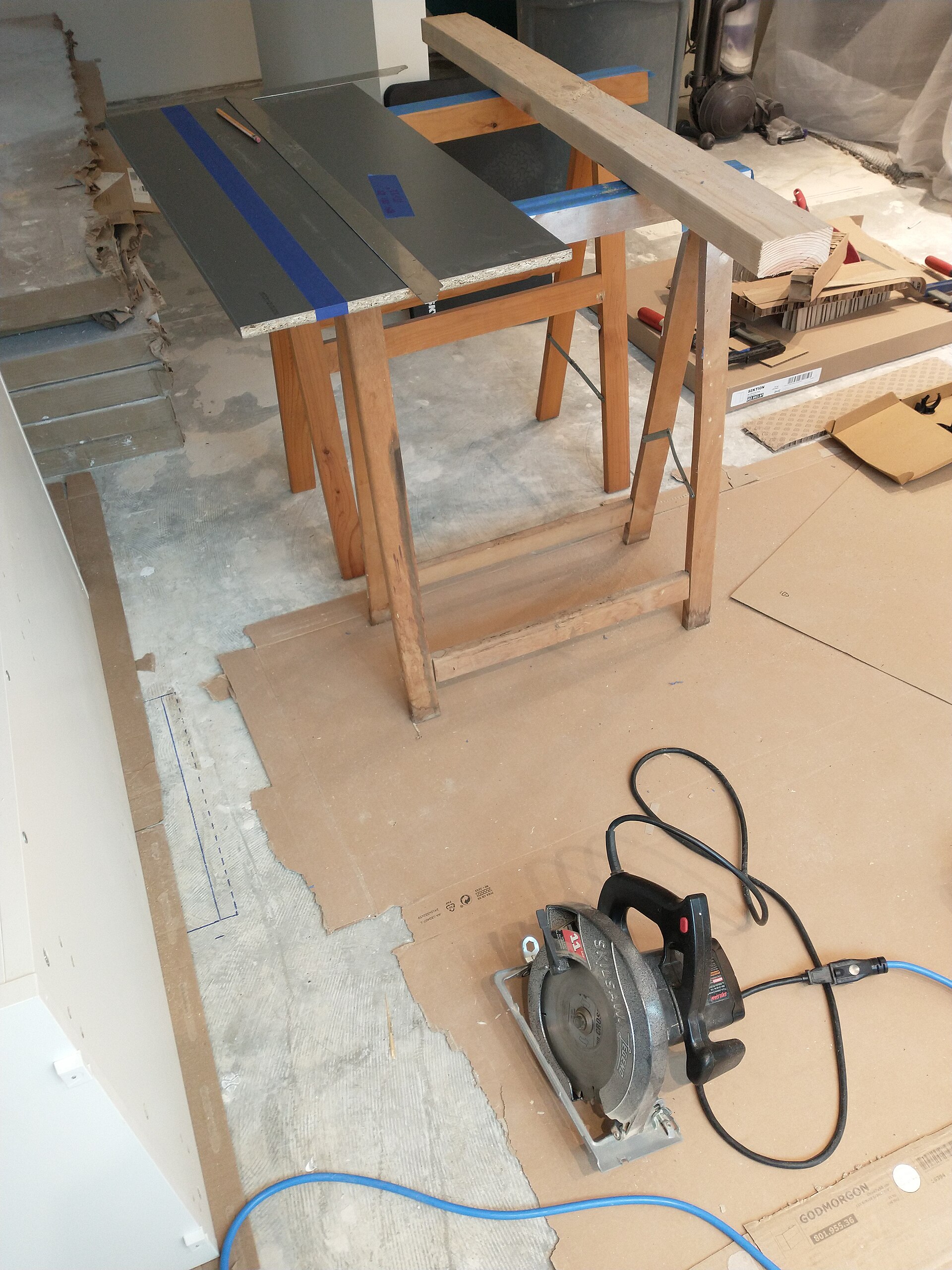
A track saw suits full sheets of plywood, MDF and melamine better because the rail can run the full length of a sheet on a pair of foam supports, and the clean edge it leaves often needs no further trimming. A circular saw can break down sheets too, but usually with a separate straightedge clamped in place each time.
This is the job track saws were designed around: turning a full sheet into panel-sized pieces without a table saw, without wrestling a full sheet across a large saw table, and with a rip fence that doesn’t need re-clamping for every different width. For someone doing built-in furniture, cabinets, or shelving from sheet stock, this is where the track saw earns its keep.
Which suits rough carpentry and site cuts better?
A circular saw suits framing, decking, fencing and general rough carpentry better because those cuts are usually shorter, don’t need furniture-grade edges, and benefit from the saw’s speed and lower setup time. A rail adds accuracy that these jobs often don’t need.
Cutting studs to length, trimming decking boards, or notching rafters doesn’t call for the same edge finish as a piece of cabinet-grade plywood. A circular saw with a sharp blade suited to the material handles these jobs quickly, and its lighter, simpler setup matters more than rail-level precision.
Does dust collection change between the two?
Track saws generally extract dust more effectively because the blade sits in a mostly enclosed shroud that connects to a vacuum hose, and the cut happens close to that shroud. A circular saw’s dust port usually does a rougher job, and a lot of dust escapes around the open base plate.
This matters more than it might seem, particularly with MDF and manufactured boards where the dust is finer and the binders in the material change how it behaves in the lungs — why MDF dust is treated differently from softwood dust is worth reading before assuming a dust mask is optional for sheet work. Whichever saw is in use, a properly fitted respirator rated for fine dust, not just a loose paper mask, is the right call for extended cutting of manufactured board, and the difference between a dust extractor and a shop vacuum is worth understanding before connecting either saw to a hose.
What about noise and eye protection?
Both tools throw wood chips and fine debris toward the operator’s face and run loud enough, for long enough, to justify hearing protection on any extended cutting session. Eye protection rated for impact, not just any glasses, is the baseline for either saw, and what an eye protection rating actually means is worth checking against what’s in the workshop drawer. For sustained cutting, what noise level makes ear protection necessary applies to both tools equally — neither is quiet enough to skip it.
Which one costs more to own?
A track saw system usually costs more upfront because the rail, connectors and any extension rails are bought separately from the saw itself, and the blade and accessory ecosystem tends to be brand-specific. A circular saw is typically the cheaper entry point and works with a wider range of generic blades and clamped guides.
What actually drives that price difference is worth understanding rather than just comparing sticker totals — see what actually drives the price of a power tool for how motor quality, build tolerances and accessory systems factor in. If cordless flexibility matters for site work versus workshop use, corded versus cordless: what actually decides it covers the trade-offs that apply to both saw types. And before buying either, the buying tools guide and the wider power tools category cover what to compare on cutting tools generally, including blade compatibility and how a saw’s stated depth of cut relates to the material actually being worked.
So which one does a home workshop actually need?
A reader doing mostly rough carpentry, framing or occasional cuts in solid timber is usually better served by a circular saw and a good clamped straightedge. A reader regularly breaking down sheet goods for cabinets, shelving or built-ins gets more consistent, cleaner results from a track saw, at the cost of a higher upfront spend and a setup step before each cut.
Many home workshops end up with both, using the circular saw for quick rough cuts and the track saw for anything that needs to look finished. Whichever is bought first, following the saw’s own manual for blade selection, depth setting and guard adjustment is the reliable path — those figures are set by the manufacturer for the specific tool, not by general rules of thumb.
Find Tool publishes general information, not professional advice. Power tools, mains electricity and workshop machinery are genuinely dangerous, and the safe settings, guards and procedures differ between models — always follow the manual and the markings on the tool in front of you rather than a general guide. Never remove or defeat a guard or safety feature. Anything involving fixed wiring, gas or structural work belongs to a qualified tradesperson. Wear the eye, ear and respiratory protection the task calls for.
Featured image: Photo by Stilfehler, source, CC BY-SA 4.0