An impact driver is better at driving long or stubborn fasteners quickly, with less arm strain, because it hits as well as spins. A drill driver is better at drilling accurate holes and driving small or delicate screws, because it gives smoother, more controllable rotation. Most home workshops end up wanting both, not one instead of the other.
What’s actually different inside them?
A drill driver spins its chuck the way most people picture a drill working: a motor turns a gearbox, the gearbox turns the chuck, and a clutch slips at a set point to stop over-driving a screw. The output is smooth and continuous.
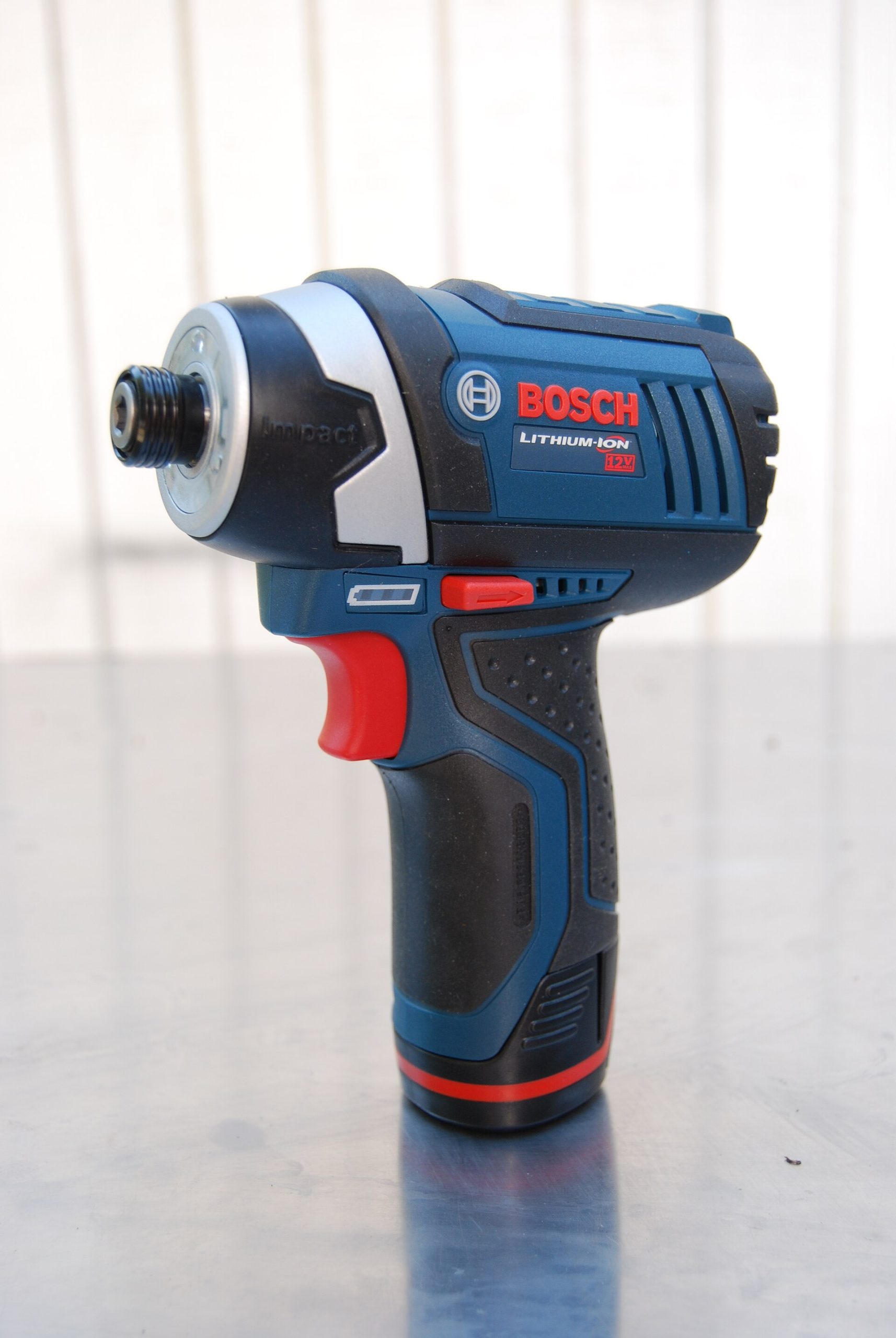
An impact driver spins too, but it adds a hammer-and-anvil mechanism inside the head. Under load, that mechanism delivers rapid rotational hits rather than one steady twisting force. Each hit adds a burst of torque without adding much resistance for the user to fight against, which is why an impact driver can sink a long screw with far less strain on the wrist than a drill would need for the same job.
That hammering action is also why an impact driver sounds different — a distinctive rattle under load — and why it needs bits designed to survive repeated shock loading rather than steady twisting.
What is an impact driver genuinely better at?
An impact driver earns its keep on fastening work, especially where the fastener is long, the material is dense, or there are a lot of them to get through in one session.
- Driving long decking or structural screws into timber without stalling or needing to lean into the tool.
- Working through a large number of fasteners — flooring, fencing, framing — where hand fatigue matters over the course of a day.
- Removing seized or rusted screws and bolts, where the hammering action can break a fastener free that a steady twist would just round out.
- Driving into hardwood or engineered timber where a plain drill driver would bog down before the screw is fully seated.
The trade-off is precision at the very start of a hole. Because the driving action is percussive, it’s easy to have a bit skate off a screw head before the impact mechanism engages properly, which is why many people start a fastener with light, steady pressure before letting the tool take over.
What is a drill driver genuinely better at?
A drill driver is the better tool wherever smooth, controllable rotation matters more than raw driving force — which covers most drilling, and a fair amount of delicate fastening too.
- Drilling clean, accurately placed holes in wood, metal or plastic, where a hammering action would wander or chip the surface.
- Driving small screws into thin material, cabinet hardware or delicate trim, where a hammer mechanism risks stripping the head or punching straight through.
- Work that benefits from a slipping clutch — repeated screws driven to a consistent depth without a torque spike snapping the head off or crushing the material.
- Anywhere a hole size needs to be exact, since the smooth rotation of a drill driver keeps a bit tracking true rather than hammering it slightly oversize.
A drill driver is also the tool to reach for with hole saws, spade bits and most drill bit accessories, since these are built around continuous rotation rather than shock loading. If a bit keeps chewing rather than cutting cleanly, that’s usually a bit or speed problem rather than a case for switching to an impact driver — see why drill bits stop cutting before assuming the tool is wrong.
Can one tool actually replace the other?
Not reliably. Both tools spin a bit, which makes them look interchangeable in a shop display, but the internal mechanism decides what each is good at, and pushing either one outside its strength shows up quickly.
An impact driver can drill in a pinch with the right bit, but the percussive action makes it harder to hold a precise, wobble-free hole, especially in metal or when starting a hole in a hard or slippery surface.
A drill driver can drive screws, and does it well for small ones, but it runs out of comfortable torque on long fasteners in dense material — the user ends up leaning on the tool, which is exactly the strain an impact driver is designed to remove.
.jpg)
Does a drill driver’s clutch do the same job as an impact driver’s hammer action?
No — they solve different problems. A clutch on a drill driver is there to protect the screw and the material, slipping once a set resistance is reached so the driver doesn’t strip the fastener or crush the surface.
An impact driver’s hammer mechanism is there to add torque without adding resistance the user has to fight. Most impact drivers don’t have a mechanical clutch at all; control over how hard a fastener is driven comes from trigger pressure, variable speed settings, and practice reading how the tool sounds and feels as a screw seats. Reading what variable speed actually changes on a power tool is worth doing before assuming faster is always better on either tool.
Which specifications actually matter when comparing the two?
Manufacturers publish torque figures, impact rates and no-load speeds for both tool types, and it’s tempting to compare numbers across categories as if they meant the same thing. They don’t — an impact driver’s torque is delivered in pulses, a drill driver’s is delivered continuously, and the figures aren’t measuring like for like.
What matters more in daily use:
- Whether the tool has a variable speed trigger and, ideally, multiple speed or power settings for different materials.
- Chuck or bit-holder type — a drill driver’s keyless chuck accepts round-shank bits and accessories; an impact driver’s quick-release hex holder is built for hex-shank bits only.
- Weight and balance, since a tool held overhead or at arm’s length for long stretches gets tiring fast regardless of its spec sheet — see what a tool’s weight actually changes in use.
- Whether the platform runs on a shared battery system already in the workshop, which affects cost more than either tool’s individual price tag — covered in what a battery platform commitment actually costs.
For a broader look at which numbers on a spec sheet are genuinely useful and which are mostly marketing, see which tool specifications are marketing, not useful.
Which one belongs in a first toolkit?
For most home workshops doing general repairs, flat-pack assembly and light DIY, a drill driver alone covers the bulk of the work — holes, small screws, and enough torque for everyday fastening. An impact driver earns its place once the work regularly includes long screws, dense timber, or driving fasteners in volume.
Anyone building a toolkit from scratch might find it useful to read what order a first toolkit should actually be bought in, since the sequence in which drilling and driving tools get added tends to matter more than owning every option at once. The broader question of what a specification actually promises versus what it delivers is covered across the buying tools guide hub.
What PPE does either tool actually need?
Both tools throw off small debris — wood chips, metal swarf, or fragments from a stripped screw head — so eye protection belongs on for any sustained drilling or driving, not just when things look risky. A clear rating is explained in what an eye protection rating actually means.
Neither tool is typically loud enough on its own to demand hearing protection for a single screw, but sustained sessions — a deck’s worth of fasteners, or repeated drilling into masonry — can add up over time. What actually crosses that line is explained in what noise level makes ear protection necessary.
Drilling into masonry, MDF or old paintwork can also throw up fine dust worth taking seriously rather than brushing off — the safety and PPE section covers when a dust mask is enough and when it isn’t.
The short version
An impact driver wins on driving — long fasteners, dense material, high volume, less strain. A drill driver wins on drilling and delicate driving — accuracy, control, and a clutch that protects small screws. Most home workshops eventually want both, and the power tools section has further reading on how each mechanism behaves once it’s put to work.
Find Tool publishes general information, not professional advice. Power tools, mains electricity and workshop machinery are genuinely dangerous, and the safe settings, guards and procedures differ between models — always follow the manual and the markings on the tool in front of you rather than a general guide. Never remove or defeat a guard or safety feature. Anything involving fixed wiring, gas or structural work belongs to a qualified tradesperson. Wear the eye, ear and respiratory protection the task calls for.
Featured image: Photo by Charles & Hudson, source, CC BY-SA 2.0