An angle grinder disc is rated for a maximum safe operating speed, printed on the disc itself along with its diameter and bore size. That speed rating exists because a spinning disc stores real energy, and a disc pushed faster than it was built for can shatter, sending fragments outward at high velocity.
What does the number on a disc actually mean?
Every angle grinder disc carries a maximum operating speed, usually shown as a number of revolutions per minute or as a surface speed figure, along with its diameter, thickness and bore (centre hole) size. This is not a suggestion. It is the ceiling the manufacturer has tested the disc to withstand, based on its material, construction and how it is reinforced.
The rating is set by the disc maker, tested against recognised abrasive product standards, and it has to be read alongside the grinder’s own no-load speed, which is printed on the tool’s rating plate. Neither number tells the whole story on its own — what matters is how they compare.
Why does matching disc speed to grinder speed matter?
It matters because if a grinder can spin faster than a disc is rated for, the disc can be driven beyond the point it was designed to survive. Reinforced abrasive discs are built with a safety margin, but that margin assumes the disc is never run above its stated limit.
A disc failing at speed does not fail quietly. Fragments can be thrown from the wheel with enough force to cause serious injury to the operator or to anyone standing nearby, which is why bystanders should stay well clear of grinding and cutting work, not just the person holding the tool.
- Check the disc’s rated speed against the grinder’s marked no-load speed before fitting it.
- Never fit a disc rated lower than the grinder’s top speed, even “just for one cut”.
- Where a grinder has variable speed, the disc rating still has to cover the maximum setting, not just the one intended to be used.
The tool’s own manual will state what speeds it runs at and what disc sizes and types it is designed to accept — that information outranks any general rule of thumb, because grinder models vary.
What’s the difference between cutting, grinding and flap discs?
Cutting discs are thin and designed to slice through material edge-on; grinding discs are thicker and meant to remove material with the face; flap discs use overlapping abrasive flaps for blending and finishing. Using the wrong type for the job strains the disc in ways it was not built for.
A cutting disc pressed sideways into a cut, or used to grind a surface flat, is being loaded in a direction it was never engineered to handle, and thin cutting discs are particularly prone to cracking or shattering under that kind of side load. Grinding discs, by contrast, are built with enough thickness to take face pressure but are not meant for plunge cutting.
Flap discs sit in between: they cut more gently and are often chosen for blending welds or knocking back rust without removing as much base material. Choosing the right category of disc for the job is as important as choosing the right size.
Does disc diameter matter for more than fit?
Diameter affects both the reach of the disc into a cut and the surface speed at its outer edge for a given RPM. A larger disc spinning at the same rotational speed moves faster at its rim, which is part of why grinders and discs are sold and rated as matched pairs, not interchangeable by size alone.
Fitting a disc of a diameter the grinder was not designed for — even if it physically fits the arbor — can put it outside the tool’s tested speed range and can also interfere with the guard’s coverage, since guards are sized to the disc diameter the tool is meant to run.
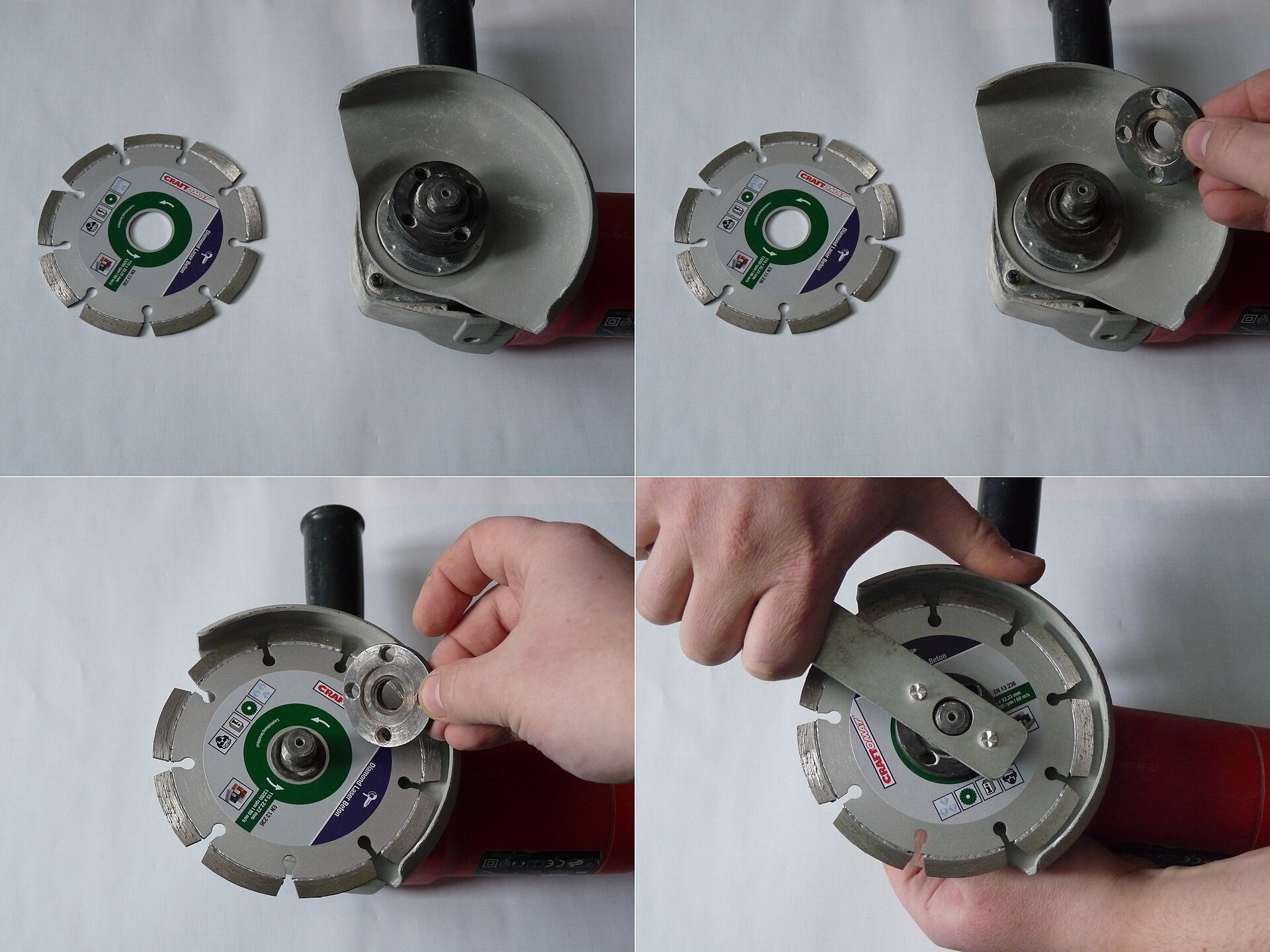

What do the arbor size and bore mean?
The bore is the centre hole that fits over the grinder’s spindle, and it has to match exactly — not “close enough” with a washer packed in to take up slack. A loose-fitting disc can run off-centre, vibrate, and wear unevenly, and an ill-fitting mount is one more way a disc can be stressed beyond its design.
Flanges and backing washers are part of the disc-mounting system too. They clamp the disc evenly and are sized to suit particular disc types and thicknesses. Substituting mismatched hardware, even with good intentions, changes how force is distributed across the disc when it is spinning.
How can you tell if a disc is damaged or expired?
A disc that has been dropped, stored badly, or left exposed to damp can be weaker than it looks, and abrasive discs also have a usable shelf life. Any crack, chip, or sign of delamination on the edge is a reason to retire the disc rather than risk it.
- Inspect a disc before every fitting — cracks are not always visible from directly above.
- Store discs flat, dry and away from anything that could chip their edges.
- Check for a use-by or manufacture date where the manufacturer prints one, and treat it as a limit rather than a guideline.
- Run a newly fitted disc briefly at operating speed with the tool pointed away from anyone, following the tool’s own start-up guidance, before beginning work.
A grinder’s guard and its dead-man switch are both part of how the tool contains and controls what happens if something does go wrong at the wheel — see what a dead-man switch does for how that safety feature works. Neither is a substitute for using a disc that is rated correctly and in good condition.
What PPE and technique does angle grinder work call for?
Angle grinder work throws sparks, abrasive dust and occasional fragments, and it is loud and sustained enough to affect hearing over time. Eye protection rated for impact, hearing protection for extended use, and a respirator suited to the dust being produced are all part of the job, not optional extras for “heavier” cuts.
Cutting masonry, stone, tile or concrete produces fine dust that can include silica, which needs proper respiratory protection and, where possible, dust suppression — see what silica dust is and why it’s regulated for more on why that dust is treated differently from ordinary workshop debris. Loose sleeves, dangling jewellery and gloves that could snag are worth thinking through as well, since anything that can catch on a spinning disc is a real hazard around rotating tools.
Firm footing, a secure grip with both hands where the tool is designed for that, and keeping the disc’s path clear of hands, cables and bystanders all matter more than any single spec on the box. The tool’s manual will describe the stance and grip it is designed to be used with — that guidance is model-specific and worth following rather than improvising around.
How do you choose between disc types when buying?
Buying the right disc means matching type, diameter, bore and speed rating to the grinder and the job, not picking on price or thickness alone. A thin cutting disc and a thick grinding disc are not interchangeable just because they fit the same spindle.
Worth comparing when buying discs:
- Rated maximum speed against the grinder’s actual no-load speed, every time — not just once when the grinder is new.
- Disc type against the actual task: cutting, surface grinding or blending are different jobs with different discs.
- Material compatibility — metal-rated discs and masonry-rated discs are not generally interchangeable.
- Reinforcement and construction claims, which are harder to verify from packaging than a simple speed number, so treating unfamiliar marketing terms with some scepticism is reasonable — see which tool specifications are marketing rather than useful for how to weigh that kind of claim generally.
For a broader look at how to compare tools and specifications before buying, the buying tools guide covers the general approach, while the power tools archive and safety and PPE archive cover related tools and the protective gear that goes with them in more depth. Readers weighing grinding discs against wire wheels for surface prep may also find wire brush vs rotary wire wheel: what is the difference useful, and anyone comparing grinders to bench-mounted grinding equipment can see what a bench grinder is used for for how the two tools differ in purpose.
None of this replaces the specific guidance printed on the disc, on the grinder, or in its manual. Those are the numbers that were tested for that exact combination, and they are the ones worth following.
Find Tool publishes general information, not professional advice. Power tools, mains electricity and workshop machinery are genuinely dangerous, and the safe settings, guards and procedures differ between models — always follow the manual and the markings on the tool in front of you rather than a general guide. Never remove or defeat a guard or safety feature. Anything involving fixed wiring, gas or structural work belongs to a qualified tradesperson. Wear the eye, ear and respiratory protection the task calls for.
Featured image: Photo by Dmitry G, source, CC BY-SA 3.0