A torque screwdriver is a screwdriver built to stop transmitting force once a chosen twisting effort has been reached, so the screw is tightened consistently rather than as hard as an arm can manage. It’s needed anywhere over-tightening can crack a part, strip a thread, crush a gasket, or shear a small fastener — small electronics, optics, some furniture and appliance work, and precision assembly.
What is a torque screwdriver, exactly?
It looks like an ordinary screwdriver, often with interchangeable bits, but the handle contains a mechanism that either clicks, slips, or signals once a preset amount of turning force has been applied to the fastener. Beyond that point, the driver stops passing effort into the screw even if the user keeps turning the handle.
This matters because a standard screwdriver has no such limit. The only thing stopping over-tightening with a plain driver is the operator’s judgement and feel, which is inconsistent from one person to the next and from one day to the next for the same person.
What does “torque” mean in this context?
Torque is a measure of rotational force — how hard something is being twisted, not how far it has turned. A screw can be turned the same number of degrees with very different amounts of twisting force behind it, and it’s the force, not the rotation, that determines whether a thread strips or a fragile part cracks.
Manufacturers of small assemblies — circuit boards, camera housings, some furniture fittings, plastic enclosures — often specify a torque range for a given screw and material because too little force leaves a loose or vibrating joint, and too much force damages the thread, the part, or both. A torque screwdriver is the tool built to hit that range reliably.
How does a torque screwdriver actually work?
Most household and hobby models use one of two mechanisms. A click-type driver has an internal spring and cam arrangement; once the set torque is reached, the mechanism releases with an audible and tactile click, and further turning of the handle no longer tightens the screw in the same way. A dial or scale on the handle lets the torque value be adjusted within the tool’s range.
Some drivers instead use a slip-clutch: past the set point, the driving mechanism simply spins free of the bit, so the handle keeps turning but nothing further happens at the screw. Digital versions exist too, with an electronic readout and sometimes a light or beep at the target value — useful where a written record of the setting is wanted, though the underlying idea is the same.
None of these mechanisms replace correct technique. The screw still needs to be started straight, the bit still needs to fully seat in the screw head, and the driver still needs to be held square to the fastener. A torque screwdriver limits force; it doesn’t compensate for a stripped screw head or a cross-threaded start.
Where is a torque screwdriver actually needed?
The honest answer is: in specific, fairly narrow situations, not as a replacement for every screwdriver in the box.
- Assembling or servicing electronics, cameras, or optical equipment where small screws thread into plastic or thin metal that strips easily.
- Certain furniture, cabinet, or appliance fittings where the manufacturer specifies a maximum tightening force to avoid cracking a fitting or crushing a soft material.
- Some bicycle components — stems, seatposts, carbon parts — where manufacturers publish torque values because over-tightening can crack carbon fibre or distort alloy parts.
- Repeated production-style assembly at home or in a small workshop, where consistency between dozens of identical fasteners matters more than it does for a single one-off job.
Ordinary woodwork, general household screws, and anything going into solid timber or metal with generous thread engagement rarely need this level of control. A well-practised hand with a standard driver, or a drill-driver’s built-in clutch setting, is normally enough for those jobs. The relevant number, whatever it is for a given fastener, always comes from the part’s manufacturer or assembly documentation — never guessed.

How does a torque screwdriver differ from a torque wrench?
Both limit twisting force and both work on the same click-or-slip principle, but they’re built for different scales of fastener. A torque screwdriver covers the low end of the torque range typical of small screws, while a torque wrench is built for the much higher forces involved in nuts and bolts on cars, machinery, and structural fittings. Details on that larger tool are covered in what a torque wrench is and why it matters on a car.
Some automotive and cycle fasteners also specify a turning angle after an initial torque value rather than a torque figure alone; that’s a different measurement covered separately in the piece on what a torque angle gauge is for. A torque screwdriver has no role in that kind of work — it’s a small-fastener tool, not a substitute for either of the above.
Does a cordless driver need a torque screwdriver too?
Not usually, because most cordless drill-drivers already include an adjustable clutch that serves a similar purpose at a coarser level. The clutch numbers on a drill-driver are relative settings rather than calibrated torque values, useful for repeatable results on the same job but not interchangeable with a manufacturer’s stated torque figure for a delicate part.
Where a job specifies an actual torque value for a small screw, a hand-operated torque screwdriver reads more reliably than a drill’s clutch dial. The distinction between what an impact driver, a drill-driver, and a torque tool are each suited to is explored further in impact driver vs drill driver: what each is better at, which is worth reading before assuming any powered driver can substitute for a calibrated hand tool.
What should be compared when choosing one?
The torque range is the first thing to check — it needs to comfortably cover the values called for by the work in hand, with the target setting sitting somewhere in the middle of the range rather than at either extreme. A tool asked to work constantly at the very bottom or top of its scale tends to be less consistent there.
Bit compatibility matters too: many torque screwdrivers use a standard interchangeable-bit system, so check that the bit shapes actually needed — Phillips, Pozidriv, Torx, hex — are available for that particular handle. A reversible or bidirectional mechanism is useful if the work involves loosening as well as tightening, since some click-type drivers only limit force in one rotational direction.
How the setting is read and adjusted is a genuine trade-off rather than a marketing detail: a simple analogue scale is quick to set and rugged, while a digital readout can be easier to read precisely and sometimes logs the last value used. Neither is objectively better — it depends on how often the setting changes and how important a written record is. General guidance on separating meaningful specifications from marketing language is covered in the site’s buying tools guide.
How is a torque screwdriver kept accurate?
Like any measuring or force-limiting tool, a torque screwdriver can drift out of calibration with heavy use, being dropped, or being stored at its maximum setting for long periods, which keeps the internal spring under constant tension. Manufacturers typically recommend storing the tool at its lowest setting and periodically checking it against a reference standard, particularly if it’s used for anything where the torque value genuinely matters rather than just needing to be “snug.”
The broader idea of how accuracy, precision and resolution differ — and why a tool being repeatable is not the same as it being correct — is explained in accuracy, precision and resolution: what’s the difference, which is a useful read for anyone treating a torque screwdriver’s number as a guaranteed value rather than a best estimate that benefits from occasional checking.
For readers building out a wider set of measuring and precision tools alongside a torque screwdriver, the measuring and precision archive and the general hand tools archive cover related equipment and how it’s used correctly.
Is a torque screwdriver worth having in a home workshop?
For most general DIY and woodworking, no — a standard screwdriver and reasonable care cover the vast majority of jobs. It becomes worth owning once the work regularly involves small screws into plastic, delicate housings, or any part where a manufacturer has published a specific torque figure, because in those situations consistent force is the difference between a secure fixing and a stripped or cracked one.
Eye protection is sensible whenever a screw or bit shows signs of slipping or a fastener is under load, since a slipped driver can send the bit or a fragment of the fastener off at speed. Beyond that, the main hazard with this particular tool is a false sense of precision — assuming a click means the job is correct rather than simply that a preset force has been reached on a tool that itself needs occasional checking.
Related reading
how power tools, hand tools and measuring kit actually work, What Is a Plumb Bob and Does Anyone Still Use One?, What Is a Post Hole Digger, and When Is It the Wrong Tool?, Hand Plane vs Electric Planer: What Does Each Do Better?
Find Tool publishes general information, not professional advice. Power tools, mains electricity and workshop machinery are genuinely dangerous, and the safe settings, guards and procedures differ between models — always follow the manual and the markings on the tool in front of you rather than a general guide. Never remove or defeat a guard or safety feature. Anything involving fixed wiring, gas or structural work belongs to a qualified tradesperson. Wear the eye, ear and respiratory protection the task calls for.
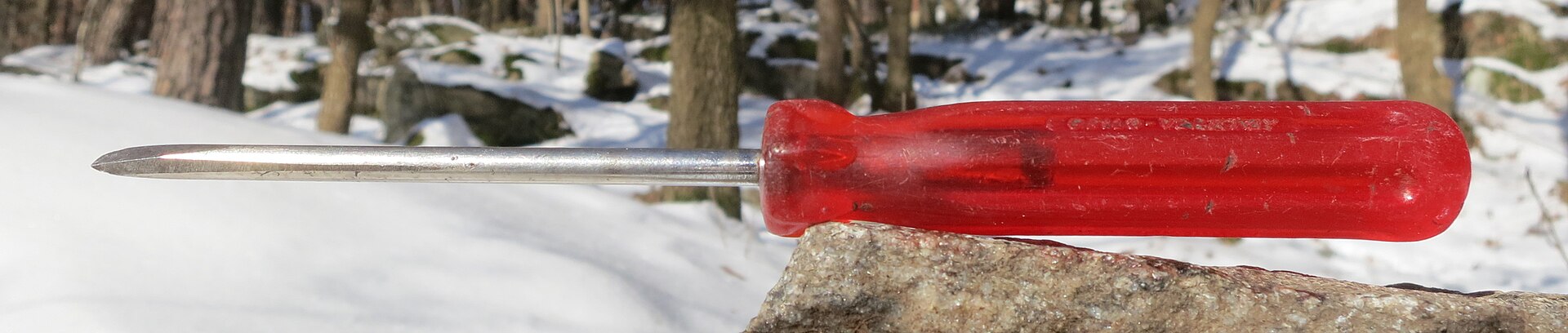
Featured image: Photo by R. Henrik Nilsson, source, CC BY 4.0