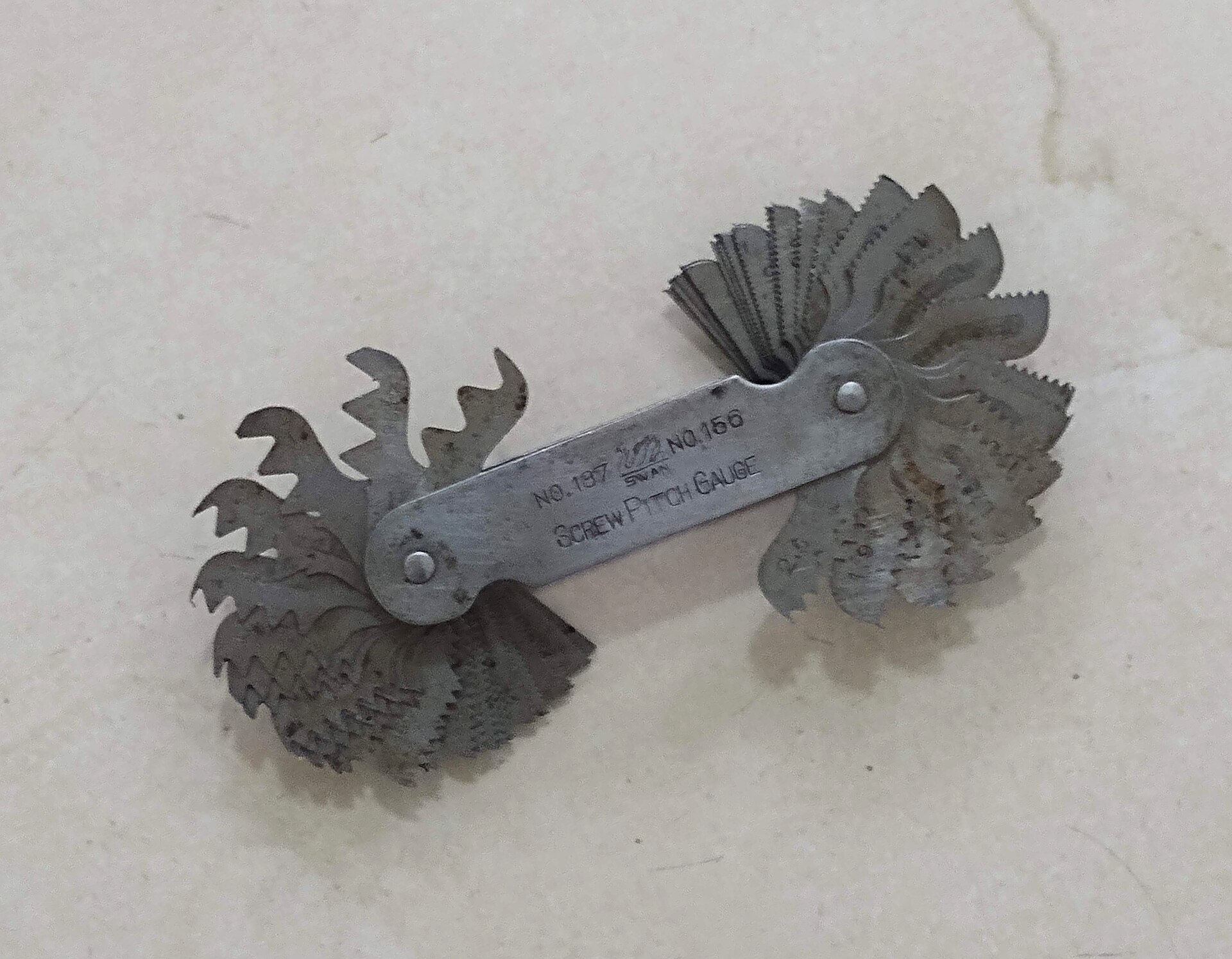
A thread pitch gauge is a small hand tool with a fan of thin, notched metal leaves used to identify the thread pattern on a screw, bolt or nut. Each leaf has teeth cut to a specific pitch; whichever leaf meshes cleanly with the threads tells you what pitch you’re dealing with, without guessing or trial-fitting fasteners.
What does a thread pitch gauge actually measure?
It measures thread pitch — the spacing between adjacent threads on a screw or bolt. On metric fasteners this is usually expressed as the distance between threads in millimetres. On imperial fasteners it’s usually expressed as threads per inch (TPI). A pitch gauge does not measure diameter, length or thread depth; it only tells you how tightly wound the thread is.
How does a thread pitch gauge work?
The tool folds out like a small multi-tool knife. Each leaf has a row of teeth cut to match one specific pitch. To use it, a leaf is pressed against the threads of the bolt, screw or the inside of a nut. If the teeth sit flush against the thread crests and roots with no daylight showing between them, that leaf’s marked pitch is the match. If the teeth rock, bind, or leave visible gaps, it’s the wrong leaf, and the next one is tried.
It’s a comparison tool rather than a measuring instrument in the strict sense — it doesn’t display a reading, it confirms or rules out a value that’s already printed on the leaf. That makes it fast to use once you understand what a good fit looks and feels like, but it relies on the fastener’s threads being in reasonable condition. Threads that are worn, crossed, or coated in thick paint or corrosion can give a false or ambiguous fit.
Why does thread pitch matter when matching fasteners?
Two bolts can look identical — same diameter, same length, same head shape — and still have completely different thread pitches. Forcing a nut or bolt with the wrong pitch onto a mating part will often start to turn before binding, stripping, or seizing partway on. That’s a common way threads get damaged on machinery, garden equipment and vehicles, especially where a mix of metric and imperial fasteners has crept into the same assembly over time.
This is particularly relevant in automotive work, where metric and imperial hardware can appear on the same vehicle depending on its origin and repair history. The article on metric vs imperial fasteners on cars goes into how that mix happens and why it matters when sourcing a replacement bolt. A pitch gauge is one of the simplest ways to confirm you’re buying the right one rather than one that merely looks right on the shelf.
Metric vs imperial thread gauges — what’s the difference?
Most pitch gauges are sold as either metric, imperial, or combination sets that include both scales on separate leaves.
- Metric leaves are marked with a pitch value in millimetres, such as the spacing between one thread crest and the next.
- Imperial leaves are marked in threads per inch, counting how many complete threads occur along one inch of the fastener.
- Combination gauges fold out with metric leaves on one side and imperial on the other, useful in a mixed workshop where both standards turn up.
Buying the wrong type isn’t a disaster — the tool still works the same way — but it means carrying two tools, or one, depending on what actually crosses the bench. Anyone regularly dealing with older machinery, imported parts, or a mix of DIY and automotive fasteners is more likely to want a combination set.

How do you read a thread pitch gauge?
Reading one is mostly about feel and light, not numbers on a dial.
- Clean the threads enough to see them clearly — old paint, rust or thread-locking compound can mask the true pitch.
- Hold the fastener so the threads are visible and steady, using a vice if it’s awkward to hold by hand.
- Try leaves in sequence, starting with a pitch that looks roughly right by eye.
- Look for a leaf that sits flush against the thread profile with no light showing through the gaps and no rocking.
- Read the pitch value stamped on that leaf — that’s the fastener’s thread pitch.
For internal threads, such as those inside a nut or a tapped hole, the same leaves are used the same way, checked against the inside of the thread rather than the outside of a bolt.
What else can you use besides a thread pitch gauge?
A pitch gauge is the quickest dedicated tool for the job, but it isn’t the only way to work out a thread. A caliper can measure the outside diameter of a bolt and, with care, the distance across several threads, from which pitch can be worked out by calculation. The article on how to read a vernier caliper explains what that instrument is actually measuring and where its precision comes from.
A feeler gauge works on a related principle — thin, graduated leaves used to check a gap rather than a thread — and the piece on what a feeler gauge is used for is a useful comparison if the idea of “leaves that either fit or don’t” is new. Neither tool replaces a pitch gauge for this specific job, but understanding the family of gauge tools helps explain why each one exists.
What should you compare when buying one?
Thread pitch gauges are inexpensive and mechanically simple, so the differences between models come down to a handful of practical points rather than headline specifications.
- Range covered — how many pitches are included, and whether common sizes for the work actually being done are present.
- Metric, imperial, or both — matching the standard most likely to be encountered.
- Leaf material and finish — stainless leaves resist corrosion better in a damp garage or outbuilding.
- Legibility of markings — stamped or engraved values that stay readable are more useful than markings that wear off with handling.
- Build of the pivot — a stiff, positive action that holds a leaf open while it’s being checked against a thread, rather than folding shut mid-use.
None of these differences justify paying for features that won’t get used — a gauge covering pitches never encountered in practice adds bulk without adding usefulness. The general approach to comparing measuring tools by what a spec actually buys, rather than by badge or price alone, is covered in the buying tools guide.
Where does a thread pitch gauge fit in a home workshop?
It earns its place alongside other small measuring and checking tools rather than sitting with the power tools. It’s handy whenever a fastener needs replacing and the original isn’t available to compare directly, when assembling flat-pack or imported furniture with unfamiliar hardware, or when working on older vehicles and machinery where thread standards may not match newer parts.
It’s a low-cost, low-risk tool to keep on hand — there’s no cutting action, no throw of material, and no sustained noise, so it doesn’t call for dedicated PPE the way power tools do. The main care point is handling the leaves themselves with a little attention, since the toothed edges are thin and can catch on skin if handled carelessly, particularly when a set is folded shut and stored in a pocket or drawer.
For a broader look at how measuring and precision tools work together in a workshop, the measuring and precision archive covers related instruments, and the tool guide hub is a good starting point for understanding how different hand tools and power tools are actually meant to be used. Anyone doing regular fastener work on vehicles may also find it useful alongside the basics covered in what a bench vice is used for in automotive work, since holding a bolt steady is the first step to checking it properly.
Find Tool publishes general information, not professional advice. Power tools, mains electricity and workshop machinery are genuinely dangerous, and the safe settings, guards and procedures differ between models — always follow the manual and the markings on the tool in front of you rather than a general guide. Never remove or defeat a guard or safety feature. Anything involving fixed wiring, gas or structural work belongs to a qualified tradesperson. Wear the eye, ear and respiratory protection the task calls for.
Featured image: Photo by Mauro Cateb, source, CC BY-SA 4.0