A shadow board doesn’t improve the tools themselves — it improves how quickly a missing one gets noticed. By giving every item a fixed, outlined spot on a board or wall, a gap becomes visible at a glance, which supports faster clean-up, better accountability, and a workshop that’s easier to work in safely.
What is a shadow board, exactly?
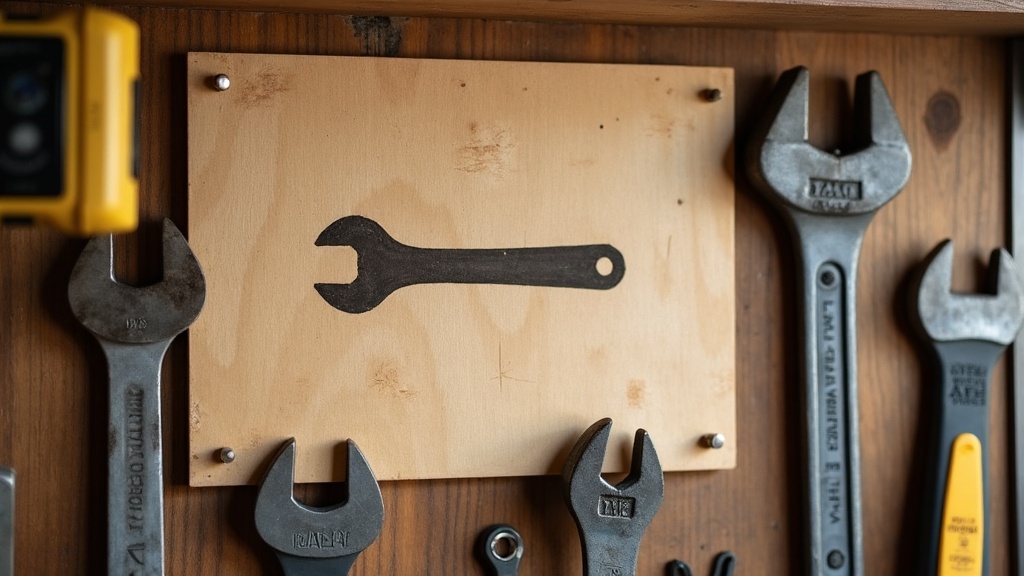
A shadow board is a mounted panel — often pegboard, plywood, or a purpose-made foam insert — where each tool has a marked outline or cut-out shape showing exactly where it belongs. The “shadow” is that outline: a painted silhouette, a routed recess, or a piece of dense foam with the tool’s shape removed.
The idea isn’t new and isn’t unique to home workshops. It’s the same logic used in aircraft maintenance bays and hospital theatres: if a space is empty where a tool should be, that’s immediately obvious, without anyone having to count or search.
What does a shadow board actually improve?
It improves visibility and accountability, not skill or precision. The main practical gains are:
- Faster spotting of a missing tool — an empty outline stands out far more than a cluttered drawer with one gap in it.
- Quicker clean-up — putting things away becomes matching a shape to a shape, which is faster than deciding where something “usually” goes.
- Less time spent searching — a tool either has its own place or it doesn’t; a shadow board removes the guesswork of checking three likely drawers.
- A rough inventory at a glance — useful if tools are shared between people, or if a set needs to be checked before and after a job.
None of this changes how sharp a chisel is, how square a saw cuts, or how accurate a measurement is. Those things depend on the tool and the technique, not on where it lives when it’s not in use. A shadow board is a storage and workflow improvement, not a performance one.
Does a shadow board make anyone safer directly?
Only indirectly, through reduced clutter and better tool accounting — it doesn’t replace guards, PPE or safe technique. A tidy, organised bench does lower some risks, but the board itself isn’t a safety device.
The indirect safety benefits are real enough to matter:
- Fewer tools left lying on a bench or floor means fewer trip hazards and fewer edge tools resting somewhere they could be knocked or grabbed carelessly.
- A missing tool being noticed immediately — rather than at the end of a job — matters if that tool was left inside machinery, near a blade, or somewhere it could be struck accidentally.
- In shared spaces, knowing a specific item is unaccounted for is worth knowing before someone reaches for a machine.
It’s worth being precise about the limits here. A shadow board does nothing to a blade guard, a riving knife, an interlock or any other fitted safety feature — those still need to be left in place and used as the manufacturer intends. Read more on how guards and kickback relate on the safety and PPE section, and treat the board as tidiness support, not protective equipment.
What does it do for tool care?
It reduces the chances of damage from tools being piled, dropped, or left in damp corners — but it doesn’t maintain them. Hanging a chisel on its own hook keeps the edge away from other metal tools that could nick it in a drawer. A dedicated spot for a hand plane keeps the sole off a dusty shelf where grit could scratch it.
That’s a passive benefit: less accidental contact, not active care. Sharpening, oiling, rust prevention and proper storage of edge tools still need doing on their own schedule. A shadow board just gives each tool a consistent, protected resting place between uses.
Where does a shadow board fall short?
It’s a poor fit for tools that don’t have one obvious storage orientation, for consumables, and for anything that needs to be grouped by task rather than by shape. A few practical limits worth planning around:
- Small parts — fasteners, drill bits, router cutters — are usually better served by labelled bins or a cabinet than by an outline on a board.
- Tools that get used constantly through a job (a tape measure, a pencil, a combination square) may spend more time in a pocket or apron than on the wall, making the outline mostly decorative for that item.
- A board only works if people actually put tools back. It solves a visibility problem, not a discipline problem — if a tool doesn’t go back on the wall, the outline just sits empty.
- Heavier or bulkier tools may need a bracket or a shelf rather than a simple pegboard hook, which changes how the board needs to be built.
None of this makes a shadow board pointless — it just means it works best as part of a wider storage plan, alongside drawers, bins and a properly set-up bench, rather than as the only system in the workshop.
How do you decide what goes on a shadow board?
Start with the tools used often enough that their absence would actually be noticed, and skip anything better suited to a drawer or bin. A sensible way to sort candidates:
- Tools reached for on most projects — hammers, squares, chisels, pliers, screwdrivers.
- Tools with a clear, stable shape that hangs or sits well against a flat board.
- Tools that matter if lost — anything that could end up left inside a workpiece, a vice, or near a machine.
Small, loose, or oddly shaped items — fasteners, bits, blades, offcuts of sandpaper — usually work better in labelled containers than on an outline. The general question worth asking about any storage choice, shadow board included, is covered on the workshop and storage section, alongside what actually makes a bench itself worth working at, discussed in what actually makes a workbench good.
Can you build one, or should you buy one?
Both are common, and the choice mostly comes down to how much control matters over layout versus how much time is available. A home-built board — pegboard, plywood, or a scrap panel — costs little and can be reshaped as the tool kit changes. A pre-made foam insert or a manufactured shadow panel offers a tidier finish and faster setup, at the cost of being fixed to whatever layout it ships with.
Either way, a shadow board is really a simple example of a workshop jig: something made or arranged specifically to solve one recurring problem, in this case “where does this tool live and is it still there.” The same logic — building something purpose-made rather than making do — is covered more generally in what is a jig, and why do people make their own.
What else changes how tools are stored?
A shadow board is one part of a wider storage picture that also includes drawers, cabinets, and how clamps, squares and measuring tools are kept close to where they’re used. Comparing storage and workholding choices more broadly is covered in what are the real differences between clamp types, and general guidance on comparing tools and setups sits on the buying tools hub, alongside the wider hand tools archive for anything hung on the board itself.
Taken together, a shadow board is a small, low-cost change that makes a workshop easier to keep tidy and easier to check at a glance — not a substitute for guards, PPE, sharpening, or good technique, but a sensible piece of the system around them.
Find Tool publishes general information, not professional advice. Power tools, mains electricity and workshop machinery are genuinely dangerous, and the safe settings, guards and procedures differ between models — always follow the manual and the markings on the tool in front of you rather than a general guide. Never remove or defeat a guard or safety feature. Anything involving fixed wiring, gas or structural work belongs to a qualified tradesperson. Wear the eye, ear and respiratory protection the task calls for.