A chalk line is a reel of string coated in loose chalk that you stretch tight across a surface and snap, leaving a straight painted mark. It works on rough, dirty, uneven or outdoor surfaces where a laser’s dot or beam is hard to see, and it needs no batteries, levelling or line of sight.
What is a chalk line, exactly?
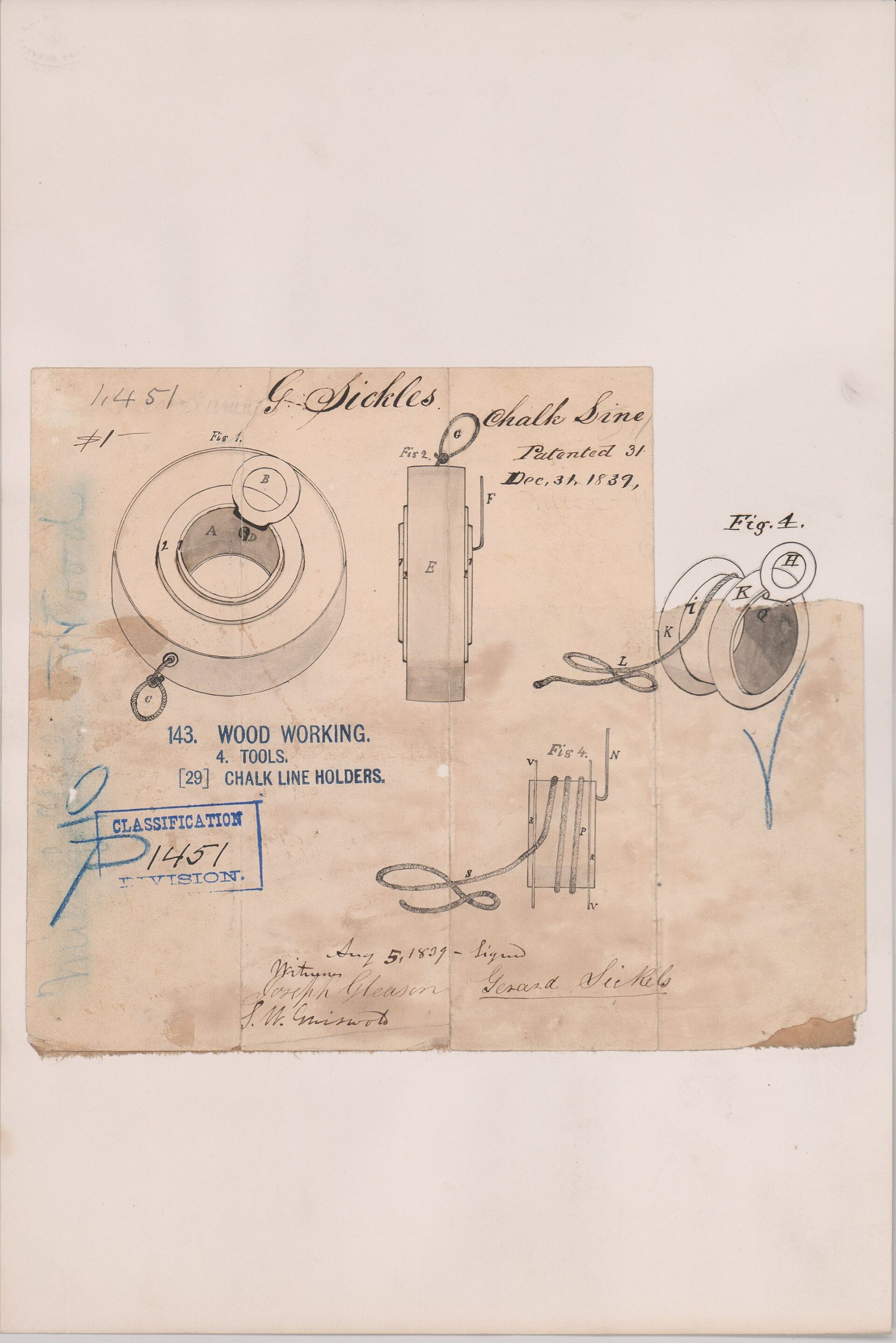
Inside the case is a reel of string and a reservoir of loose chalk powder. Pulling the string out coats it in chalk. Hook the end over a nail or have a second person hold it, pull the string taut between two points, then lift it slightly off the surface at the middle and let it snap back. The impact transfers a straight line of chalk onto whatever is underneath.
It is one of the oldest layout tools in the trade, and it survives for a simple reason: it makes a long, straight, highly visible mark on almost any material in the time it takes to walk from one end of a sheet to the other.
How does a chalk line actually work?
The mark is not measured or calculated — it is a straight physical line between two fixed points, the same way a taut piece of string always describes the shortest path between them. Because the mark comes from a real, physical straight edge rather than an optical projection, it does not shift, bend, or wash out in bright light. It stays exactly where it was snapped until it is covered, scrubbed off, or the material is cut away.
Chalk lines are commonly used for long rip cuts on sheet goods, marking out floor joists or deck boards, aligning rows of tile or shingles, and squaring up a slab or subfloor before framing starts. Anywhere a story stick or a tape measure gives you two points, a chalk line gives you the straight run between them. For more on marking out points before you connect them, see what a story stick does for repeated measurements.
What is a laser level, and how is it different?
A laser level projects a line or a point using a laser diode, usually referencing either gravity (a self-levelling unit) or a fixed angle set by the user. It answers a different question than a chalk line: not “what is the shortest path between these two marks” but “what is level, plumb, or square from this one reference point, projected across a room or a site.”
That makes it excellent for tasks a chalk line cannot do at all — transferring a height around a room, checking that a run of cabinets stays level across a long wall, or squaring up a large layout without physically stretching a string across it. The full range of what these tools can and cannot do is covered in What Is a Laser Level and What Are Its Real Limits?
Where does a chalk line beat a laser?
In several everyday situations, a length of chalked string is simply the better tool.
- Bright light and outdoor sites. A laser’s line washes out in direct sunlight unless the unit has a detector or a very bright, receiver-friendly beam. A chalk mark is visible in any light, indoors or out.
- Rough or dirty surfaces. Subfloor, concrete, framing lumber and roofing all take a chalk mark cleanly. A laser dot on a rough or uneven surface can be hard to pin down precisely enough to mark against.
- No power, no battery, no setup. A chalk line works the instant you pull the string out. There is no self-levelling wait, no charging, and nothing to break if it gets knocked off a ladder.
- Long, straight rip cuts on sheet material. Snapping a line down a sheet of plywood and running a circular saw along it is faster and more forgiving than fighting glare to see a laser line on the same material.
- Cost and durability. A basic reel has almost nothing to go wrong with it. It tolerates dust, drops and being left in a toolbox for months without needing recalibration.
- Marking that has to survive being walked on or handled. A chalk line stays put through the rest of the job; a laser line disappears the moment the tool is switched off or moved.
The common thread is that a chalk line is a physical mark, not a reference beam. Anywhere the job needs a permanent line to cut, nail, or tile against — rather than an ongoing reference to work from — chalk generally wins.
Where does a laser win instead?
A laser earns its keep on jobs a piece of string cannot do by itself:
- Transferring one height mark around an entire room, for cabinets, tiling, or a dropped ceiling.
- Checking level or plumb over a distance where stretching a string is impractical.
- Continuous reference over time — leaving the laser running while multiple items are set to the same line, rather than re-snapping chalk for each one.
- Squaring layouts across a large floor area using cross-line lasers, without needing two people to hold string.
Neither tool replaces a spirit level for checking a single short span accurately by eye — the vial in a good spirit level is still doing a job a laser and a chalk line both leave alone. See What Is a Spirit Level’s Vial Actually Telling You? for how that works.
Does the type of chalk matter?
Chalk lines usually take one of two broad chalk types, and mixing them or overfilling the reservoir is a common cause of a clogged or gritty line rather than a clean one.
- Standard chalk gives a bold, easily visible line that brushes or washes off most surfaces — good for temporary marks on framing, subfloor or sheet goods that will be cut or covered.
- Marking or “permanent” chalk is formulated to resist brushing and weathering, intended for outdoor layout or marks that need to survive longer exposure. It is correspondingly harder to remove from finished surfaces, so it is worth thinking through where the line will end up before choosing it.
Manufacturers vary in what their reservoirs and mechanisms tolerate, so check the tool’s own instructions before assuming any chalk brand or colour is interchangeable.
How do you snap an accurate line?
The accuracy of a chalk line depends entirely on how it is set up, not on the tool itself.
- Anchor both ends firmly at the exact points to be connected — a loose hook or a hand that shifts under tension is the most common source of a crooked line.
- Keep the string flat against the surface before lifting it, rather than pulling it away at an angle, which can throw the snap off to one side.
- Lift from the centre of the span and let go cleanly rather than dragging the string sideways, which smears the mark instead of leaving a crisp line.
- On very long spans, a helper holding the far end steady generally gives a straighter result than relying on a single fixed hook alone.
Because the chalk mark is a real physical line rather than a reading on a scale, there is no accuracy spec to compare between tools the way there is with a tape measure — the practical result comes down to setup and technique. For background on how measuring accuracy is actually defined on layout tools, see What Does Accuracy Mean on a Tape Measure?
Is there any hazard worth knowing about?
A chalk line itself is low-risk compared with most workshop tools, but a few points are worth keeping in mind. Snapping a line overhead or at face height can flick loose chalk dust back toward the eyes, so basic eye protection is sensible for repeated overhead marking. In an enclosed space with heavy or repeated use, fine chalk dust can be an irritant, and a simple dust mask is a reasonable precaution for anyone sensitive to it.
Where chalk lines are used on a ladder or scaffold to mark a high wall or ceiling line, the fall risk from the working position matters far more than the tool itself — that is a site-safety and ladder-stability question, not something specific to chalk lines.
Do you actually need both tools?
Most home workshops end up with both, because they solve different problems. A chalk line earns its keep on sheet goods, framing, decking and any long straight cut or run that needs a permanent mark. A laser level earns its keep on level and plumb reference across a room, and on layouts too large to stretch a string across conveniently.
Neither is a status upgrade over the other — buying a laser does not make a chalk line obsolete, and a cheap chalk line does not replace what a self-levelling laser does for a long run of cabinetry. When comparing either against a project’s actual needs, it helps to think in terms of what each tool measures or marks, not which one sounds more advanced. For a broader look at how to compare tools by what they actually do rather than by spec sheets, see the buying guide hub, and for more layout and measuring comparisons, browse Measuring & Layout and Comparisons. Chalk lines themselves sit alongside other everyday layout tools covered in Hand Tools.
Find Tool publishes general information, not professional advice. Power tools, mains electricity and workshop machinery are genuinely dangerous, and the safe settings, guards and procedures differ between models — always follow the manual and the markings on the tool in front of you rather than a general guide. Never remove or defeat a guard or safety feature. Anything involving fixed wiring, gas or structural work belongs to a qualified tradesperson. Wear the eye, ear and respiratory protection the task calls for.