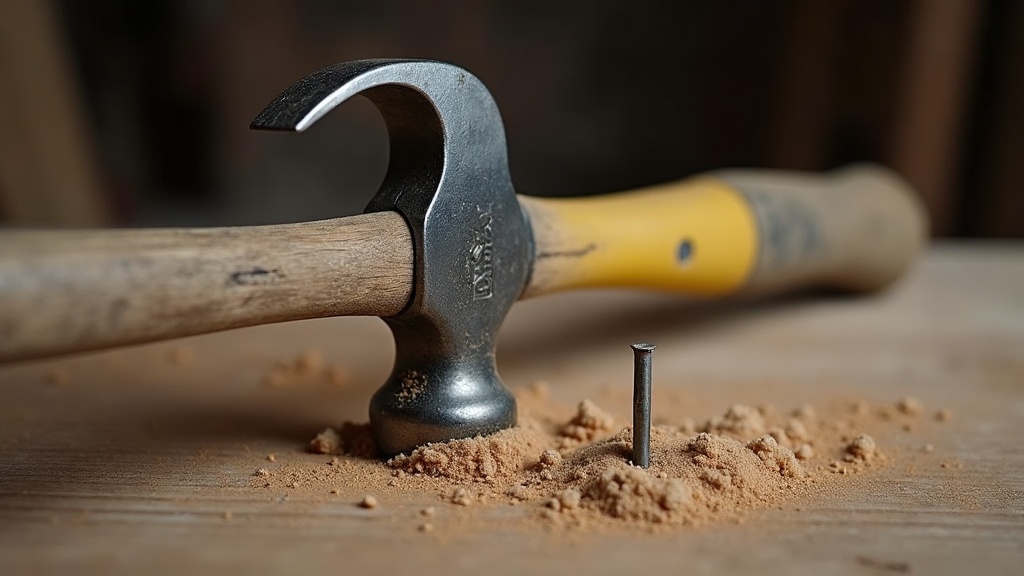
A claw hammer is a lighter, general-purpose hammer with a curved claw, built for everyday jobs around the house and small workshop. A framing hammer is heavier, longer-handled, and usually has a straighter claw and milled face, built for driving large nails into structural lumber quickly and repeatedly.
What actually separates the two hammers?
The difference comes down to weight, handle length, face pattern and claw shape — each one changes how much force reaches the nail and how controllable the swing is.
- Weight: Claw hammers are lighter and easier to control for one-handed, close-up work. Framing hammers carry more head weight to drive large nails in fewer strikes.
- Handle length: A longer handle on a framing hammer generates more swing speed and force from the shoulder, at the cost of precision.
- Face: Many framing hammers have a milled, waffled face that bites into the nail head to reduce slipping on rough lumber. A claw hammer usually has a smooth face, which leaves a cleaner mark on visible or finished wood.
- Claw shape: Claw hammers have a curved claw, good for prying and pulling nails with leverage. Framing hammers often have a straighter claw, better for splitting boards apart or gaining a purchase point in framing work.
What is a claw hammer actually for?
A claw hammer is the general-purpose choice for household repairs, light carpentry, assembling furniture, and pulling small to medium nails. Its smooth face and moderate weight suit finished work where marring the surface matters.
Because it is lighter and shorter-handled, a claw hammer is easier to control at odd angles — starting a nail with fingers close to the head, tapping a chisel, or knocking apart small joints. The curved claw gives good leverage for pulling nails out cleanly, which matters when reusing timber or fixing a mistake without splitting the board.
Most home workshops only need one hammer, and for the majority of tasks — hanging pictures, small repairs, flat-pack assembly, light trim work — a claw hammer covers it.
What is a framing hammer actually for?
A framing hammer is built for driving large common nails into structural lumber — wall studs, joists, subfloor — as fast as possible with as few swings as possible. It trades precision for raw driving power.
The extra head weight and longer handle mean each swing delivers more energy to the nail, which matters when a job involves dozens or hundreds of full-size nails in a day. The milled face helps the hammer grip the nail head instead of glancing off, especially on treated or rough-sawn timber where a smooth face tends to slip.
This is a construction-site tool. It is heavier to swing repeatedly, less forgiving of a mistimed strike, and more likely to mark or dent a workpiece where appearance matters.
Can a framing hammer be used for general household jobs?
Technically yes, but it is usually the wrong tool for the job. The extra weight and length make close, controlled work harder, and the milled face leaves a textured dent on any surface it strikes.
Trying to start a small nail, tap a dowel, or work on a finished surface with a framing hammer is more likely to result in a bent nail, a marked workpiece, or a strike that misses the intended spot. The tool is optimized for repetition and power, not finesse.
Can a claw hammer be used for framing work?
It can drive large nails, but it takes more swings and more effort, and fatigue sets in faster over a full day of framing-scale work. For occasional structural fastening in a home workshop, a claw hammer is usually adequate; for repeated, sustained framing, it is the wrong tool for the volume of work.
Framing, wall assembly and anything load-bearing also sit outside general DIY territory in many cases — where a project affects structure, it is worth checking local building rules and, where the work is structural, involving a qualified tradesperson rather than relying on hand-tool choice alone.
Does hammer weight matter more than most people think?
Yes — weight is the single biggest factor in how a hammer feels and performs, more than handle material or claw style. A heavier head drives nails in fewer strikes but tires the arm faster and is harder to control precisely.
There is no single “correct” weight; it depends on the size of nail being driven and how long the task runs. Comparing hammers by weight and handle length side by side, rather than by name alone, gives a better sense of how each will actually feel in use. The buying tools guide covers how to compare specifications like this across categories of hand and power tools.
What should a home workshop actually have?
For most home workshops, a mid-weight claw hammer covers general repairs, assembly and light carpentry. A framing hammer is worth adding only if a specific project — a shed, deck, or wall — involves driving a large number of full-size nails.
- General repairs, picture hanging, small joinery: a standard claw hammer.
- Furniture assembly, trim, finished surfaces: a claw hammer with a smooth face to avoid marring wood.
- Occasional structural framing at home scale: either hammer works, but a framing hammer reduces fatigue on long runs of nailing.
- Frequent or professional-scale framing: a dedicated framing hammer, sized to the nails and lumber involved.
Where nailing volume is genuinely high, it is also worth considering whether a nail gun suits the job better than either hammer — see how a nail gun’s trigger mode changes how it fires, which affects both speed and control on repetitive work.
What safety points apply to hand hammering?
Eye protection matters more than people expect with hammers — nail heads can chip, old nails can shear, and struck metal fragments travel fast. Safety glasses are worth wearing for any nail-pulling or demolition work, not just power tool use.
A hammer with a loose or cracked head, or a handle with splits near the head, should be retired rather than repaired with tape or glue — a head coming loose mid-swing is a genuine hazard to hands and anyone nearby. Checking the head-to-handle fit before each use, especially on an older hammer, is a habit worth keeping.
Broader PPE guidance for workshop tasks, including where dust and noise protection matter alongside eye protection, is covered in the safety and PPE section.
How does this compare to choosing power tools?
The same logic that separates a claw hammer from a framing hammer — weight versus control, general-purpose versus task-specific — shows up across power tools too. A cordless drill and an impact driver split roles the same way a claw hammer and a heavier hammer do; the drill vs impact driver vs hammer drill comparison walks through that trade-off in more detail.
For anyone building out a first set of tools, the tool guide hub explains how various hand and power tools actually work, and the comparisons archive covers more head-to-head choices like this one.
Which hammer is the better first purchase?
A mid-weight claw hammer is the better first purchase for almost every home workshop. It handles the widest range of everyday tasks, and a framing hammer can be added later if a specific project genuinely calls for it.
Buying both eventually is common once framing-scale projects come up, but starting with a single, versatile claw hammer avoids paying for capacity that most household tasks never use. For guidance on comparing tool specifications generally — weight, material, handle type — before buying, the buying guides archive has further reading on what actually matters versus what is just marketing detail.
Find Tool publishes general information, not professional advice. Power tools, mains electricity and workshop machinery are genuinely dangerous, and the safe settings, guards and procedures differ between models — always follow the manual and the markings on the tool in front of you rather than a general guide. Never remove or defeat a guard or safety feature. Anything involving fixed wiring, gas or structural work belongs to a qualified tradesperson. Wear the eye, ear and respiratory protection the task calls for.
Related reading
What Is a Chalk Line, and Where Does It Beat a Laser?, Drill vs Impact Driver vs Hammer Drill: Key Differences, What Are the Real Differences Between Clamp Types?.
Featured image: Photo by Luigi Zanasi, source, BY-SA