A moisture meter tells you roughly how much water is held inside a piece of wood at the moment you test it, expressed as a percentage of the wood’s dry weight. It does not tell you whether that level is stable, whether it will change, or whether the wood is safe to build with — that judgement is still yours to make.
What does a moisture meter actually measure?
Most meters aimed at hobbyists measure moisture content by weight, not volume. The number on the screen is an estimate of how many grams of water sit inside every hundred grams of completely dry wood fibre. Freshly felled timber can hold a very high proportion of water. As it dries, that proportion drops until it settles into balance with the air around it — a point called equilibrium moisture content.
The meter itself does not weigh anything. It infers moisture from an electrical property of the wood, which is where the two common meter designs diverge.
Pin vs pinless meters — what’s the real difference?
Pin meters push two small electrodes into the surface and measure electrical resistance between them; wetter wood conducts better, so resistance drops as moisture rises. Pinless meters use an electromagnetic sensor pressed flat against the surface and read a wider, deeper slice of the timber without piercing it.
Pin meters leave small holes, which matters on a finished surface but not on scrap or the underside of a board. Pinless meters are faster and non-marking but average moisture over a chunk of wood rather than pinpointing a single depth, so a wet patch surrounded by dry wood can get diluted in the reading.
Neither type is “more accurate” in every situation — the right one depends on whether the surface can take marks and whether a general reading or a pinpoint one is more useful. This is the same trade-off that comes up across most measuring tools: the spec sheet number matters less than what the job actually needs, which is worth keeping in mind whenever you’re comparing measuring tools before buying.
What moisture percentage is “safe” for timber?
There is no single safe number — the right target depends on what the timber will become and where it will live. Furniture destined for a centrally heated room needs to dry to a lower moisture content than framing timber that will sit in a garden shed, because both eventually settle to match the humidity around them.
Instead of chasing one figure, the useful question is: what moisture content will this piece of wood naturally settle at once it’s installed, and is it already close to that? A kiln-drying schedule, a supplier’s spec sheet, or a woodworking reference for the species and end use will give a realistic target — the meter just tells you how close the board is to it right now.
Why does a reading vary across the same board?
Wood dries from the outside in, so the surface of a board is almost always drier than its core while it’s still losing moisture. A pin meter with adjustable pin depth, or one used at an angle to reach further in, can pick up that difference; a surface-only reading can make a board look drier than it really is.
Readings also vary along the length and width of a board, especially near the ends, which dry faster than the middle and are the classic starting point for splits. Checking several spots rather than one gives a far more honest picture than a single reading taken wherever the meter happened to land.
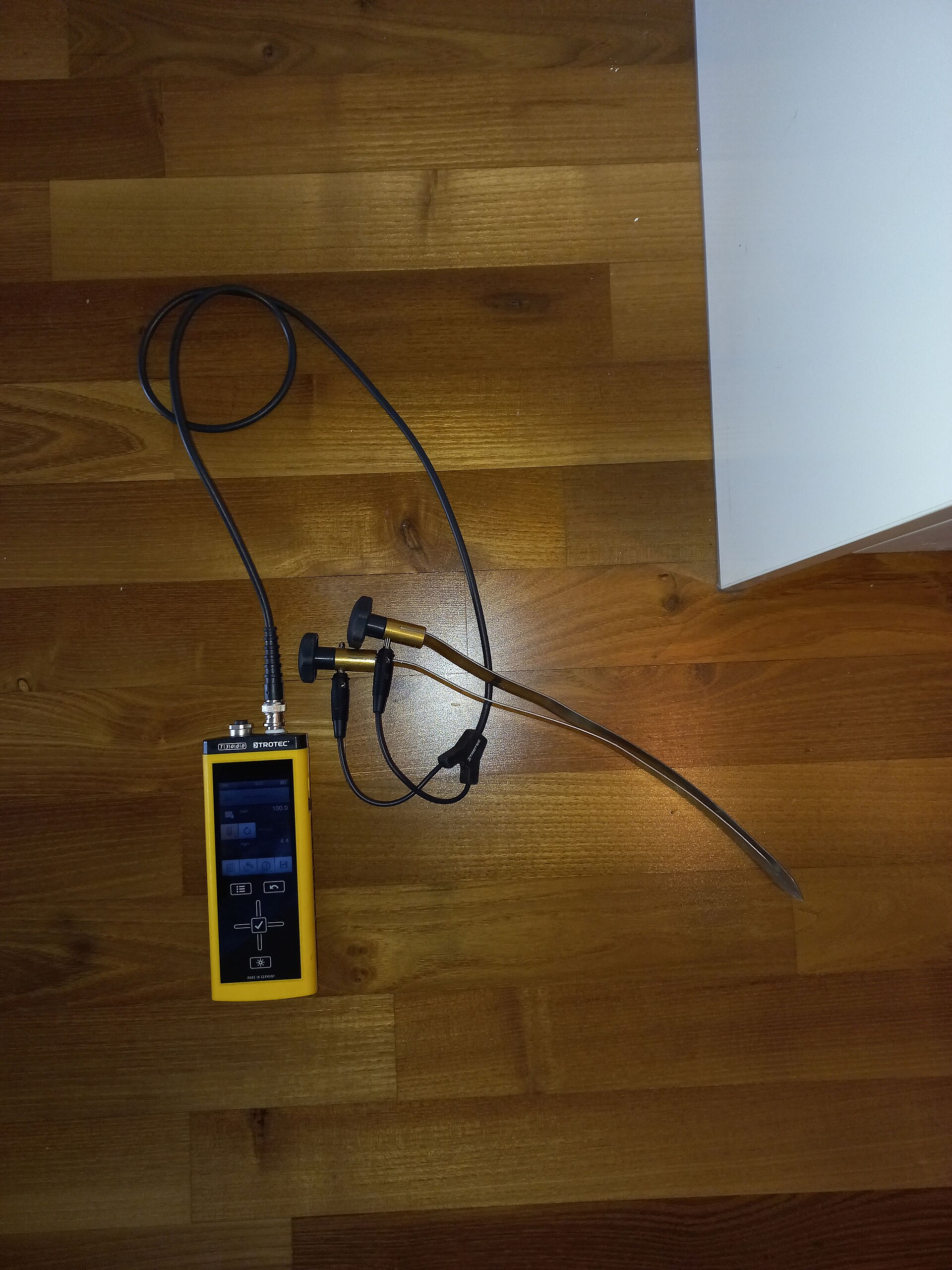

What can throw a moisture meter reading off?
Several things skew a reading without the meter “failing”:
- Species — different woods have different natural densities and electrical properties, and many meters have a species-correction setting or chart that needs to be used correctly.
- Temperature — very cold or very warm timber can read differently than the same board at room temperature.
- Surface treatments — finishes, glues, and some preservative treatments can interfere with pin contact or the pinless sensor’s field.
- Metal nearby — pinless meters in particular can be thrown off by staples, nails, or a metal bench surface close to the sensor.
None of this makes the meter useless — it just means a single reading, taken once, on one spot, is a rough indicator rather than a certificate.
Why does moisture content matter before you build anything?
Wood that is still losing moisture keeps changing shape while it does it — shrinking across its width and thickness far more than along its length. Build with timber that’s still wet and the piece can cup, twist, or open up gaps at joints months later, once it’s finally reached equilibrium in its new environment.
This is also why timber is often left to acclimatise in the room or workshop it will be used in before it’s cut to final size. A moisture meter is a way of checking that acclimatisation is actually happening rather than assuming it after a few days, and of comparing boards from the same stack that may not be drying at the same rate.
It matters for accuracy too, in the same way that careful marking and measuring do — a board that moves after it’s cut undoes the benefit of careful measuring done earlier in the process.
How do you use a moisture meter well?
A few habits make the readings more trustworthy:
- Test several spots on each board, including near the ends and away from any obvious knots or damage.
- Set the correct species setting if the meter offers one, and follow the manufacturer’s instructions for pin depth or sensor placement.
- Compare boards from the same batch to each other, not just to a single target number — a big spread across the stack is often more telling than any one reading.
- Recheck over a few days if there’s any doubt, rather than treating one reading as final. Moisture content is a moving target until the wood stops losing water.
Like most measuring tools, a moisture meter rewards a consistent method more than an expensive model — the same principle that applies to other tools that infer something hidden rather than measuring it directly.
Is a moisture meter worth buying for a home workshop?
It’s worth it for anyone regularly buying rough-sawn timber, working with reclaimed wood of unknown history, or building anything that needs to stay flat and tight over time — furniture, flooring, cabinetry. For someone buying pre-dried, kiln-dried stock from a reliable supplier for occasional small projects, it’s a nice-to-have rather than essential.
When comparing meters, the things that matter are pin versus pinless (and whether the surface can take pin marks), whether species correction is built in or done by chart, and how easy the display is to read in a dim workshop — not headline claims about how “accurate” a unit is, since accuracy depends as much on technique as on the electronics inside. These are the same kinds of trade-offs worth weighing across any measuring purchase, covered more broadly in the measuring and layout tools archive and in the wider guide to how measuring and power tools actually work.
Moisture content also feeds directly into machining decisions — timber that’s still too wet can behave unpredictably on a planer or jointer, tearing or springing back after a pass, which is worth knowing before reaching for either tool on borderline stock, as covered in the piece on what a planer and a jointer actually do differently. For anyone weighing up which measuring or workshop tools genuinely earn a spot on the bench, the buying guides section is a reasonable place to keep comparing before spending money.
Find Tool publishes general information, not professional advice. Power tools, mains electricity and workshop machinery are genuinely dangerous, and the safe settings, guards and procedures differ between models — always follow the manual and the markings on the tool in front of you rather than a general guide. Never remove or defeat a guard or safety feature. Anything involving fixed wiring, gas or structural work belongs to a qualified tradesperson. Wear the eye, ear and respiratory protection the task calls for.
Featured image: Photo by Asurnipal, source, CC BY-SA 4.0