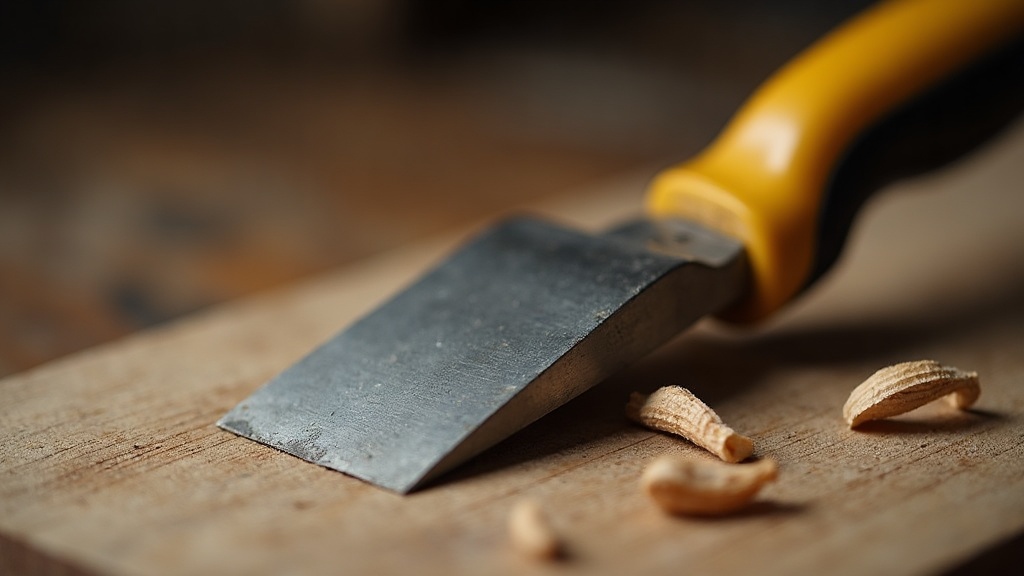
A card scraper is a thin, flat piece of hardened steel, usually rectangular, with no handle and no moving parts. Woodworkers flex it slightly and push or pull it across the surface of wood, where a tiny burr on its edge shaves off gossamer-thin curls instead of dust. It levels tricky grain and glue lines that a plane or sander struggle with.
What does a card scraper actually do?
It removes a very fine layer of wood fibre using a burr — a microscopic hook of steel folded over on the edge — rather than a sharpened bevel like a chisel or plane iron. That burr shaves rather than tears, which is why it can work cleanly on grain that reverses direction or swirls around a knot.
Because the cut is so thin, a card scraper does not remove much material quickly. That is the point. It is a finishing tool, not a shaping tool. It comes out after the bulk of the wood has already been planed or cut to size, when the job is smoothing the last thousandths of an inch before finish goes on.
How is it different from sandpaper?
Sandpaper abrades the surface with grit particles, tearing fibres loose and leaving a fine layer of dust. A card scraper shaves the fibres cleanly with a burr, leaving thin curls instead of dust, and it does not clog the wood’s open pores the way sanding grit sometimes can.
The practical difference shows up on figured wood — curly maple, birdseye, tight crotch grain — where sandpaper can round over the surface unevenly and dull the figure, while a scraper follows the grain and keeps the surface crisp. It also produces far less airborne dust for a comparable amount of surface smoothing, though any dry wood work still throws some fine particles worth managing.
Why do woodworkers keep one on the bench?
A card scraper handles situations that stump other tools: reversing grain, figured veneer, dried glue squeeze-out, and small proud edges left after joinery. It works in tight spots a plane can’t reach and finishes a surface without the swirl marks a power sander can leave.
- It cleans up glue squeeze-out along a joint without gouging the surrounding wood the way aggressive sanding can.
- It levels a slightly proud dowel, plug, or edge-banding flush without changing the surrounding surface.
- It smooths grain that keeps tearing out under a hand plane, because the scraping action does not need the wood to cooperate the way a planed cut does.
- It is small, quiet, needs no power, and produces almost no dust cloud — useful for a quick touch-up at the bench without setting up a machine.
None of this makes it a replacement for a hand plane or a sander. It is a narrow-purpose tool that earns its keep on a narrow set of problems, which is exactly why so many woodworkers keep one within reach rather than reaching for it first.
How do you actually use one?
The scraper is held in both hands, flexed into a slight bow with the thumbs pushing from behind, and tilted forward at a shallow angle so the burr just catches the surface. Pushing or pulling it across the grain in this position peels off fine curls; too upright and it will not cut, too flat and it will scratch instead of shave.
Getting a feel for the angle takes some practice on scrap wood before working on a finished piece. The flex in the blade is what lets it follow a slightly uneven surface rather than digging in at one spot, so a rigid, unflexed scraper tends to chatter or leave lines.
Because the tool relies entirely on that fine burr, the burr wears down with use and needs to be renewed periodically — this is normally done by drawing a hard, smooth rod (a “burnisher”) along the edge to roll a fresh hook of steel over. It is a quick job once learned, and most scrapers ship without detailed instructions, so it is worth checking the manufacturer’s guidance or a reputable woodworking reference the first time.
What PPE and dust precautions actually apply?
A card scraper is hand-powered and produces mostly curls rather than airborne dust, but any wood surfacing work still throws some fine particles, especially on dry hardwoods. Basic eye protection is sensible when scraping overhead or at eye level, and a dust mask is worth having on hand for extended sessions or dusty species.
The sharpening step carries its own small risk: burnishing rods and the freshly formed burr edge are sharp enough to nick a finger if handled carelessly, so keep fingers behind the blade’s working edge, the same habit worth building around chisels and plane irons.
For broader background on how hand tools like this compare with their powered equivalents, the tool guide hub and the hand tools category cover the mechanics of several bench tools in plain language.
How does it compare with a hand plane?
A hand plane removes more material per pass using a bevelled iron set at a fixed angle, and it is the tool for flattening and dimensioning wood. A card scraper removes far less material using a burr, and it is the tool for the final smoothing pass, especially where the plane leaves tear-out.
Many woodworkers use both in sequence: plane first to get the surface flat and close to final thickness, then scrape to erase any tear-out or reversing-grain marks the plane could not avoid. Understanding what the numbers on a plane’s body actually mean — the details covered in what the numbers on a hand plane mean — helps explain why a plane alone sometimes cannot finish the job a scraper picks up.
The same logic applies to chisels: a chisel’s bevel angle, discussed in what a chisel’s bevel angle is actually for, is chosen for controlled paring cuts, not for the whisper-thin shaving a scraper’s burr produces.
Is a card scraper worth buying for a home workshop?
Yes for most hobbyists, because it is inexpensive relative to other bench tools, has no moving parts to maintain beyond the burr, and solves a specific, recurring problem: smoothing figured or tricky grain without sanding dust or plane tear-out. It is a low-cost addition alongside tools already on the bench.
When comparing scrapers, the things that matter are the steel’s hardness and flatness rather than the shape or brand marketing on the packaging. A blade that is too soft will not hold a burr; one that is too hard can be harder to burnish evenly. Flatness matters because a warped card will not sit consistently against the wood.
For a broader framework on how to weigh specifications like this against price and marketing claims, the buying tools guide and the buying guides category lay out what actually predicts a tool’s usefulness versus what is just packaging.
What other hand tools pair naturally with a scraper?
A card scraper rarely works alone. It sits alongside a smoothing plane, a sharp chisel for cleaning joints, and an accurate square or combination square for checking that a surface is actually flat before finishing begins. Layout tools matter here too, since scraping unevenly can hide a surface that is not truly flat.
For checking flatness and squareness before and after smoothing, see what a combination square is and why it is used so much, a tool that shows up on nearly every serious bench for exactly this kind of check.
Readers building out a hand-tool kit from scratch may also find it useful to browse the wider hand tools archive and the measuring and layout category, both of which cover the tools that typically sit next to a scraper in a well-used kit.
Where does it fit next to power sanders?
A random orbital sander and a card scraper solve overlapping but distinct problems. The sander covers large flat areas quickly and evens out overall thickness variation; the scraper targets small trouble spots — a tear-out patch, a glue line, a proud edge — with more control and far less dust.
For background on what a random orbital sander is actually suited to and where it struggles, see the article on what a random orbital sander does by default. Understanding both tools’ strengths makes it easier to decide when reaching for a scraper saves time rather than costing it.
A card scraper will not replace a sander on a tabletop that needs squaring across its whole surface, and a sander will not replace a scraper’s ability to work into a tight corner or handle grain that keeps tearing. Keeping both in the kit, and knowing which one a given job calls for, is really the whole answer to why so many woodworkers keep a card scraper close at hand.
Find Tool publishes general information, not professional advice. Power tools, mains electricity and workshop machinery are genuinely dangerous, and the safe settings, guards and procedures differ between models — always follow the manual and the markings on the tool in front of you rather than a general guide. Never remove or defeat a guard or safety feature. Anything involving fixed wiring, gas or structural work belongs to a qualified tradesperson. Wear the eye, ear and respiratory protection the task calls for.
Related reading
What Is a Socket Set’s Drive Size Telling You?, What Does a Screwdriver’s Tip Type Actually Change?.
Featured image: Photo by Simon A. Eugster, source, CC BY-SA 3.0
