A screwdriver’s tip type changes how much grip it gets on the fastener head, how much torque it can transmit before it slips or strips, and how easily it will “cam out” under pressure. Different tip shapes exist because different fastener heads need different amounts of grip, precision and slip resistance.
What does a screwdriver’s tip type actually change?
The tip is the interface between the tool and the fastener. Its shape determines the contact area between driver and screw head, which in turn determines how much twisting force can pass through before the driver either slips out (cam-out) or the fastener head deforms. A tip that doesn’t match the screw head wastes force and rounds off the recess.
Why do slotted and Phillips tips behave so differently?
A slotted tip sits in a single straight groove with almost no self-centring; a Phillips tip is a cross shape designed to cam out on purpose once torque gets high, protecting the fastener from over-tightening damage on assembly lines.
Slotted screws are the oldest design and the simplest to make, but a flat blade only contacts two flat surfaces. It’s easy to knock the driver sideways out of the slot, and there’s nothing stopping it sliding across the workpiece and marking the surface if it slips.
Phillips heads were engineered specifically so that a power tool driving them would cam out at a certain torque rather than keep tightening and snap the screw or strip the material. That’s useful on a production line with a fixed clutch setting, but for a hobbyist hand-driving a screw, that same cam-out tendency is exactly what causes a stripped, chewed-up recess when someone pushes through resistance instead of backing off.
What is a Pozidriv, and why does it get confused with Phillips?
Pozidriv looks similar to Phillips at a glance but has extra small ribs between the main cross, giving more contact area and much less cam-out. Using a Phillips driver in a Pozidriv screw (or vice versa) usually works briefly, then chews the recess.
Pozidriv was developed to fix the deliberate slip of Phillips, and it shows in daily use: it holds far more solidly under torque and is common on European-made furniture, decking and construction fasteners. The catch is that the two head types are close enough in appearance that people grab the wrong bit, apply force, and round off a recess that would have held up fine with the correct tip. Checking the shape closely, or trying the fit before applying real pressure, avoids most of that damage.
Why do some tips resist cam-out and others don’t?
Cam-out resistance comes down to how much the tip’s flanks lock against the recess walls rather than sliding up a ramp. Star-drive and square-drive designs are built with steeper, straighter walls specifically to resist that slip, which is why they’re favoured for high-torque fastening.
This matters most whenever a fastener needs to go in fully seated and stay there — structural screws, decking, cabinet hardware that will be tightened and loosened repeatedly. A recess that resists cam-out lets more of the driver’s force go into turning the fastener instead of being absorbed by the tip riding up and out. It also reduces the number of stripped screws that then have to be drilled out, which is its own small hazard from flying metal chips and broken bits.
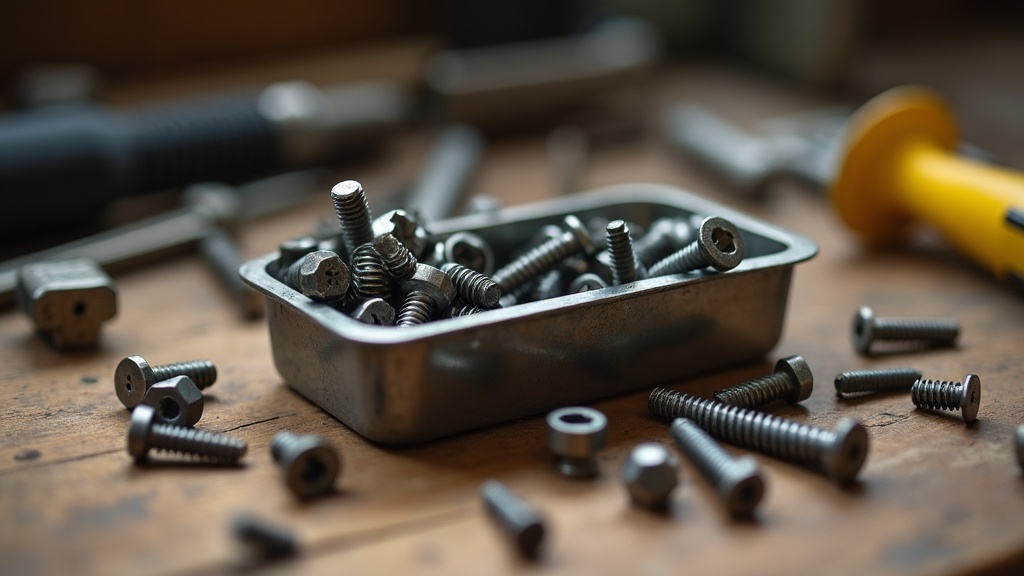
What do Torx, hex and square tips add?
Torx (star-shaped), hex (six-sided) and square-drive tips all give a much larger, more even contact area than a cross-point design, which is why they’re common on anything meant to take high torque without slipping — furniture assembly, automotive trim, deck screws.
- Torx / star: six rounded points of contact, very resistant to cam-out, common on furniture flat-pack hardware and machine screws.
- Hex: a straight six-sided socket, simple and strong, common on bolts and some cabinet hardware.
- Square (Robertson): a square recess that self-centres well on the bit, popular in cabinetry and decking because it holds the screw on the tip without falling off.
None of these are “better” in an absolute sense — they’re matched to jobs where slippage under load is the main problem. A cabinetmaker driving hundreds of identical screws benefits enormously from a tip that holds the fastener on the bit and doesn’t cam out; someone tightening one old slotted brass screw on an antique hinge has no use for a star-drive bit because the fastener simply isn’t made that way.
Does tip size matter as much as tip type?
Yes — a correctly shaped tip in the wrong size still strips the recess. Slotted and Phillips tips especially come in graduated sizes, and a tip one size too small rocks inside the recess under load; one size too large won’t seat fully and bears on the edges instead of the flat faces.
This is one of the most common causes of stripped screw heads in a home workshop: reaching for whatever driver is closest rather than matching size to the fastener. Trying the fit by hand before applying any real force — the tip should sit flush and not wobble — catches most mismatches before they cause damage.
How does tip type affect using a power driver instead of a hand screwdriver?
Power drivers apply torque faster and with less feel for resistance than a hand screwdriver, so tip mismatch causes damage more quickly. A driver bit that fits loosely will cam out or spin the recess round almost instantly under power, rather than the gradual slip a hand tool gives some warning of.
This is also where eye protection matters. A stripped screw head under power can shed small metal fragments, and a bit that suddenly cams out can send the driver skidding across the workpiece. Safety glasses are worth wearing for any driving job done with a power tool, particularly overhead work or anything involving hardened screws that resist easily. For background on how variable speed and clutch settings on a driver interact with torque and slip, the guide to what variable speed changes on a power tool covers the mechanism in more depth, and the comparison of cordless drills and drivers explains why a dedicated driver often handles screws better than a general-purpose drill.
What should you actually compare when buying a set?
The useful comparison isn’t tip count, it’s whether the set actually covers the fastener types already in a given home or project, and whether the tip material and fit are precise enough to resist rounding off under real use.
- Fastener coverage: check what’s actually holding together furniture, appliances, decking or bicycles at home before buying — a huge bit set is only useful if the shapes in it match.
- Tip precision: a driver tip machined to a tight tolerance for its size holds better and strips less than a loosely cast equivalent, even within the same nominal type.
- Handle and shank: for hand screwdrivers, a comfortable handle diameter and a shank long enough to reach the fastener matter as much as the tip itself.
- Magnetic tips: useful for holding small screws in awkward spots, though the magnetism has nothing to do with torque transfer or cam-out resistance.
Buying a huge multi-bit set because it looks comprehensive is rarely the right comparison — a smaller set that precisely matches the fasteners actually in use, in the right sizes, does more useful work than a large set of mediocre-fitting bits. The buying tools hub covers this kind of trade-off in more general terms, and the buying guides archive has further comparisons on choosing between similar-looking options.
Why this is worth getting right
A mismatched tip doesn’t just look untidy — it turns a five-second job into a stuck, rounded-off fastener that then needs extraction, which is its own source of flying debris and slipped tools. Matching tip type and size to the fastener before applying force is the simplest way to avoid that, whether the job is a single hinge screw or a full sheet of cabinet hardware.
For a broader look at how hand tools are built and why their shapes differ, the tool guide hub and the hand tools archive cover related fastening and gripping tools, including the distinctions explained in pliers vs pincers vs nippers. Anyone driving fasteners with a power tool regularly should also look at the safety and PPE archive for guidance on eye protection suited to that kind of work.
Find Tool publishes general information, not professional advice. Power tools, mains electricity and workshop machinery are genuinely dangerous, and the safe settings, guards and procedures differ between models — always follow the manual and the markings on the tool in front of you rather than a general guide. Never remove or defeat a guard or safety feature. Anything involving fixed wiring, gas or structural work belongs to a qualified tradesperson. Wear the eye, ear and respiratory protection the task calls for.
Related reading
What Is a Bradawl For? A Plain-Language Guide.
Featured image: Photo by R. Henrik Nilsson, source, CC BY 4.0
