Pliers grip and often cut, pincers are built almost entirely for pulling nails and fasteners by rocking on curved jaws, and nippers are dedicated cutters with no gripping face at all. The difference comes down to jaw shape and what the pivot is designed to do with leverage.
All three sit in the same drawer in most workshops, and the names get used loosely. But once you look at the jaws rather than the handles, the three tools separate out clearly, and it becomes obvious why reaching for the wrong one makes a simple job harder than it needs to be.
What are pliers actually for?
Pliers are a general gripping tool with two jaws that close in a roughly parallel or slightly angled line, used for holding, bending, twisting and sometimes cutting wire with a built-in cutting edge near the pivot. They are the most versatile of the three, which is also why they are the least specialised.
A typical pair has a flat or serrated jaw section for gripping round or flat stock, and many combination pliers add a wire-cutting notch closer to the pivot where leverage is highest. Some patterns, like long-nose or slip-joint pliers, trade cutting ability for reach or an adjustable jaw opening.
Because the jaws are relatively flat and the grip is spread along the jaw face, pliers are good at:
- Holding a bolt head or nut steady while a spanner turns the other side
- Bending wire, sheet metal tabs or thin brackets to shape
- Pulling out a stuck dowel, screw shank or broken fitting where a flat grip helps
- Cutting wire within the tool’s rated capacity, using the notch near the pivot
What pliers are not built for is levering out a nail head that is flush or below the surface, because the jaw geometry does not give a rolling contact point against the wood. That is where pincers take over.
What makes pincers different from pliers?
Pincers have curved, half-round jaws that meet at a point, designed to grip a nail head or fastener shank and then rock backward against the curved jaw face, using it as a fulcrum against the workpiece. The curve does the lifting; the handles just supply the leverage.
This is a narrower job than what pliers do, and pincers are shaped accordingly. The jaws taper to a thin edge so they can slide under a nail head that sits close to the surface, then close around the shank. Once gripped, the tool is rolled over onto its curved jaw back, which acts like a small rocker and multiplies the pulling force far beyond what an arm alone could manage.
Pincers generally are not used for gripping nuts, bending wire or holding round stock, because the jaw faces meet at a point rather than running parallel. Trying to use them as general-purpose pliers usually ends with the workpiece slipping out, since there is very little flat contact area.
Where pincers matter most is demolition, reclaiming old timber, or removing fixings before reworking a joint — jobs that also tend to throw off splinters and the odd flying nail head, which is a reasonable moment to think about eye protection even for a task that looks purely manual.
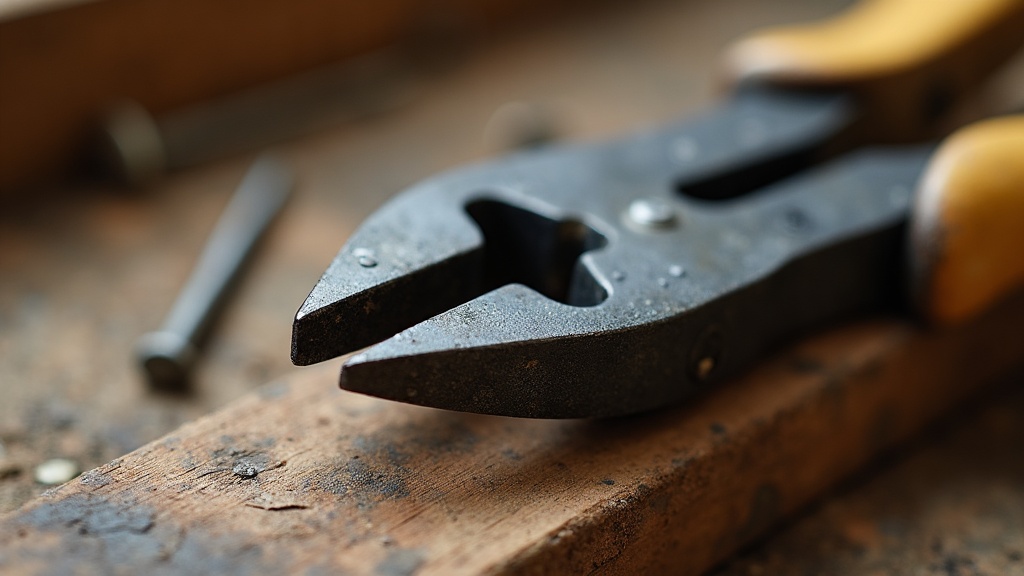
What are nippers, and how are they different from both?
Nippers are dedicated cutting tools with two sharpened edges that meet along their full length when closed, and no flat gripping face at all. Diagonal cutters, end nippers and side cutters are all variations on the same idea: shear through wire, nail shanks or small fasteners cleanly, rather than grip or lever anything.
The jaw shape is the giveaway. Where pliers have a flat or serrated section built for holding, and pincers have a rounded jaw built for rocking, nippers have a sharpened V that closes fully shut with almost no gap. That full closure is what lets them shear through material rather than just crush or bend it.
Common uses include:
- Cutting wire, cable ties or small-gauge fencing to length
- Trimming a nail shank flush after driving, particularly in fine woodwork or upholstery
- Snipping off proud fixings, staples or excess solder wire
- Cutting plastic or nylon fasteners cleanly without crushing them
Because the cutting edges are hardened and ground fine, nippers are a poor substitute for pliers when a job needs a firm grip rather than a clean cut — the edges will mark or bite into softer material instead of holding it steady. And they are not built to rock against a nail head the way pincers are; there is no curved fulcrum surface to lever against.
Can one tool replace the other two?
Not reliably. Each tool’s jaw geometry is matched to one mechanical action — gripping, rocking leverage, or shearing — and using the wrong shape for the job usually means more force, more slipping, and a higher chance the tool or the fastener moves unexpectedly.
A combination pliers’ built-in cutter can handle occasional light wire work, so a lot of home workshops get by without owning nippers at all. But asking pliers to pull a flush nail, or asking pincers to hold a nut, is asking the tool to do a job its jaw was never shaped for. The failure mode is usually a slip rather than a break, which is still enough to pinch a finger or send a small fastener flying.
Cutting operations, in particular, throw off small metal fragments. Eye protection is worth having on hand whenever nippers or a pliers’ cutting notch are doing the actual shearing, not just when a power tool is involved.
How do you choose between them for a home workshop?
Think about what the jaws need to do most often: hold and bend, pull fasteners, or cut cleanly. Buy the tool whose jaw shape matches that action, rather than picking by size or handle comfort alone, and check that the jaw opening suits the fastener sizes actually used in the workshop.
A few things are worth comparing before buying any of the three:
- Jaw hardening and finish — cutting edges that are properly hardened stay sharp longer under repeated use; softer edges dull quickly on hardened nails or wire
- Pivot type — a solid riveted pivot tends to stay tight, while a loose or worn pivot lets the jaws twist sideways under load, which is where slips happen
- Handle length relative to jaw size — longer handles give more leverage for pulling or cutting, useful for pincers and heavier-duty nippers especially
- Jaw taper — a thinner taper on pincers reaches under low nail heads more easily, but a very fine taper can flex or chip on harder fasteners
None of these are numbers a marketing spec sheet reliably standardises, so it is worth handling the tool, checking the jaw meets cleanly with no visible gap when closed, and confirming the pivot has no side-to-side play before buying.
For a broader look at how to weigh up specifications on any hand tool before spending money, the buying a tool guide covers what actually matters versus what is just marketing. The how tools actually work hub is a good starting point for understanding hand tool mechanics more generally, and the full hand tools archive covers related bench tools in the same kind of plain-language detail.
Do pliers, pincers and nippers need any safety gear?
Yes — cutting wire or nail shanks with pliers or nippers can send small metal fragments flying, and pulling stuck fasteners with pincers can cause a sudden slip. Eye protection is sensible for both, and a firm grip on the workpiece reduces the chance it jumps free under load.
These are hand tools, not powered ones, so the ear protection and dust concerns that apply to saws or sanders do not really come into play here. But the same rule that applies across the workshop still holds: any operation that can throw off a fragment, however small, is worth doing with eyes covered. The safety and PPE archive has more on matching protective gear to the actual hazard a task presents, rather than treating all PPE as interchangeable.
For readers comparing hand tools against powered alternatives for similar jobs — cutting wire mesh with power shears versus hand nippers, for instance — the comparisons archive and the power tools archive cover where a powered tool earns its keep and where a simple hand tool remains the better choice. For general guidance on choosing between tool categories for a home workshop, the buying guides archive is worth browsing as well.
Find Tool publishes general information, not professional advice. Power tools, mains electricity and workshop machinery are genuinely dangerous, and the safe settings, guards and procedures differ between models — always follow the manual and the markings on the tool in front of you rather than a general guide. Never remove or defeat a guard or safety feature. Anything involving fixed wiring, gas or structural work belongs to a qualified tradesperson. Wear the eye, ear and respiratory protection the task calls for.
Related reading
Rasp vs File: What’s the Real Difference?, What Is a Spokeshave Used For? A Plain-Language Guide, What Is a Mallet For If You Already Own a Hammer?.
Featured image: Photo by R. Henrik Nilsson, source, CC BY 4.0
