The numbers stamped on a hand plane are a sizing system, not a performance rating. A low number such as No. 3 or No. 4 marks a shorter, lighter plane built for fine smoothing. A high number such as No. 6 or No. 7 marks a longer plane built for flattening and jointing long edges.
Where does the plane numbering system come from?
The numbering most hobbyists run into traces back to a 19th-century American toolmaker’s catalogue, which grouped bench planes by size and gave each size a number. Other manufacturers copied the scheme closely enough that it became a rough industry shorthand, even though it was never an official standard the way a thread pitch or a drill bit gauge is.
That matters because it means the number tells you roughly where a plane sits in the family — smoother, general-purpose jack, or long jointer — rather than a precise, guaranteed measurement you can rely on across every brand.
What does a bigger number actually change about the plane?
A bigger number generally means a longer, heavier plane. Length changes how the sole reacts to an uneven surface: a long sole bridges high spots and won’t dip into every hollow, which is exactly what you want when trying to true up a long edge or a door stile. A short sole follows the contour of the wood more closely, which suits following a slightly curved surface or doing fine finishing work where the board is already close to flat.
Weight follows length too. A longer plane carries more momentum through the cut, which can make long, continuous strokes feel steadier, but it also takes more effort to control and to lift repeatedly.
What do the size groups mean in practice?
Roughly speaking, the numbered bench plane family splits into three jobs rather than eight separate tools:
- Smaller numbers are smoothing planes — the last plane used before finishing, taking thin shavings to leave a clean surface.
- A mid-size number is the general-purpose “jack” plane — the one most hobbyists reach for first because it handles rough stock removal and light smoothing reasonably well.
- The largest numbers are jointer or fore planes — long enough to true a board edge or flatten a wide panel without following every dip in the wood.
None of these is a “better” plane than the others. They are different tools for different stages of the same job, similar to how choosing between a claw hammer and a framing hammer comes down to the work in front of you rather than one being an upgrade on the other.
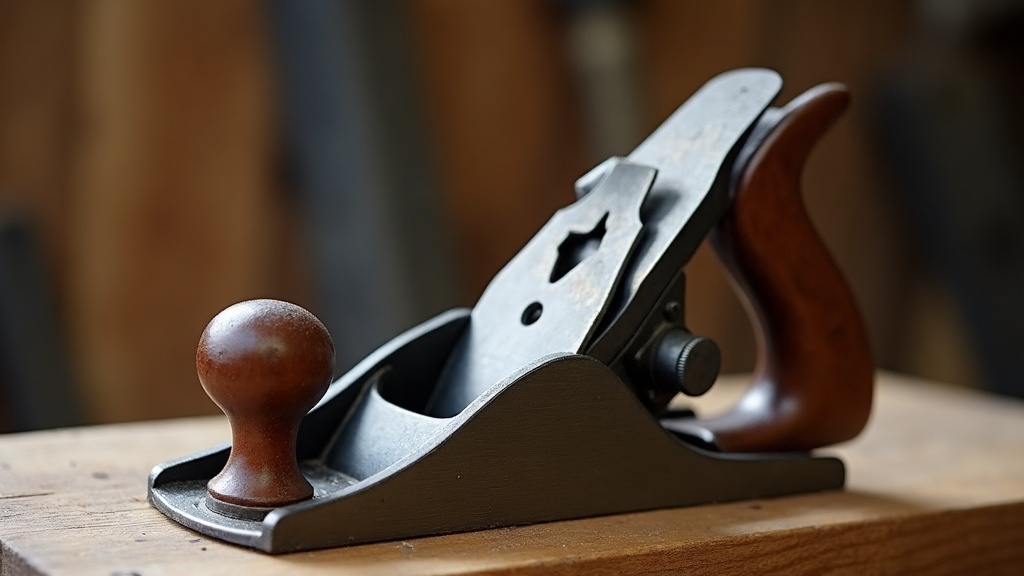
What does the blade (iron) width tell you?
Blade width scales with plane size and sets how much of the board the edge covers in one pass. A wider iron removes more material per stroke but needs more force to push through the cut. A narrower iron is easier to control and is common on smaller smoothing and block planes, where fine control matters more than coverage.
Blade steel type is a separate spec from width. It affects how long an edge holds before it needs honing and how it behaves on the sharpening stone, but it doesn’t change what the number on the plane’s body means.
What does the frog and mouth opening adjust?
On a bench plane, the frog is the part that holds and angles the blade, and it can usually be shifted slightly forward or back. Moving it changes the size of the mouth — the gap in the sole just ahead of the cutting edge. A narrower mouth supports the wood fibres closer to the cut and tends to reduce tearout on fussy grain, taking a fine shaving. A wider mouth clears thicker shavings more easily when removing stock quickly.
These are adjustments made by feel and by testing a cut, not settings with a fixed correct number. If your plane came with instructions from the maker on frog position or depth adjustment, follow those rather than a generic rule, since geometry varies between models.
What’s the difference between a bench plane, block plane and jointer plane?
These are different families rather than different sizes of the same tool:
- Bench planes are the numbered family described above, held with the blade bevel down, used mostly on long grain.
- Block planes are small, one-handed planes with the blade set at a low angle and bevel up, useful for end grain, chamfers, and quick trimming.
- Jointer planes are simply the largest bench planes, named for the job of jointing (truing) a long edge, most often before glue-up.
Power tools solve some of the same problem differently — a benchtop planer or jointer removes material and flattens stock much faster with a rotating cutter. The comparison of how a planer differs from a jointer is worth reading if you’re deciding whether a hand plane or a machine suits your workflow better.
Does a higher number mean a “better” or more expensive plane?
No. Size is chosen for the task, not for quality. A No. 7 jointer isn’t a superior version of a No. 4 smoother — it’s built for a different stage of the work and is often too large and heavy for fine finishing.
Price differences within a size come from the flatness and machining of the sole, the steel used in the blade, the fit and adjustability of the mechanism, and the materials used in the handle and body — not from the printed number itself.
How do plane numbers compare across brands?
Not every manufacturer applies the numbering scheme identically, and dimensions can drift between makers even when the number matches. Two planes both labelled with the same size number can differ in sole length, blade width, or weight.
Because of that, it’s worth treating the number as a starting point rather than a full specification. The broader hub on choosing tools and reading specifications covers this pattern generally — numbers and model names are a shorthand, and the real comparison happens at the level of actual measurements. The comparisons archive and buying guides archive are useful if you’re cross-shopping specific tools rather than categories.
What should you compare when choosing a hand plane?
Rather than shopping by number alone, compare:
- Intended job — smoothing, general stock removal, or jointing a long edge.
- Sole length and flatness — a longer sole needs to actually be flat to do its job; a warped sole undermines the whole point of a jointer plane.
- Blade width and steel — wider takes more effort per pass; steel type affects sharpening frequency, not the number.
- Weight and balance — how the plane feels held and pushed matters more than any spec sheet figure.
- Adjustability — how easily the depth and mouth can be fine-tuned once you’re using it.
The general framework for reading tool specifications on the hand and power tool guide hub applies here too: work out what a number actually controls before treating it as a reason to buy.
What matters for safety when using or sharpening a plane?
A hand plane has no motor and no guard to consider, but two parts of the process still need care. Sharpening on a bench grinder or power honing wheel throws sparks and fine metal filings, so eye protection is worth wearing during that step. Planing hardwood or MDF for any length of time produces fine dust that’s worth managing with basic respiratory protection and, where possible, working near an open window or dust extraction.
The workpiece itself also needs to be secured — in a vice or with bench dogs and clamps — before pushing a plane across it. An unsecured board can shift under the sideways pressure of a plane stroke, which is a control problem worth solving with better clamping rather than working around it. The safety and PPE archive covers dust and eye protection basics that apply just as much to hand tool work as to powered machinery.
Where do power planers and jointers fit in?
For anyone doing this regularly, a power jointer or thickness planer removes far more material per pass and is worth comparing once hand-plane work starts feeling slow for the volume of boards involved. The power tools archive is a reasonable starting point for that side of the decision, alongside the direct planer-versus-jointer comparison linked above.
For most home workshops doing occasional smoothing, edge jointing, or trimming, understanding what the number on a hand plane actually changes — length, weight, blade width, and mouth setting — is enough to pick the right one for the job in front of you, rather than chasing a bigger number as if it were an upgrade.
Find Tool publishes general information, not professional advice. Power tools, mains electricity and workshop machinery are genuinely dangerous, and the safe settings, guards and procedures differ between models — always follow the manual and the markings on the tool in front of you rather than a general guide. Never remove or defeat a guard or safety feature. Anything involving fixed wiring, gas or structural work belongs to a qualified tradesperson. Wear the eye, ear and respiratory protection the task calls for.
Related reading
What Does a Screwdriver’s Tip Type Actually Change?, Pliers vs Pincers vs Nippers: What’s the Real Difference?.
Featured image: Photo by Giles Laurent, source, CC BY-SA 4.0
