The fixing decides itself once you know two things: how much holding power the joint actually needs, and whether it ever has to come apart. Nail guns win on speed and are forgiving on thin trim; screws win on strength, adjustability and anything load-bearing or removable. Most jobs use both, in different places.
What is actually different between a nail and a screw?
A nail holds by friction and the slight crush of wood fibres gripping its shank. A screw holds by a threaded spiral biting into the material and pulling two surfaces together as it is driven. That single difference explains almost every trade-off between them.
Nails go in fast and leave a smaller, less visible hole, but they resist being pulled straight out much better than they resist being levered sideways. Screws resist both directions better because the thread is mechanically locked into the timber, not just wedged into it. That is why a screwed joint generally holds more load for its size, and why it can be removed and reused without destroying the piece around it.
When does a nail gun actually win?
A nail gun wins on speed, on repetition, and on jobs where the tiny extra strength of a screw is not the point. It also avoids the risk of splitting thin trim, because a nail displaces less material than a screw thread does.
Typical wins for a nail gun include:
- Fixing skirting, architrave, quarter-round and other trim where the nail is mostly holding the piece against glue, not carrying structural load.
- Building sub-assemblies quickly, such as stud walls or timber frames, where a large number of fixings need to go in fast and the joint will be reinforced elsewhere.
- Fine finish work like picture frame moulding, where a small nail head can be filled almost invisibly and a screw head could not.
- Sheathing and underlayment, where an even pattern of fast fixings matters more than the pull-out strength of any single one.
A nail gun’s real advantage is throughput. One trigger pull replaces marking, drilling and driving. That is worth a lot on a long run of trim or a full sheet of subfloor, and much less on a single joint that needs to hold real weight.
When do screws win?
Screws win whenever a joint needs to be strong, adjustable, or reversible. A screw can be tightened to draw two parts hard together, backed out to make an adjustment, and removed cleanly if the piece needs to come apart later.
Screws are the better choice for:
- Anything that carries ongoing load — shelving, cabinet carcasses, worktop brackets, deck boards underfoot.
- Furniture and cabinetry that may need to be disassembled for moving or repair.
- Hinges, hardware and fittings, where the fixing has to resist being worked loose by repeated movement.
- Joints where clamping force matters — pulling two boards tight against each other rather than just pinning them in place.
A screw’s thread also gives it something a nail cannot offer: a known, repeatable grip that improves with a longer or coarser thread in soft material, and a finer thread in hardwood or manufactured board. Choosing the right screw for the material is its own small skill, and it is covered in more detail on our tool guide hub, which explains how fasteners, drivers and drill bits actually interact.
Does a nail gun or a screw split the wood more?
A screw is more likely to split thin or brittle timber near an edge because its thread displaces material as it advances. A nail gun’s smooth-shanked nail is generally gentler on thin stock, which is one reason trim carpenters lean on nailers for delicate moulding.
Splitting risk goes up near the end of a board, in dense hardwoods, and with anything close to the edge. The usual fix for a screw is a pilot hole sized to the screw’s shank, which lets the thread bite without wedging the fibres apart. For a nail gun, the equivalent care is choosing a nail size and angle that suits the moulding, and letting the tool’s depth setting — set according to its own manual — control how far the head sinks rather than forcing it.
Drilling a pilot hole by hand or with a driver is its own small decision, and knowing why a bit stops cutting cleanly through hardwood is useful background before starting a run of screws — see what actually dulls a drill bit for that.
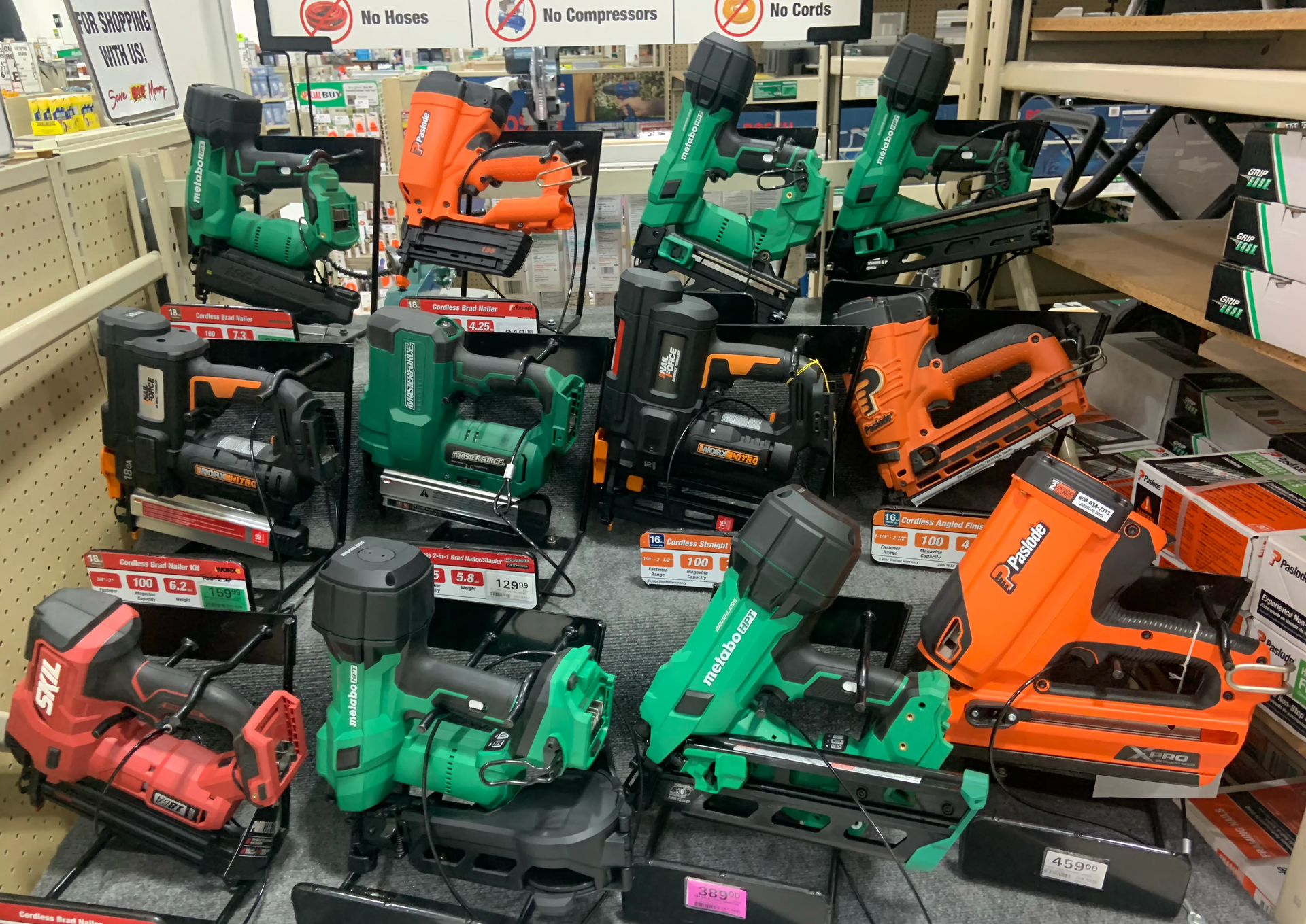
Is a nail gun safe to use in a home workshop?
A nail gun is safe when it is used the way its manual describes: with the safety contact tip engaged against the workpiece, hands kept clear of the line of fire, and the tool disconnected from its air supply or battery whenever it is not actively being used. It is not a tool to point at anything other than the material being fixed.
Fasteners can ricochet off a knot or a hard edge, and a misfire can eject a nail unexpectedly, so eye protection is not optional for anyone operating or standing near a nailer — see what an eye protection rating actually covers. If the nailer is run from a compressor or is a gas-actuated model used for any length of time, the combined noise of the compressor and the tool can be sustained and loud enough to need hearing protection too; this guide to noise levels explains what “sustained and loud” actually means in practice.
Many nail guns also rely on a sequential or bump-fire trigger mechanism and a spring-loaded contact safety, which is a form of dead-man switch design — the tool will not fire unless both the trigger and the tip are actively engaged. Understanding what that mechanism is protecting against is worth five minutes before first use; see what a dead-man switch actually does. None of these features should ever be taped down, bridged, or otherwise worked around — if a cut or a fixing feels awkward with the safety engaged, the answer is a different angle, a jig, or a different tool for that joint, not a workaround.
The manual for a specific nailer will state its own depth-of-drive adjustment, recommended fastener range and air pressure or battery requirements. Those figures vary by model and by the material being fixed, so they belong in that document, not guessed at.
What about structural fixings — joists, load-bearing walls, decking framework?
Anything that carries structural load — joist hangers, load-bearing stud walls, deck framing, roof members — is governed by building codes that specify fastener type, spacing and pattern for a reason. That is a decision for a qualified tradesperson or the relevant building authority, not a judgement call between a nail gun and a screw box.
For non-structural work — trim, furniture, shelving, garden projects — the choice sits with the person doing the job, guided by the trade-offs above. The line between the two is worth respecting: a fixing that looks fine on the day can become a safety problem years later if it was never rated for the load it is carrying.
How should the two be compared before buying either?
Buying a nail gun or a set of screwdriving gear is really a question of what kind of jobs come up most often in a given workshop, not which tool is objectively “better.” A cordless finish nailer earns its keep on a house full of trim; it sits idle in a shop that mostly builds furniture from screwed joints.
Worth comparing before spending money:
- How often the work involves long, repetitive runs (nailer territory) versus individual joints needing strength or adjustment (screw territory).
- Whether the nail gun runs on a compressor, gas cartridge or battery — each changes the running cost and the noise profile, covered in corded vs cordless: what actually decides it.
- Whether an impact driver or drill driver already covers most screw work, since the two tools are not interchangeable for every fastener — see impact driver vs drill driver: what each is better at.
- How the marketing numbers on either tool translate into real use, rather than taking them at face value — which tool specifications are marketing, not useful is a useful check before comparing models.
For a broader look at how to weigh up any power tool purchase against the jobs actually planned, the buying tools hub and the wider power tools archive cover the specifications that matter and the ones that do not. For fasteners, drivers, and the hand-tool side of the equation, the hand tools archive is the better starting point, and general workshop safety practice is covered across the safety and PPE archive.
In the end, the fixing rarely needs a debate. Ask what the joint has to resist — pulling apart, being levered sideways, or coming undone for a future repair — and the answer between a nail gun and a screw usually falls out on its own.
Find Tool publishes general information, not professional advice. Power tools, mains electricity and workshop machinery are genuinely dangerous, and the safe settings, guards and procedures differ between models — always follow the manual and the markings on the tool in front of you rather than a general guide. Never remove or defeat a guard or safety feature. Anything involving fixed wiring, gas or structural work belongs to a qualified tradesperson. Wear the eye, ear and respiratory protection the task calls for.