A mitre saw is built to cut a board across its width, quickly and at a controlled angle — skirting, mouldings, framing. A table saw is built to cut a board along its length, holding a straight edge over a long run — ripping stock to width or breaking down sheet material. They solve different shapes of problem, and most home workshops eventually need both.
What does a mitre saw actually do?
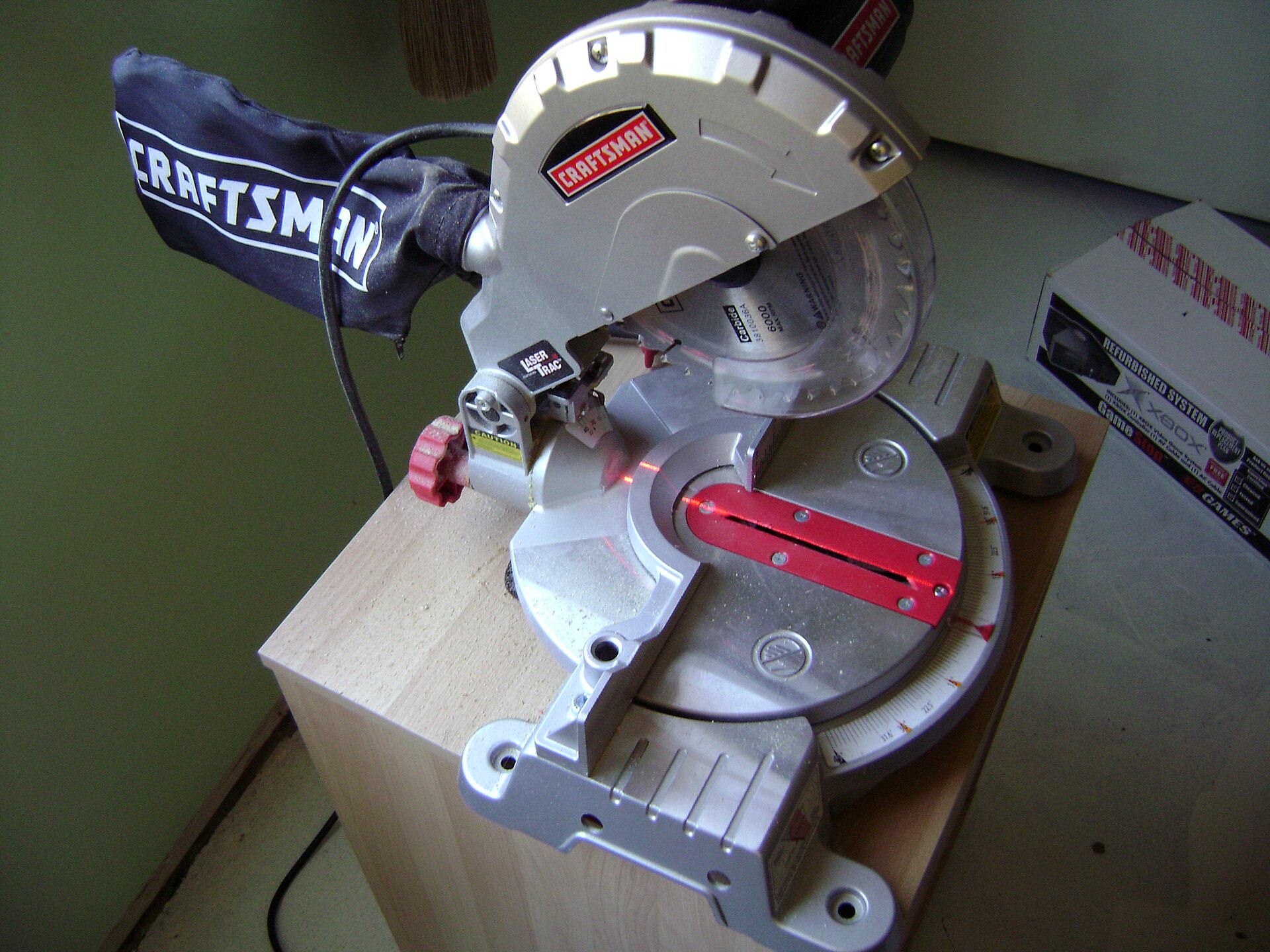
A mitre saw takes a board, holds it against a fence, and brings a spinning blade down through it at a set angle. It answers one question well: “how do I cut this piece off cleanly, at this angle, in a repeatable way?”
That makes it the natural choice for crosscuts — cuts across the grain, at the end of a board — especially where several pieces need to match. Skirting board, architrave, picture frames, deck joists cut to length, stud walls: anywhere a stack of boards needs the same angle and the same length, a mitre saw earns its bench space.
The blade travels down (and often forward and back, on a sliding model) rather than the workpiece moving through the blade. The board stays still and the tool does the moving, which is part of why mitre saws feel approachable to newer users — there’s no feed rate to judge, just a controlled downward cut.
What does a table saw actually do?
A table saw flips the arrangement: the blade stays fixed, spinning up through a slot in a flat table, and the workpiece is pushed past it against a fence. It answers a different question: “how do I cut this board to an exact width, or break down a full sheet, with a straight edge the whole way along?”
That’s ripping — cutting along the length or grain of a board — and it’s a job a mitre saw cannot do safely or accurately at any real length. A table saw’s fence gives a consistent reference the entire way through the cut, which is what makes it the right tool for turning a rough board into a set of matching strips, or a sheet of plywood into panels.
A table saw’s fixed table and rip fence also make it the better choice for repeat cuts of identical width across many pieces — cabinet sides, shelving, drawer parts — where a mitre saw’s cutting geometry simply doesn’t apply.
Which one handles crosscuts on long stock better?
The mitre saw does, for anything short enough to fit under its fence and support. Once a board gets long — a full-length skirting run, a wide panel — a table saw’s crosscut sled or mitre gauge can still manage it, but supporting the offcut and the remaining length safely becomes the harder part of the job, and that’s where a mitre saw with extension supports is simply easier to set up correctly.
For angled crosscuts specifically — 45-degree mitres on a frame, compound angles on crown moulding — the mitre saw’s pivoting head and (on compound models) tilting head are purpose-built for exactly that, in a way a table saw’s mitre gauge only approximates.
Which one handles ripping boards to width better?
The table saw, without much competition. Its rip fence stays parallel to the blade for the full length of the cut, which is what keeps a long rip straight. A mitre saw has no equivalent fence running the length of a rip cut and isn’t designed to attempt one.
This is also where a table saw’s riving knife earns its keep — it sits behind the blade to help stop the two freshly cut faces of the wood from pinching back together and grabbing the blade, which is one of the main causes of kickback on a rip cut. Whether the riving knife on your machine is correctly fitted and adjusted is worth checking against the manual before any ripping session; see what a riving knife does and why it isn’t optional.
A push stick belongs in the same conversation. Ripping narrow strips means hands get close to the blade as the cut finishes, and a push stick keeps fingers well clear of that zone while still giving control over the workpiece — see what a push stick is and why it matters so much. An anti-kickback pawl, where a machine has one, is a separate line of defence against the workpiece being thrown back at the operator; what an anti-kickback pawl does covers how that works.
Can either tool do the other’s job?
Not comfortably, and not by any means that involves working around a fitted guard. A mitre saw can be pushed into rough rip cuts with jigs in a pinch, but it wasn’t designed for the sustained, straight-line feed a rip needs, and the results show it. A table saw can crosscut short pieces using a mitre gauge or a crosscut sled, and plenty of workshops do exactly that for smaller parts — but for long runs of matching angled crosscuts, a mitre saw is faster to set and repeat.
The honest summary: a mitre saw is a crosscut specialist, a table saw is a rip and sheet-breakdown specialist, and the overlap between them is narrower than either tool’s marketing suggests.

What about sheet goods like plywood or MDF?
A table saw with a good fence and outfeed support handles full sheets more predictably than a mitre saw ever could — a mitre saw’s throat simply isn’t built to take a 2400mm sheet. For anyone who breaks down sheet goods regularly without a table saw, a track saw is the other realistic option, and the trade-offs between that and a fixed saw are covered in circular saw vs track saw: what actually changes.
MDF in particular throws up very fine dust that behaves differently from softwood sawdust in the lungs, and it’s worth understanding that difference before spending long sessions cutting sheet material on either machine — see why MDF dust is treated differently from softwood dust. A well-fitted dust extraction port on either saw, connected to a shop vacuum or extractor, makes a real difference to what actually reaches the air around the operator.
Which is safer for a home workshop?
Neither tool is inherently safer — each carries different risks tied to how it’s used. A mitre saw’s blade is exposed briefly during the downward cut and the main risks are hand placement and the blade’s momentum on the way back up. A table saw’s blade is exposed continuously above the table, and its main risks involve kickback and hands travelling too close to the blade during a rip.
Both throw dust and both are loud over a full session. Eye protection matters on both — offcuts, dust and the occasional thrown chip are common to each — and the standard that eye protection is actually rated to is worth understanding rather than assumed; see what an eye protection rating actually means. Hearing protection matters too, particularly on longer cutting sessions; what noise level makes ear protection necessary explains where that threshold generally sits. On both tools, all fitted guards, riving knives and interlocks should stay in place and adjusted as the manual describes — they’re doing a specific job on each machine, not an optional add-on.
What blade should each tool use?
The blade drives most of the cut quality on either saw, and tooth count is one of the biggest factors — more teeth generally give a smoother finish and are better suited to crosscuts and sheet goods, fewer teeth clear material faster and suit ripping. What tooth count on a saw blade changes covers that trade-off in more detail, and it applies to both mitre saw and table saw blades. The manual for each specific machine will state the correct blade diameter, arbor size and maximum RPM — that always overrides general advice, since fitting the wrong blade to either tool is a real hazard, not a minor mismatch.
What should you compare before buying either?
Table capacity, fence quality and dust collection tend to matter more in daily use than headline power figures. For a mitre saw, check the maximum crosscut width and whether it slides (sliding heads reach wider boards but need more bench depth behind them). For a table saw, check the rip capacity to the right of the blade, the table size, and whether the fence locks parallel reliably — a fence that drifts out of parallel undermines every rip cut made on it.
General guidance on reading specifications without being swayed by numbers that don’t matter in practice is covered in the buying tools guide, and the wider category of comparisons between tool types sits in the comparisons archive.
Do you actually need both?
For anyone doing trim work, framing or repeated angled cuts, a mitre saw solves that on its own. For anyone building furniture, cabinets or anything from sheet stock, a table saw is close to unavoidable. Most home workshops that grow past occasional DIY end up with both, because the two problems — cutting across a board and cutting along one — don’t actually overlap as much as they first appear to.
Find Tool publishes general information, not professional advice. Power tools, mains electricity and workshop machinery are genuinely dangerous, and the safe settings, guards and procedures differ between models — always follow the manual and the markings on the tool in front of you rather than a general guide. Never remove or defeat a guard or safety feature. Anything involving fixed wiring, gas or structural work belongs to a qualified tradesperson. Wear the eye, ear and respiratory protection the task calls for.
Featured image: Photo by Ewen Roberts from San Diego, United States, source, CC BY 2.0