A pipe wrench is a hand tool with a hinged, serrated jaw built to grip round pipe and fittings rather than the flat faces of a nut or bolt. Its jaw is deliberately loose and angled so that turning force makes it clamp down harder — the more you push, the tighter it bites.
What exactly is a pipe wrench?
It is a heavy-duty wrench with two jaws — one fixed, one hinged — set at a slight angle to each other, both lined with hardened, angled teeth. Unlike a spanner or an adjustable wrench, it is not meant to grip a flat surface cleanly. It is meant to bite into a curved, often rough or corroded, cylindrical surface and hold on while you apply real turning force.
You will see it called a Stillson wrench in some catalogues and older toolboxes — that name comes from an early patented design and has stuck around as a near-generic term in some regions, much like “adjustable wrench” covers several actual designs.
Why is the jaw shaped like that?
The hinged upper jaw and angled teeth exist so the tool self-tightens under load instead of slipping off round stock. The harder you turn, the more the jaw pivots inward and digs the teeth into the pipe wall — grip increases with force rather than staying fixed.
Break that down into its parts:
- The hinge: the top jaw is not rigidly fixed to the body. It can rock slightly in its slot, adjusted by a knurled nut, which lets it seat against pipes of different diameters and then pull in tighter as torque is applied.
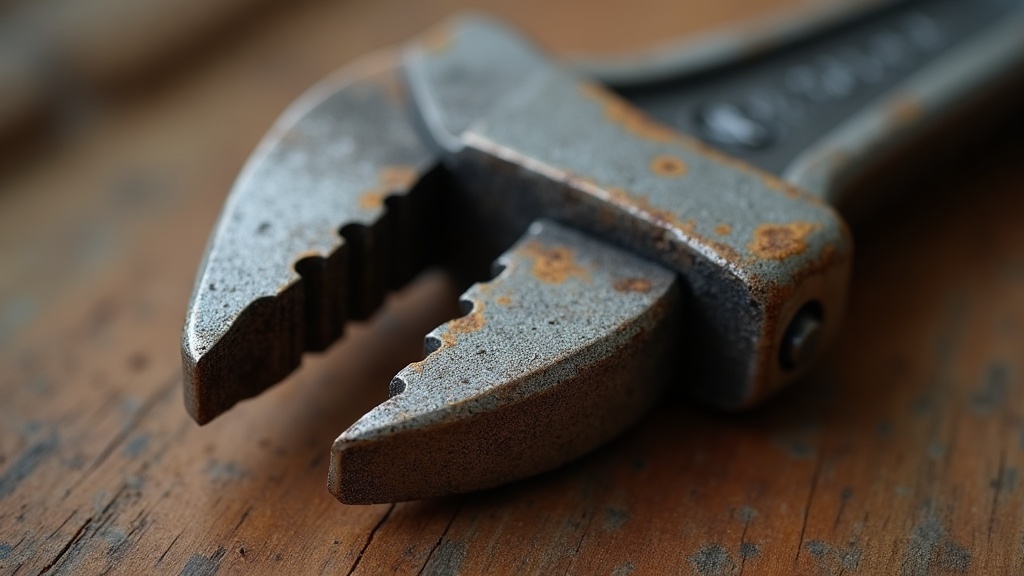
- The angled teeth: the serrations are cut on a diagonal, not straight across. That angle is what converts rotational force into an inward, biting pressure on the pipe surface rather than letting the jaws simply slide around it.
- The offset jaw faces: the two jaws are not parallel to each other the way a spanner’s faces are. That deliberate skew is what lets the tool clamp onto a curved surface at two points instead of trying to flatten it against a straight edge.
The result is a tool that behaves almost opposite to a spanner. A spanner is precision-fitted to one flat size and is meant to be gentle on the fastener’s finish. A pipe wrench is intentionally aggressive — it is built to mark, dent and bite into whatever it grips, because the priority is torque transfer on an awkward round shape, not cosmetic protection.
What is a pipe wrench actually used for?
It is used for gripping and turning round pipe, pipe fittings, and rounded or damaged fasteners that a spanner or socket cannot get a clean purchase on. Its main home is plumbing and general pipework, not fine fastener work.
Typical jobs include:
- Turning galvanized or black steel pipe and fittings during general plumbing or heating work.
- Holding one section of pipe steady while another wrench turns a connected fitting.
- Gripping a rounded bolt head, rusted nut, or corroded fixture that a spanner just slips over.
- Removing or fitting rigid pipe in workshop, garden, or outbuilding plumbing where the surface is round rather than hexagonal.
It is a poor substitute for a proper spanner or socket on ordinary nuts and bolts. Because the teeth are designed to bite and mark, using a pipe wrench on a fastener you care about the finish of — a chrome fitting, a decorative nut, anything plated — will usually leave visible tooth marks. For that kind of fastener work, a fitted spanner or socket is the right call; see the comparison of metric versus AF spanner sizing for how those are actually matched to a fastener.
Do pipe wrenches come in different sizes, and does it matter?
Yes — pipe wrenches are sized by overall length, and length roughly determines both the jaw capacity (the largest pipe diameter it can open onto) and the leverage available. A longer wrench opens wider and gives more turning force for the same hand effort.
This is worth thinking about before buying rather than after. A wrench too small for the pipe in front of you will not open wide enough to bite properly, and a wrench too large is clumsy and hard to control in a tight space under a sink or behind a radiator. Manufacturers publish a jaw capacity figure for each length, and that figure — not the handle length alone — is the number to check against the actual pipe or fitting diameter you are working with.
Two wrenches are also frequently used together: one holding a fitting steady, a second turning the connected pipe. If that is the kind of job ahead, it is worth having two wrenches rather than trying to improvise with a single tool and a makeshift second grip.
Is a pipe wrench the same as an adjustable wrench?
No. An adjustable wrench has smooth, parallel jaws meant for flat-sided fasteners like hex nuts and bolt heads. A pipe wrench has angled, serrated, self-tightening jaws meant for round pipe, and it will damage a flat fastener’s finish if used the same way.
The confusion is understandable because both look like a single adjustable-jaw tool with a worm screw for opening and closing. But the jaw geometry tells the real story: flat and smooth means it is meant for hex shapes, angled and toothed means it is meant to bite round stock. Reaching for the wrong one is a common beginner mix-up — grabbing a pipe wrench because it is the biggest thing in the toolbox, when a fastener actually calls for a properly sized spanner or socket. The broader logic of matching a gripping tool to the shape it is meant for comes up again in the comparison of pliers, pincers and nippers, where jaw shape again decides what a tool is actually good for.
Why does it leave marks, and is that normal?
Yes — tooth marks on the pipe surface are a normal and expected result of how a pipe wrench grips, not a sign of misuse. The hardened teeth are designed to dig in slightly so the jaw does not slip under load.
That is fine on structural pipe that will be hidden, painted over, or replaced, but it is not the tool to reach for on anything with a visible, plated, or cosmetic finish. If a job calls for turning something without marking it — a chrome tap connector, a polished fitting — a strap wrench or a padded jaw is the better choice, and if neither is available, it is worth stopping to find the right tool rather than forcing the pipe wrench onto a surface it will damage.
What should be checked before buying one?
The main things to compare are jaw capacity against the pipe sizes actually used at home, overall weight against how the tool will be handled in tight spaces, and jaw material and hinge quality, since these determine how well the tool holds up to repeated heavy use.
A few practical points worth weighing:
- Jaw capacity vs pipe size: check the manufacturer’s stated capacity range against the actual outside diameter of the pipe or fitting in question, not just a rough guess by eye.
- Weight and length: a longer wrench gives more leverage but is harder to swing in a cramped space like under a sink or inside a cupboard. Some ranges offer shorter, more compact frames aimed at tighter jobs at some cost to maximum leverage.
- Jaw and hinge construction: heavier-duty wrenches use hardened replaceable jaw inserts, which matters if the tool is going to see frequent use rather than the occasional job.
- Aluminium vs cast iron bodies: aluminium-bodied wrenches are lighter to swing but generally cost more for the same capacity; cast iron is heavier but often the more common choice for occasional home use.
None of these decide the “best” wrench — they decide which trade-offs fit the jobs actually likely to come up. The general logic of reading a spec sheet rather than a marketing headline is covered in more depth in the buying tools guide, and the hand tools archive has more on how gripping and turning tools are built for specific jobs.
What PPE and precautions apply to using one?
Eye protection is worth wearing whenever a pipe wrench is used to free a stuck or corroded fitting, since rust, scale, or paint flakes can come off under load, and a slipped wrench can send debris or the tool itself moving unexpectedly. Sturdy gloves help protect hands from the sharp, aggressive teeth and from pinch points at the hinge.
Because the tool relies on leverage, it is worth thinking through where hands and body will end up if the fitting suddenly gives way or the wrench slips — bracing against a stable surface and keeping the working area clear of anything that could be struck. On pipework connected to a live water or gas supply, or anything structural, that is a different category of job entirely: fixed plumbing and gas connections are governed by codes and are work for a licensed plumber or gas-safe engineer, not a DIY task with a wrench from the toolbox. If the job in front of you is that kind of connection rather than a freestanding length of pipe, that is the point to call in a professional rather than proceed.
For more on matching protective equipment to the actual hazard rather than a generic checklist, the safety and PPE archive covers this across different tools and tasks. General background on how hand tools are built and chosen sits in the tool guide hub, and broader comparisons between similar-looking tools are collected in the comparisons archive.
Find Tool publishes general information, not professional advice. Power tools, mains electricity and workshop machinery are genuinely dangerous, and the safe settings, guards and procedures differ between models — always follow the manual and the markings on the tool in front of you rather than a general guide. Never remove or defeat a guard or safety feature. Anything involving fixed wiring, gas or structural work belongs to a qualified tradesperson. Wear the eye, ear and respiratory protection the task calls for.
Related reading
What Is a Bench Hook? A Simple Woodworking Jig Explained.
Featured image: Photo by R. Henrik Nilsson, source, CC BY 4.0
