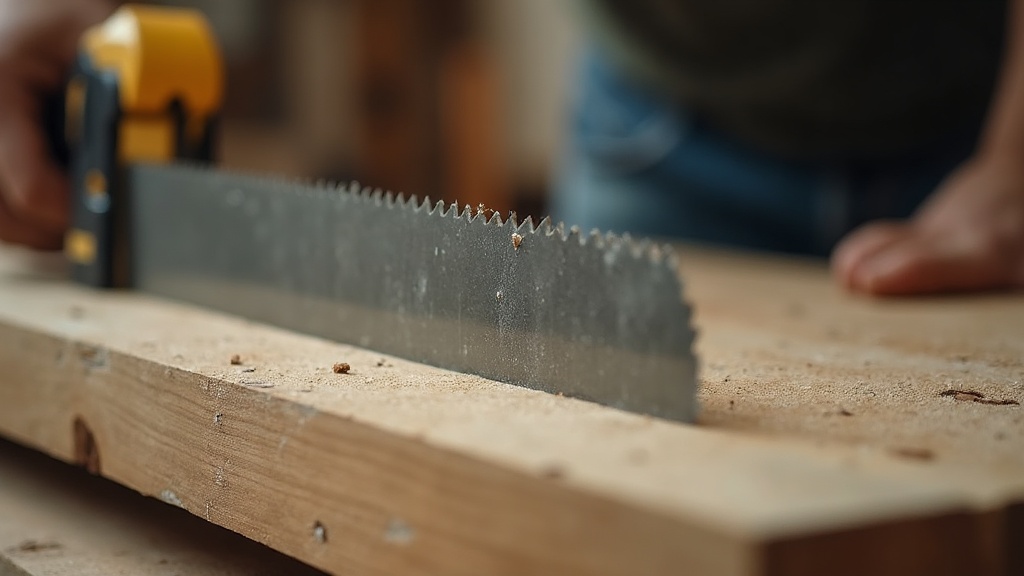
A Japanese pull saw cuts on the pull stroke instead of the push stroke, using a thin, hard, often disposable blade. Cutting on the pull keeps the blade in tension rather than compression, so it can be made thinner without buckling — which means a narrower kerf, less waste, and a cut that tends to track straighter with lighter effort.
What actually makes a pull saw different from a Western saw?
The core difference is which stroke does the cutting. A Western handsaw is pushed into the wood, so the blade has to be thick and stiff enough to resist buckling under that compression. A Japanese saw — often called by its family names, ryoba, dozuki or kataba — is designed to cut as it’s pulled back toward the body.
Because a blade in tension doesn’t need the same stiffness to stay straight, the steel can be ground much thinner. That thinner stock removes less material with every pass and needs less force to move through the wood, which is where most of the “it just cuts easier” feeling comes from.
The handle follows from the same logic. Most pull saws have a long, slim, often unfinished wooden or rattan-wrapped handle meant to be held loosely, letting the arm’s pulling motion do the work rather than a hard push grip.
Why does a thinner blade change the quality of the cut?
A thinner blade means a narrower kerf — the actual slot the saw removes — so less wood is turned into dust for the same cut, and there’s less resistance to fight through. That translates into finer, more controllable cuts, especially in joinery where a wide kerf would waste material or throw off a tight-fitting joint.
Thin steel does trade off some rigidity. Left unsupported or pushed instead of pulled, that same blade can flex or wander. That’s why technique matters here more than it does with a stiffer Western saw: light pressure, straight pulling strokes, and letting the tool’s own geometry do the guiding rather than muscling it through the cut.
The teeth themselves are usually filed differently too, often with a more aggressive rake angle suited to pulling, and on a ryoba-style blade there are two distinct edges — one ground for cutting with the grain (rip) and one for cutting across it (crosscut). That’s worth knowing before assuming any pull saw handles both jobs equally well; the same principle behind matching tooth pattern to task shows up in the difference between rip and crosscut saws generally.
Which jobs suit a pull saw best?
Pull saws are strongest at fine, controlled cuts where accuracy matters more than speed: dovetails, tenon shoulders, trimming dowels or plugs flush, and cutting delicate mouldings without tearing the surface. A dozuki, with its rigid spine along the top of the blade, is built specifically for that kind of precise joinery work.
A ryoba, with no spine and teeth on both edges, is more of a general-purpose bench saw — useful for rougher crosscuts and rip cuts in stock that’s too awkward or small for a powered saw. A kataba is a single-edge version of the same idea, often thinner and finer still, aimed at the most delicate trim and flush-cutting work.
What pull saws are not built for is heavy stock removal or rough carpentry framing. Pushing a thin blade hard through thick, dense material is exactly the situation it’s least suited to — that’s a job for a saw designed to cut under compression, or for a powered saw suited to the material’s thickness.
Do pull saws replace a powered saw in a home workshop?
No — a pull saw fills a different niche. It’s a hand tool for control, precision and quiet, single-piece work, not a substitute for the speed and repeatability of a powered saw on longer runs of material.
For straight repeat cuts in sheet goods or dimensional lumber, a circular saw or mitre saw will still get through the work faster and more consistently — see what a circular saw is genuinely good and bad at and what sliding actually adds to a mitre saw for how those tools are meant to be used. A pull saw earns its place alongside them for the fussy joinery and trim work that a powered blade struggles to finish cleanly.
Anyone building out a small hand-tool kit for joinery is usually weighing a pull saw against chisels and planes for the same fine-fit work — the logic behind how a chisel’s bevel angle affects the cut and what the numbers on a hand plane actually mean follows the same theme: geometry decided by the job, not by habit.
What should a buyer actually compare between pull saws?
The main things worth comparing are blade type (ryoba, dozuki, kataba), tooth configuration, and whether the blade is replaceable or meant to be sharpened. None of these has a single “better” answer — they trade off against the kind of cutting planned.
- Replaceable vs sharpenable blades: many affordable pull saws use hardened teeth that hold an edge well but can’t be resharpened, so the blade is swapped when it dulls. Traditional blades can be sharpened but need more care and skill to maintain.
- Blade length and depth: longer, deeper blades suit bigger stock; shorter, finer ones are easier to control in tight joinery.
- Tooth pattern: rip, crosscut, or a combination edge changes how cleanly the saw handles cutting with or across the grain — the same distinction covered in general terms for rip vs crosscut saws.
- Handle style: traditional wrapped handles flex slightly with the hand; some modern versions use rubber or composite grips, which changes feel more than function.
None of these decisions has a fixed “right” spec — they depend on the work planned, in the same way choosing between other saw types comes down to matching tool to task rather than chasing a headline number. The buying tools guide covers that kind of trade-off thinking in more general terms, and the comparisons archive is a useful place to see how other saw types stack up against each other.
What PPE and handling does a pull saw actually need?
Even though it’s hand-powered, a pull saw has a genuinely sharp, exposed blade, and off-cuts and fine wood dust are both real risks. Eye protection is worth wearing whenever cutting produces flying chips or dust, and a dust mask matters when working dry hardwood or repeated fine cuts that build up airborne dust.
Because the blade cuts on the pull, fingers and the supporting hand need to stay well clear of the path the blade travels toward the body — a stable clamp or bench hook holding the workpiece matters more here than with a push saw, since there’s no forward resistance to slow an unexpected slip.
Store the saw with the blade covered or sheathed when not in use; a thin blade this sharp left loose in a drawer is easy to catch a hand on without warning. The safety and PPE section covers this kind of everyday hand-tool handling in more depth, and the hand tools archive is a good next stop for how other traditional tools are built around the same push-or-pull cutting logic.
Is a pull saw worth adding to a home workshop kit?
For anyone doing fine joinery, trim work or flush-cutting by hand, yes — it does a job that powered saws and Western handsaws both do less cleanly. For rough carpentry or heavy stock removal, it’s the wrong tool for the job and a powered saw remains the better choice.
Like most hand-tool decisions, the answer comes down to the kind of cutting actually being done rather than which saw looks more capable on a shelf. The tool guide hub and buying guides archive are both good starting points for working out where a pull saw fits alongside the rest of a home workshop’s cutting tools.
Find Tool publishes general information, not professional advice. Power tools, mains electricity and workshop machinery are genuinely dangerous, and the safe settings, guards and procedures differ between models — always follow the manual and the markings on the tool in front of you rather than a general guide. Never remove or defeat a guard or safety feature. Anything involving fixed wiring, gas or structural work belongs to a qualified tradesperson. Wear the eye, ear and respiratory protection the task calls for.
Featured image: Photo by Tool Dude8mm, source, BY