Secateurs, loppers and a pruning saw are three sizes of the same job. Secateurs cut thin stems one-handed, loppers use long handles for leverage on thicker branches, and a pruning saw handles wood too thick or too hard for either. The right choice mostly comes down to branch diameter.
What is the actual difference between secateurs, loppers and a pruning saw?
The difference is capacity and mechanism, not brand or price. Secateurs are a hand-sized shearing tool for green growth and small stems. Loppers are the same shearing action on longer handles, giving enough leverage to cut branches too thick for one hand. A pruning saw abandons shearing altogether and cuts with teeth, for wood that would crush or jam a blade instead of slicing cleanly.
Trying to force a job up or down this ladder is where most problems start — secateurs strained past their limit splay open or snap a spring, and loppers pushed onto genuinely thick wood either stall mid-cut or slip off at an angle. Matching the tool to the branch is the whole trick.
What are secateurs actually for?
Secateurs are for stems and small branches a hand can close around comfortably — soft new growth, roses, most perennial stems, and thin woody growth up to roughly finger thickness. They are the tool used most often in an ordinary garden, because most pruning is on that scale.
There are two common mechanisms, and the difference matters:
- Bypass secateurs use two curved blades that slide past each other, like scissors. They give a clean cut on living wood and are the usual choice for anything you want to keep growing well.
- Anvil secateurs have a single blade that closes onto a flat plate. They crush slightly rather than slice, which suits dead or dry wood but can bruise live stems.
Either type needs a keen edge to work properly. A blade that has gone dull tends to squash the stem instead of parting it, which leaves a ragged wound that heals more slowly. Sharpening a secateur blade is a small job that pays off quickly — the difference between honing and full sharpening is covered in more detail on the site’s hand tools section if that distinction is unfamiliar.
What are loppers for, and when do secateurs stop being enough?
Loppers are for branches too thick to close a hand around, roughly thumb to wrist thickness depending on the model and the wood. The long handles convert arm movement into much more force at the blade than secateurs can generate, without straining the wrist.
The trade-off is size and weight. Loppers are slower to use, awkward in tight shrubs, and overkill for anything secateurs would manage in one snip. They earn their place on thicker, woodier growth — the base of an overgrown shrub, a hedge branch that has got away, or the kind of stem that makes secateurs feel like they are being levered rather than closed.
Like secateurs, loppers come in bypass and anvil versions, and the same logic applies: bypass for a cleaner cut on living wood, anvil for tougher or deadwood where a crush cut is acceptable. Some loppers add a ratchet mechanism that takes several smaller bites to complete one cut, which increases the effective capacity of the tool without needing longer handles or more hand strength.
Why not just use loppers on everything, since they cut more?
Loppers cut more diameter, but not more cleanly, and not more safely. Pushed onto wood near the top of their stated capacity, the blades can slip sideways instead of closing straight through, and the branch can spring back once it separates. That is a normal characteristic of the tool at its limit, not a fault — the answer is to move up to a saw rather than force the cut.
There is also a control issue. A pruning saw lets the branch be supported and the cut finished in a controlled, straight-line motion. Loppers at full capacity are working against spring-back and leverage limits at the same time, which is harder to keep steady, particularly overhead.
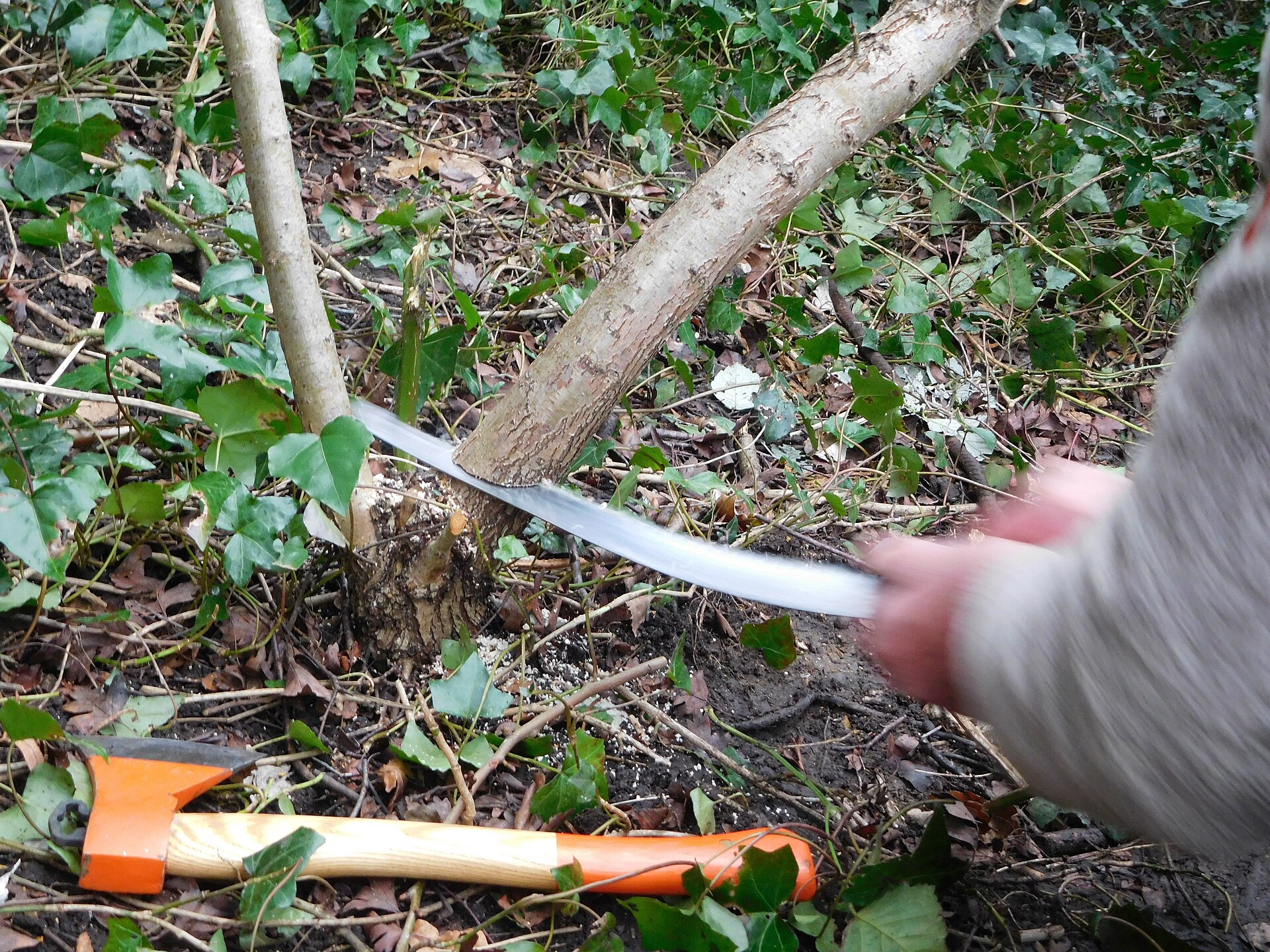

What does a pruning saw do that loppers can’t?
A pruning saw cuts branches thick enough that shearing blades would bind, twist, or simply fail to close. Rather than squeezing through the wood, the coarse, aggressively raked teeth are pulled and pushed through it, removing material with each stroke the way any hand saw does.
Pruning saw teeth are shaped differently from a general carpentry saw. They are usually set to cut mainly on the pull stroke, coarser than a joinery saw, and designed to clear damp, resinous sawdust without clogging — green wood behaves very differently under a blade than dry timber does. The number of teeth per inch and the tooth pattern change how aggressively the saw cuts and how smooth the resulting face is; what tooth count on a saw blade changes applies to pruning saws as much as any other kind.
Folding pruning saws are common for general garden use and store safely closed. Fixed-blade versions on a pole extend reach into a tree canopy without a ladder, which is worth comparing against just using loppers on a longer handle — reach and cutting mechanism are two separate decisions.
How do you decide which one a particular branch needs?
Diameter is the main test, but wood type and position matter too:
- Thin, green, flexible — secateurs, ideally bypass for a clean cut.
- Thicker, woody, still within one hand’s grip using leverage — bypass loppers.
- Thick, dry, or awkwardly angled wood that loppers can’t close through cleanly — pruning saw.
- Dead or already-dry wood at any of these sizes — anvil secateurs or loppers often work well, since a crush cut matters less on wood that isn’t healing.
If a cut needs real effort to force closed, or the blades stop mid-branch instead of gliding through, that is the tool telling the reader to switch up rather than push harder.
What safety points actually matter with these tools?
All three tools cut on contact, and injuries usually come from the free hand, an overhead branch falling unexpectedly, or a slip when the blade meets a knot or a harder-than-expected section of wood.
- Eye protection is worth wearing for overhead work, since sawdust, bark fragments and springy twigs come back down toward the face.
- Keep the free hand well clear of the cutting point on secateurs and loppers, and never brace a branch directly behind where a saw blade is travelling.
- Support or plan for the fall of any branch being removed, particularly overhead — a branch that drops unexpectedly is a common cause of injury that has nothing to do with the blade itself.
- Gloves that fit well help grip on loppers and secateurs, but loose gloves or sleeves near any tool with a moving blade are a snagging risk rather than protection — the same principle covered in why loose sleeves and gloves matter around rotating tools applies here even though these are hand tools, not powered ones.
None of these tools need power or come with mains safety concerns, but the same care around sharp edges, falling material and controlled cuts applies regardless of scale. The site’s broader safety and PPE section covers the reasoning behind these habits in more depth.
Does blade quality matter more than the tool type?
Within each category, edge quality and how well the tool has been maintained make a bigger practical difference than brand. A dull, gritty pair of bypass secateurs will cut worse than a sharp, clean pair of anvil secateurs, even though bypass is generally considered the better mechanism for live wood.
Blade material affects how long an edge holds and how it responds to sharpening — the general reasoning behind why carbide costs more on saw blades is a useful comparison for why some pruning saw blades cost more than others, even if garden tools rarely use carbide teeth themselves. Rust is the other real enemy; sap and moisture sit on these blades constantly, and what rust actually does to a tool explains why wiping a blade down after use matters more than it seems.
Choosing between models of the same tool type comes down to the same comparison points as any other purchase — what a spec actually changes in use rather than what sounds impressive on packaging. The site’s buying tools guide and buying and comparing archive go through that reasoning for tools generally, and it applies just as well to a pair of secateurs as to a power tool.
Is one of these tools enough on its own?
For most home gardens, secateurs alone will do the majority of pruning across a season, and loppers only come out a handful of times for the thicker growth secateurs can’t manage. A pruning saw tends to be reached for rarely, but when it’s needed, nothing else substitutes for it — a branch too thick and dry for loppers simply won’t yield to shearing blades no matter how much force is applied.
Owning all three, kept sharp and stored so the edges don’t knock against each other, covers essentially every pruning job a garden is likely to produce without needing to force a cut the tool wasn’t built for. The broader logic of matching tool to task rather than buying the biggest option available is covered generally in the tool guide hub, and it holds just as well for a border spade or shovel — see spade vs shovel — as it does for pruning tools.
Find Tool publishes general information, not professional advice. Power tools, mains electricity and workshop machinery are genuinely dangerous, and the safe settings, guards and procedures differ between models — always follow the manual and the markings on the tool in front of you rather than a general guide. Never remove or defeat a guard or safety feature. Anything involving fixed wiring, gas or structural work belongs to a qualified tradesperson. Wear the eye, ear and respiratory protection the task calls for.
Featured image: Photo by Ian Alexander, source, CC BY-SA 4.0
Related reading
Rotary vs Cylinder Mower: What Actually Differs?, Wheelbarrow vs Garden Cart: What Is the Difference?, How Should Garden Tools Be Stored Over Winter?.