A bench vice’s jaw width is simply the measurement across the flat gripping faces — the widest piece of material the jaws can close on squarely. It tells you the ceiling on stock size, not how hard the vice can clamp or how far it can open. Those are separate figures worth checking too.
What does jaw width actually measure?
Jaw width is the horizontal dimension of the flat clamping surface, measured side to side across the fixed or moving jaw. It is usually the first number quoted on a vice’s spec sheet or box, because it is the easiest to visualise: it tells you, at a glance, whether a given board, bar or bracket will sit flat against both jaws at once.
It says nothing on its own about clamping force, jaw opening, or how far the jaws sit from the vice’s body. Those are governed by the screw mechanism, the casting, and the slide travel — all separate specifications that happen to sit next to jaw width on a spec sheet.
Does a wider vice always clamp better?
No. A wider vice can hold wider material, but the strength of the grip depends on the screw, the guide bars, and how rigidly the vice is bolted down — not on jaw width by itself.
A narrow vice bolted solidly to a heavy bench can out-hold a wide vice bolted through a thin, flexing top. Jaw width tells you what fits between the faces; it does not tell you how much force stays on the workpiece once you start sawing, filing or hammering against it.
How does jaw width relate to jaw opening and throat depth?
Jaw opening is how far the jaws can spread apart, and throat depth is how far the jaws sit below the vice’s slide, letting long stock hang past the bench edge. Both are independent of jaw width.
A vice can have narrow jaws but a generous opening, useful for gripping thin sheet stock edge-on. Another can have wide jaws but a shallow opening, better suited to flat, uniform-thickness material than to odd-shaped offcuts. When comparing vices, treat width, opening and throat depth as three separate questions, not one combined “size.”
What jaw width actually matters for, in practice
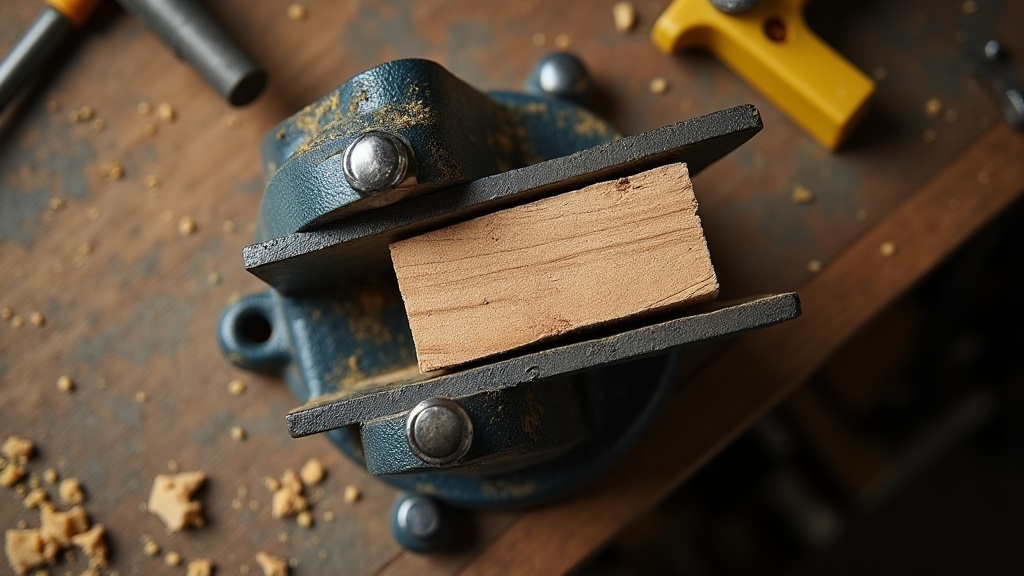
Jaw width matters most when the work itself is wide or when you need both jaws bearing evenly across a flat face — for example, holding a length of skirting board on edge, clamping a wide bracket for filing, or supporting a panel while its edge is planed.
- Narrow-jawed vices suit rods, small brackets and fine metalwork, where a wide face would be wasted and a compact vice leaves more room on the bench.
- Wide-jawed vices suit boards, long brackets and anything that needs even pressure along its whole width rather than pinching at two points.
- Where the workpiece is narrower than the jaws, the vice still closes fine — it just isn’t using its full width, which is not a problem in itself.
Where the workpiece is wider than the jaws, the ends hang unsupported and can rock or twist under load, which is where a genuinely undersized vice becomes a real limitation rather than a cosmetic one.
Does jaw width need to match the workbench?
Loosely, yes — a vice needs to sit on a bench solid enough to resist the forces it transmits, and a wider vice generally transmits more leverage through longer jaws. A flimsy top will flex under a wide vice doing heavy work regardless of how good the vice itself is.
This is really a question about the bench, not the vice. If you are choosing or building a bench to take a vice, it’s worth reading about what actually makes a workbench good before assuming a bigger vice automatically solves a stability problem.
Does jaw width affect what it does to the workpiece?
Wider jaws spread clamping force over more surface, which can reduce local marking on soft or finished material — but only if the faces are flat, clean and in good condition. Worn or pitted jaws mark work regardless of width.
For finished timber, plated metal or anything you don’t want dented, jaw liners (wood, leather, or plastic pads) protect the surface far more than jaw width does on its own. When filing, grinding or sawing material held in the vice, eye protection is worth wearing — clamped stock still throws chips and filings, and a vice holds the workpiece still, not the debris it produces.
What else should you compare when choosing a bench vice?
Jaw width is one line on a spec sheet among several that matter together. Worth checking alongside it:
- Jaw opening — how far the jaws travel, which limits the thickest stock you can grip.
- Throat depth — how far below the slide the jaws sit, which affects clamping long or overhanging pieces.
- Mounting footprint and bolt pattern — whether it matches the bench you actually own.
- Body material and construction — cast iron versus steel affects rigidity and how the vice tolerates hammering against it.
None of these numbers tell you which vice to buy outright; they tell you what a given vice is suited to, which is the more useful question. The general approach to reading spec sheets like this is covered in the buying tools guide, and the hand tool basics that pair with a vice — squares, gauges, files — are covered across the hand tools archive.
How do you check a vice’s jaws for wear or misalignment?
Close the jaws fully on a flat, straight piece of scrap and look for light gaps at the ends or middle — an even gap-free contact means the faces are still flat and parallel. A gap at one end usually means wear, a bent guide bar, or a vice that was never quite square to begin with.
A reliable straight edge or a known-square try square makes this check far more trustworthy than eyeballing it. Background on why a straightedge and a level do different jobs is covered in what is a straight edge and why a level is not one, and checking squareness itself is covered in what is a try square, and how do you check one.
If jaws no longer close flat on known-straight stock, no amount of jaw width solves it — the vice needs adjustment, replacement jaw faces, or replacing outright.
Where jaw width sits in a wider workshop setup
A bench vice is one piece of a bench’s overall working surface, alongside storage for the hand tools that get used at it. If you’re setting up or reorganising a workshop bench, the workshop and storage archive and the broader buying guides section cover how bench layout, storage and tool choice tend to interact in a small home workshop.
Jaw width is a useful, honest number — but it answers one narrow question: what fits between the faces. Opening, depth, mounting and the bench underneath it decide whether that width actually gets used well.
Find Tool publishes general information, not professional advice. Power tools, mains electricity and workshop machinery are genuinely dangerous, and the safe settings, guards and procedures differ between models — always follow the manual and the markings on the tool in front of you rather than a general guide. Never remove or defeat a guard or safety feature. Anything involving fixed wiring, gas or structural work belongs to a qualified tradesperson. Wear the eye, ear and respiratory protection the task calls for.
Related reading
Featured image: Photo by SamuelDutta, source, BY