A drill press is a stationary machine that lowers a spinning bit straight down into a fixed workpiece, instead of the operator holding both the bit and its angle by hand. That fixed geometry is what it does better than any hand drill: perfectly perpendicular holes, repeatable depth, and control over speed that a handheld tool can’t offer.
What is a drill press, exactly?
A drill press is a motor, a chuck and a spindle (the “quill”) mounted on a rigid column above a flat table. The motor turns the chuck, the quill moves up and down on a lever or handle, and the table holds the workpiece underneath. Everything except the up-and-down motion is fixed relative to everything else.
That’s the whole trick. A hand drill is a moving tool applied to a still workpiece by an unsteady human arm. A drill press is a still tool applied by a controlled mechanical motion, with the workpiece clamped to a table that doesn’t move either. Removing the human wobble from the equation is where all the benefits come from.
How does a drill press differ from a hand drill in what it holds still?
A hand drill fixes nothing except the bit in the chuck. Everything else — the angle, the depth, the pressure — depends on the person holding it. A drill press fixes the angle of the bit relative to the table permanently, and fixes the depth to whatever the operator sets on a stop or scale, following the machine’s own markings and manual.
The workpiece is also held differently. On a drill press it’s normal to clamp the piece to the table, or hold it in a vice bolted to the table, so it can’t spin or lift as the bit bites. With a hand drill, the workpiece is usually held by the other hand or by a separate clamp that’s easy to skip on a quick job — which is exactly when things go wrong.
What can a drill press do that a hand drill genuinely cannot?
A drill press produces consistently straight, repeatable holes at a controlled speed and depth — none of which a hand drill can guarantee, because a hand drill relies entirely on the operator’s steadiness and eye for square. Several practical jobs follow directly from this.
- True right-angle holes. The quill travels on a fixed axis square to the table, so a hole drilled square stays square from entry to exit — important for dowel joints, shelf-pin holes and anything that needs to line up with another hole.
- Repeatable depth across many holes. A depth stop or scale lets the same hole be drilled to the same depth over and over, which matters for shelf pins, hinge mortises or a row of identical fixings. A hand drill depends on a depth collar clipped to the bit, which slips and is easy to knock out of position.
- Larger bits and hole saws under control. Bigger diameters bite harder and generate more resistance. A drill press’s rigid mounting and table clamp keep the workpiece from spinning out of a hand’s grip the way it can with a handheld tool.
- Controlled speed for the material. Different materials and bit sizes call for different spindle speeds — usually changed by moving a belt between pulleys or via an electronic dial, depending on the machine. A hand drill’s trigger gives rough speed control at best.
- Consistent work in metal. Drilling steel or aluminium cleanly generally wants a slower, steadier speed and firm, even pressure that a handheld tool struggles to sustain — this is a job the drill press is built for.
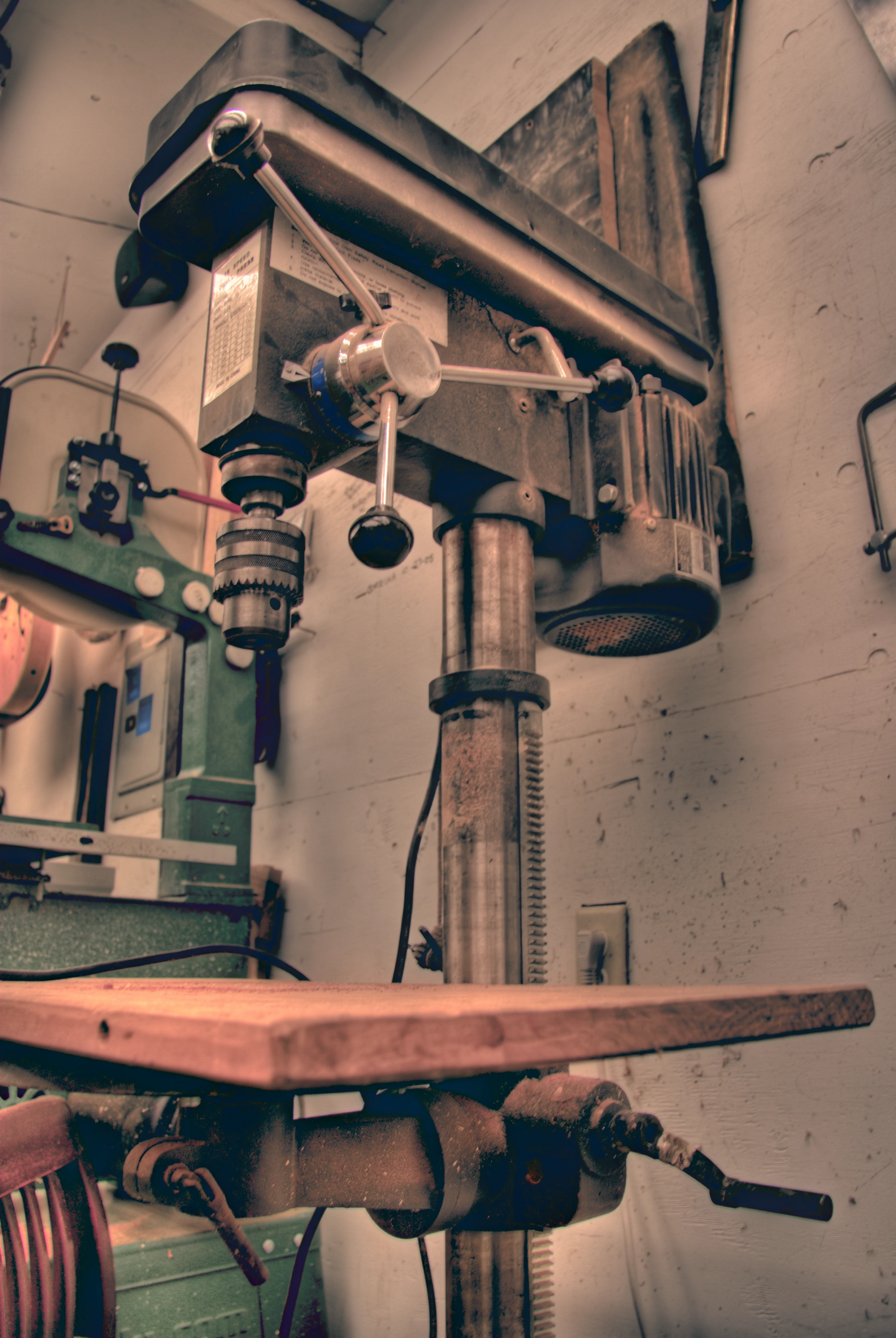

What do the speed and depth settings actually control?
Spindle speed and feed pressure control how cleanly the bit cuts and how much heat builds up at the tip; depth settings control how far the bit travels before it stops. The right combination depends on the bit type, the material and the hole diameter — all of which the tool’s manual and its own speed chart are there to specify.
As a general idea: larger bits and harder materials usually call for slower spindle speeds, while smaller bits in softer material can run faster. That’s a description of the relationship, not a number to copy — the correct setting for a specific bit, material and machine belongs in the manufacturer’s documentation, not guessed from a general rule. The buying guide hub and tool guide hub cover how to read spec sheets like this without over-trusting a single figure.
What safety features does a drill press have, and why do they matter?
Most drill presses have a chuck guard that shields the rotating chuck and bit, a table that can be clamped square and at height, and often a switch that needs to be actively held or reset rather than one that can be left running unattended. These exist because a spinning bit and an unrestrained workpiece are a genuine hazard, not a formality.
A loose workpiece is one of the most common causes of injury on a drill press: if it isn’t clamped, a bit that grabs can spin the piece violently, and hands are often nearby. Clamping the workpiece to the table, or holding it in a vice bolted down, is not optional technique — it is the difference between a controlled hole and a spinning piece of metal or wood. The same logic applies to the chuck guard and any interlock the machine has: they’re there because the failure mode they prevent is a real one, and the fix for an awkward setup is a jig or a different clamping approach, never removing the guard.
The safety and PPE archive covers this kind of fixed machine safety in more depth, and it’s worth reading before a first session on any stationary power tool.
Does a drill press replace a hand drill or a cordless drill/driver?
No — a drill press is a bench-mounted tool for precise, repeatable holes in a fixed location. A hand drill or cordless drill/driver is still needed for anything that has to go where the workpiece is: assembling furniture in place, drilling into a wall, or driving screws. They solve different problems and most home workshops end up with both.
The comparison between a drill/driver and an impact driver is a separate but related question, covered in impact driver vs drill driver: what each is better at. Whether a cordless tool suits the job at all versus a corded one is covered in corded versus cordless: what actually decides it.
What should you compare when choosing a drill press?
The comparison that actually matters is throat capacity (how far the chuck sits from the column, which limits the size of the workpiece), chuck capacity (the largest bit shank it can hold), table size and tilt, and how the speed is changed — belt-and-pulley or electronic variable speed. Motor power numbers on their own tell less than the range of speeds and the rigidity of the column and table.
Bench-top versus floor-standing is mostly about workpiece size and available space, not raw capability — a bench-top model does the same basic job as a floor-standing one, just with a smaller work envelope. A vice or clamping setup adds to the real cost of owning one, and it’s worth reading how a bench vice is used for holding work in what is a bench vice used for in automotive work for a sense of how work-holding logic carries across tools.
Depth stops and scales vary in how fine and how repeatable they are between models; the general idea of measuring and controlling a depth setting is covered in what is a depth gauge used for. For a wider look at how to weigh up specifications rather than chase a single number, the buying and comparing archive and the power tools archive are useful starting points.
What PPE and setup does drill press work need?
Eye protection is needed for any drilling, since chips and swarf come off the bit and can fly regardless of material. Loose sleeves, gloves and jewellery should stay away from the rotating chuck — a spinning bit can catch fabric or a glove and pull a hand in, which is why many machinists deliberately don’t wear gloves at the drill press.
Hearing protection matters for extended sessions, particularly with metal or with a machine that runs at higher speed for long stretches. Drilling wood, especially MDF and dense hardwoods, produces fine dust that’s worth capturing or filtering with a mask rated for fine particulates rather than a basic dust mask — MDF dust in particular is worth taking seriously over repeated exposure.
Why sleeves and gloves matter around any rotating tool, not just this one, is covered in more detail at why loose sleeves and gloves matter around rotating tools. For general workshop safety practice beyond any single machine, the safety and PPE archive and workshop and storage archive both cover related ground on keeping a home workshop set up sensibly.
Find Tool publishes general information, not professional advice. Power tools, mains electricity and workshop machinery are genuinely dangerous, and the safe settings, guards and procedures differ between models — always follow the manual and the markings on the tool in front of you rather than a general guide. Never remove or defeat a guard or safety feature. Anything involving fixed wiring, gas or structural work belongs to a qualified tradesperson. Wear the eye, ear and respiratory protection the task calls for.
Featured image: Photo by Reggie Alvey, source, CC BY-SA 3.0
Related reading
What Is a Paint Sprayer and When Does It Beat a Brush?, What Is a Bandsaw Used For Outside a Woodshop?, What Is a Wet Tile Saw and What Makes It Different?.