Bypass secateurs use a sharp curved blade that slides past a lower jaw, cutting like scissors — best for live, green stems. Anvil secateurs use a straight blade that closes onto a flat plate, crushing through the stem — better suited to dead or woody wood. The stem type decides which is right.
What is the actual mechanical difference?
The difference comes down to how the two blades meet when the handles close. It sounds like a small detail, but it changes what each tool is good at and what it does to the plant tissue.
Bypass secateurs work like a pair of scissors. A single sharp blade curves past a lower jaw without touching it, shearing the stem cleanly between the two edges. Because the blade only meets the jaw at one point as it travels, the cut is a slicing action rather than a squeezing one.
Anvil secateurs work differently. A single straight blade comes straight down onto a flat, usually softer, plate (the “anvil”). The stem is trapped and compressed until the blade forces its way through. There is no slicing motion — it is closer to a controlled crush.
Both designs rely on spring tension to reopen the jaws and a sharp edge to do the actual cutting. Neither replaces the other; they are built for different jobs.
Why does that difference matter for the plant?
A bypass cut leaves a clean, angled wound with minimal crushed tissue around it, because the blade slices through fibres rather than pressing them together. This matters most on living stems, where a clean cut heals faster and is less likely to let in disease or dieback.
An anvil cut, by contrast, tends to bruise or flatten the tissue just above the cut point before the blade fully separates it. On green, sappy growth this crushing can leave a slightly ragged, damaged stub. On dead or already-woody material, that distinction barely matters, because there is no living tissue left to bruise.
This is the main reason gardening advice consistently points to bypass secateurs for pruning live growth — roses, soft shrubs, perennials, fruit trees — and anvil secateurs for deadwood, thick dry stems, or general woody clearance where a clean wound is not the priority.
Which type cuts thicker stems more easily?
Anvil secateurs generally push through thicker, harder, or drier wood with less hand effort, because the straight blade drives directly down onto a firm surface rather than needing to align two curved edges precisely.
Bypass secateurs can struggle on very thick or very dry stems, because the blade has to travel past the jaw at the correct angle, and a stem that is too big for the tool can cause the blades to twist or jam rather than cut cleanly.
That said, “thicker” and “harder” are not the same thing. A bypass pair rated for a certain stem diameter in green wood may still labour on a dry, seasoned branch of the same diameter, because dry wood resists the slicing action more than fresh wood does. The stated capacity on a pair of secateurs is a guide for typical conditions, not a guarantee across every type of stem — check the tool’s own markings and manufacturer guidance rather than assuming one figure covers everything.
Do bypass and anvil secateurs need different maintenance?
Both types need a sharp edge to work well, but they wear differently. Bypass blades rely on two surfaces staying correctly aligned as they pass each other, so a loose pivot or a bent blade shows up quickly as crushed or torn cuts instead of clean ones.
Anvil secateurs rely on the blade meeting the anvil plate squarely. Because the anvil is usually a softer material than the blade, it wears down gradually with use, and once it develops grooves or unevenness the tool stops cutting cleanly even with a sharp blade.
Keeping either tool cutting well comes down to the same basics: a clean, sharp edge, a pivot that is neither too loose nor over-tightened, and blades kept free of sap and rust between uses. For more on how blade edges lose their cutting ability over time and what actually restores it, see how a sharpening stone’s grit affects an edge and what rust actually does to a tool left damp in a shed or under a bush.
.jpg)
Can one pair of secateurs do both jobs?
Not really — the two designs are built around opposite cutting actions, so a single blade set cannot deliver a clean slicing cut and a crushing anvil cut at the same time. Most gardens with a mix of live and dead growth end up needing both types eventually.
Some ratchet-style secateurs use an anvil action in stages, closing in small increments to help with thicker wood without needing as much hand force in one squeeze. This is a variation on the anvil principle rather than a third category, and it still shares the same crushing action rather than a slicing one.
For a broader look at where secateurs sit next to other pruning tools — and when a job actually calls for loppers or a pruning saw instead — see secateurs vs loppers vs pruning saw, which covers stem diameter and reach as the deciding factors between the three.
How do you choose between bypass and anvil for a home garden?
Start with what is actually being cut most often. A garden dominated by roses, soft perennials, and young shrub growth calls for bypass secateurs as the default, kept for anything alive. Anvil secateurs earn their place for deadheading old wood, clearing dead branches, or general rough cutting where wound quality does not matter.
Many home gardeners end up owning one of each rather than trying to make a single pair do everything. That is a reasonable outcome rather than a compromise — the two tools are solving different problems.
- Bypass secateurs: choose for live stems, roses, soft wood, and anywhere a clean healing cut matters.
- Anvil secateurs: choose for deadwood, dry stems, and general clearance where crushing the cut edge is not a concern.
- Stem diameter capacity: treat the manufacturer’s stated maximum as a guide for typical conditions, not an exact limit across all wood types.
- Blade material and anvil wear: check how the anvil face is described, since it wears faster than the blade and affects cut quality over time.
When comparing pairs in a shop or online, it helps to think about specification claims the same way as with any other tool purchase — some numbers describe a real, useful difference and others are marketing detail that will not change how the tool performs in a garden. The general guide to which tool specifications are marketing, not useful applies just as much to secateurs as to power tools, and the wider buying tools guide covers how to weigh up competing specs before choosing.
What PPE actually matters when pruning?
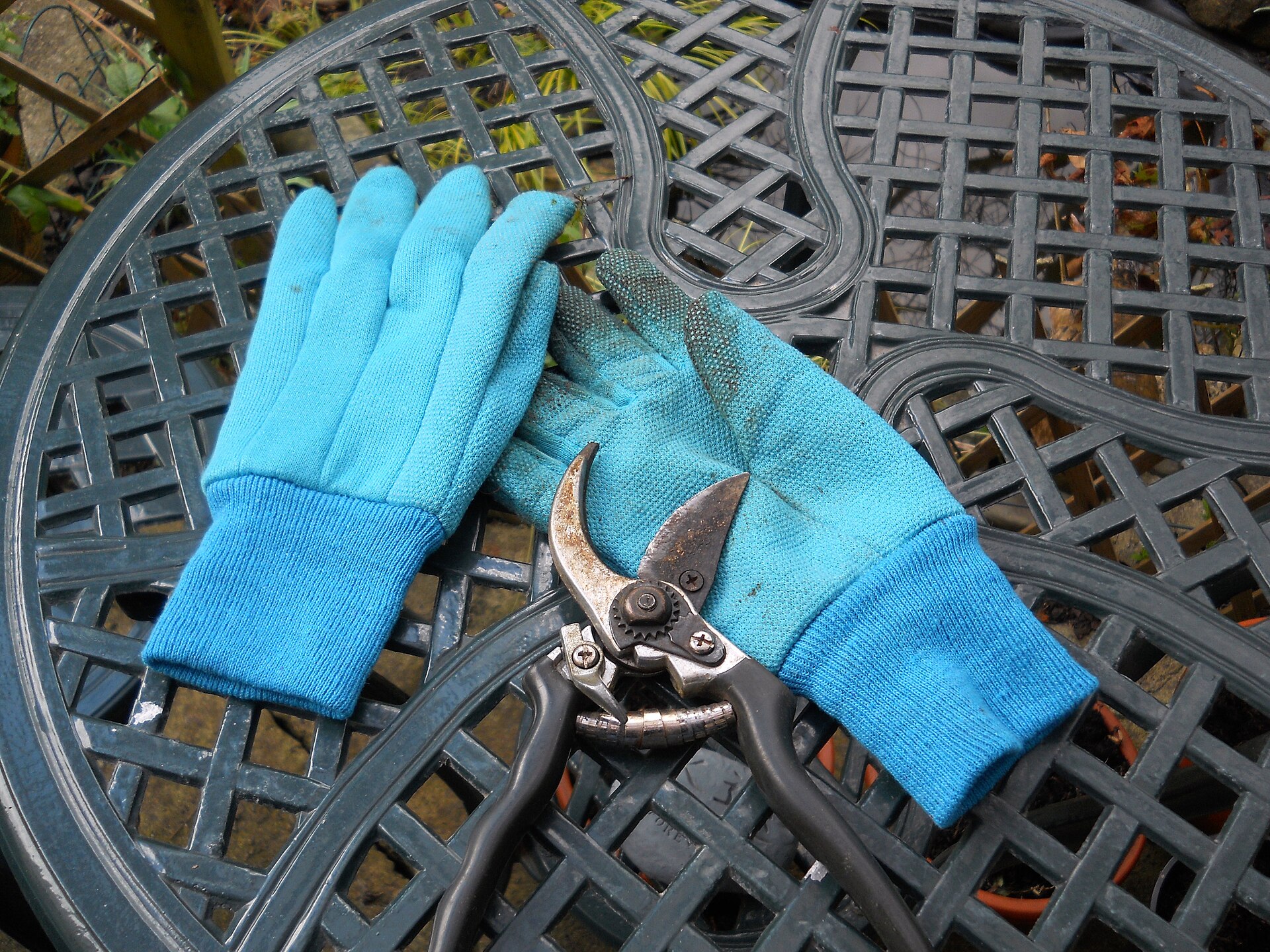
Pruning throws small pieces of stem, thorn, and bark, so eye protection is worth wearing when working through dense or thorny growth at close range, particularly overhead or when clearing old wood where debris can drop back down. Sturdy gloves protect against thorns and splinters, but should fit closely enough not to interfere with grip or blade control.
None of this needs to be treated as heavy safety kit — it is closer to the same common-sense precautions used for any hand tool that can pinch, cut, or fling small debris. The wider safety and PPE section covers this kind of everyday protective gear in more depth, alongside guidance that applies across hand tools and power tools alike.
Where do bypass and anvil secateurs fit among other hand tools?
Secateurs are one of a small set of cutting hand tools where the mechanism, not the material, decides which job it suits — much like the distinction between a chisel’s flat back and its bevel, or a saw’s tooth count. Anyone building out a set of garden or workshop hand tools benefits from understanding that a tool’s action, not just its size, determines what it does well.
For a broader sense of how hand tools in general are chosen and compared, the hand tools archive and the buying and comparing archive both cover related decisions, from blade types to when a second, dedicated tool is worth the drawer space rather than trying to make one tool do every job.
Related reading
how power tools, hand tools and measuring kit actually work, What Is Chainsaw Kickback and What Causes It?, Pressure Washer Bar and Litres-Per-Minute Rating Explained, What Is a Lawn Scarifier and What Does It Do?
Find Tool publishes general information, not professional advice. Power tools, mains electricity and workshop machinery are genuinely dangerous, and the safe settings, guards and procedures differ between models — always follow the manual and the markings on the tool in front of you rather than a general guide. Never remove or defeat a guard or safety feature. Anything involving fixed wiring, gas or structural work belongs to a qualified tradesperson. Wear the eye, ear and respiratory protection the task calls for.
Featured image: Photo by shrinkin'violet from Bristol, UK, source, CC BY 2.0