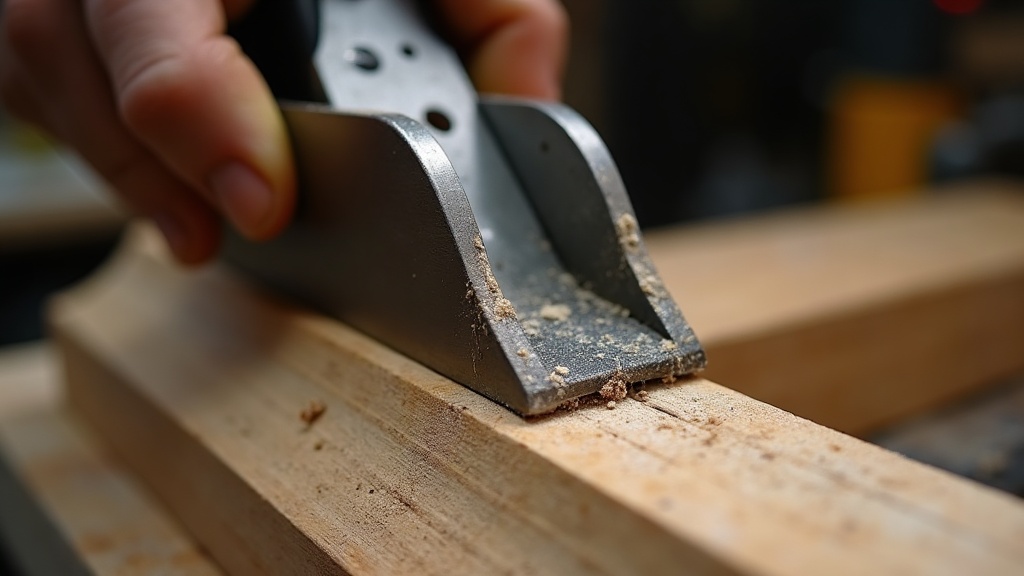
A spokeshave is a short-bodied hand plane, held with a handle on each side, used to shave curved and tapered surfaces that a longer plane can’t follow. It’s the tool for rounding chair legs and spindles, shaping tool handles, easing curved edges, and refining any shape a bandsaw or spokeshave itself has already roughed out.
What does a spokeshave actually do?
It removes thin, controlled shavings from wood, guided entirely by the two handles rather than a long flat sole. That short footprint is the whole point: it lets the blade follow a curve, a hollow, or a changing taper that a jack plane or jointer plane simply cannot register against.
Traditionally it earned its name shaping wheel spokes — hence “spoke” shave — but it settled into a much wider role wherever wood needs to move from flat-and-square to round-and-flowing. Chair makers, boat builders, tool handle makers and anyone who carves or turns by hand tend to keep one within reach.
What jobs is a spokeshave good for?
It’s best on convex curves, gentle concave curves, and tapers — anywhere a straight-soled plane would rock or dig in because it’s only touching the high points of the curve.
- Rounding over square stock into an octagon and then a cylinder, as with a chair leg or a walking stick
- Shaping the curved rails, arms and back splats on chairs and rockers
- Tapering canoe paddles, oars, axe handles and other long curved handles
- Easing and fairing curved edges on boat parts, guitar bodies and shaped furniture components
- Cleaning up bandsawn curves so the surface is smooth enough to sand or finish
On dead-flat, dead-straight work it’s the wrong tool — a bench plane with a long sole will keep a straight edge straight far more easily. The spokeshave’s short sole is an advantage on curves and a liability on flats, because it will happily follow small humps and hollows instead of ironing them out.
How is a spokeshave different from a hand plane?
The core difference is length and the way it’s held: a bench plane has a long flat sole and is pushed from behind, while a spokeshave is short, has a handle on each side, and is pulled or pushed with the wrists steering it around a curve.
Bench planes reference off a long sole to flatten and straighten. A spokeshave has almost no sole to speak of in front of and behind the blade, so nothing stops it from following the contour under it. That’s exactly what curved work needs. Readers who want the fuller picture of what plane numbers and sole lengths mean can see what the numbers on a hand plane mean, which covers how sole length changes what a plane is suited to.
It’s also worth separating a spokeshave from a card scraper, which removes much finer shavings and is often the next step after shaving to knock down tear-out or blend a curve into a smooth finish — that comparison is covered in the piece on what a card scraper is and why woodworkers keep one.
What are the parts of a spokeshave?
A spokeshave has a blade (or “iron”), a body that holds it at a set angle, two handles either side of the blade, and usually some means of adjusting how far the blade projects.
- Flat-bottomed spokeshaves — for flat or gently convex curves, the most common general-purpose type
- Round-bottomed (concave-sole) spokeshaves — for shaping the inside of curves, hollows and coves
- Adjustable-mouth models — let the gap in front of the blade be narrowed for fine shavings on figured or difficult grain
Blade adjustment is usually by small thumbscrews that tilt the blade forward or back, changing both the depth of cut and how evenly the edge sits across the mouth. Fine adjustment matters more on a spokeshave than on many other hand tools, because a shallow, even shaving is what keeps the tool tracking smoothly around a curve instead of catching.
How do you use a spokeshave without tearing the grain?
Grain direction matters more with a spokeshave than almost any other hand tool, because curved stock often changes grain direction along its length. The short answer is to work in small sections, checking the cut after every pass and reversing direction whenever the surface starts to feel rough or lift.
A shave that’s set too deep, or pushed against the grain, will tear out chunks rather than curl off a shaving. Signs to watch for:
- A shaving that tears or splits instead of curling cleanly away
- The tool chattering or skipping rather than gliding
- A fuzzy or torn surface where the grain has lifted rather than been sliced
The usual fix is a lighter cut, not more force — back the blade off slightly, take a thinner shaving, and work the section from the other direction if the surface still isn’t clean. On stock with grain that reverses along a curve (common on cabriole legs and chair spindles), it’s normal to change direction several times across a single piece.
What PPE does spokeshave work need?
Eye protection is worth wearing whenever shavings or splinters could come back toward the face, which happens more with a spokeshave than most hand planes because of how close the hands sit to the cutting edge and how often the tool is pulled toward the body.
The blade itself is exposed on both sides of the mouth, so it’s worth keeping fingers clear of the cutting edge when adjusting depth, and storing the tool with the blade retracted or capped when it’s not in use. Sanding dust generated while finishing shaved curves — especially on hardwoods — is worth capturing with a dust mask or extraction, the same as for any other hand-sanding step.
Do you need to sharpen a spokeshave blade often?
Yes, more often than a bench plane iron in practice, because the blade is doing fine, repeated shaving work on curved and often figured grain, which dulls an edge faster than long straight passes on clean-grained flat stock.
A dull spokeshave blade tends to tear rather than cut, push the tool off line, and require more force to move — all of which make the curve harder to control accurately. A blade that’s kept sharp, by contrast, needs very little pressure and gives a much better feel for where the tool is on the curve. Sharpening technique follows the same bevel-angle principles used for chisels and plane irons; the article on what a chisel’s bevel angle actually does covers how bevel angle affects edge durability and how it’s chosen.
What should you look for when buying a spokeshave?
The comparisons that matter are blade material and how it holds an edge, how finely the blade adjusts, whether the sole is flat or curved for the work planned, and how comfortable the handles are for the hand sizes actually using it.
- Blade steel — harder steels tend to hold an edge longer but can take more effort to sharpen; softer steels sharpen quickly but need touching up more often
- Adjustment mechanism — thumbscrew adjusters that move smoothly and hold their setting matter more day-to-day than any other single feature
- Sole shape — flat for general convex work, curved sole for hollows and coves; some woodworkers keep both
- Handle shape and length — affects comfort over long sessions and how precisely the tool can be steered
None of these settle the question of which is “best” — they settle which fits the work planned. A broader look at how to weigh spec sheets against real use is in the buying tools guide, and the wider range of hand tools a curved-work bench typically draws on is covered in the hand tools archive. For readers comparing spokeshaves against other curve-shaping options in a project, the comparisons archive is a useful next stop.
Where does a spokeshave fit next to other shaping tools?
A spokeshave usually sits between rough shaping and finish sanding: it takes over once a bandsaw, drawknife or rasp has established the rough curve, and it hands off to scraping or sanding once the surface is smooth and even.
It isn’t a substitute for power shaping tools on large curved work — a bench-mounted spindle sander or a portable belt sander will remove stock faster on big pieces — but it gives control that power sanding can’t match on tight curves, transitions and places where the grain direction keeps changing. Readers building out a fuller shaping toolkit, hand or powered, can browse the tool guide hub for how each type of tool actually works, or the power tools archive for the machine side of shaping and smoothing.
Find Tool publishes general information, not professional advice. Power tools, mains electricity and workshop machinery are genuinely dangerous, and the safe settings, guards and procedures differ between models — always follow the manual and the markings on the tool in front of you rather than a general guide. Never remove or defeat a guard or safety feature. Anything involving fixed wiring, gas or structural work belongs to a qualified tradesperson. Wear the eye, ear and respiratory protection the task calls for.
Related reading
What Is a Pipe Wrench, and Why That Shape?, What Is a Bradawl For? A Plain-Language Guide, What Is a Mallet For If You Already Own a Hammer?.
Featured image: Photo by R. Henrik Nilsson, source, CC BY 4.0
