A mallet delivers a broad, controlled push of force rather than a hammer’s sharp, concentrated blow. That difference protects chisel handles, dowels and joints from splitting, and lets softer mallet faces move parts without denting or bruising the surface a steel hammer would mark.
What does a mallet actually do differently to a hammer?
A hammer concentrates energy into a small steel face travelling fast. That is exactly what you want for driving a nail through resistant fibres, or for the sharp shock a cold chisel needs on metal. A mallet spreads that same energy over a bigger, softer face, so the strike is more of a firm shove than a crack.
The result is a blow that transfers force without the shock and without the sharp edge contact. Wood, plastic and rubber mallet faces flex slightly on impact, which softens the peak force reaching the tool or the workpiece. That is the whole story, and it matters more than it sounds.
Why does a wood chisel need a mallet instead of a hammer?
A chisel handle is shaped and sized to take repeated blows from a mallet face, not a steel hammer face. Striking it with a hammer concentrates force into a small area of the handle, which can crack, split, or mushroom the striking end over time.
The bevel and edge of the chisel are doing the cutting; the mallet’s job is only to push the blade through the fibres in a controlled way. A heavier or lighter mallet changes how much waste comes away with each strike, but the type of tool striking the chisel is what protects the handle. For more on how the edge itself is ground to do its job, see what a chisel’s bevel angle is actually for.
What is a soft-faced mallet for?
A soft-faced mallet — rubber, rawhide, or a plastic-and-nylon combination — is for moving or seating a part without marking it. It is the tool for tapping a dowel joint home, persuading a stubborn workpiece into a vice, or adjusting a hand plane’s blade without denting the sole or the iron.
Furniture assembly is the classic case. Clamping up a chair or a cabinet carcass often needs a joint knocked square or a rail persuaded flush before the clamps go on. A steel hammer face against raw wood leaves a bruise that no amount of sanding fully removes; a mallet face does the same job and leaves nothing behind.
Soft mallets also show up away from the bench. Fitting a wheel bearing race, seating a leather washer, or knocking a tent peg without splitting it are all jobs where a hard steel face would do damage a softer one avoids.
Can a mallet replace a hammer for driving nails?
No. A mallet’s soft or wide face is the wrong shape and the wrong material for starting and driving a nail cleanly, and its lighter, distributed blow will not deliver enough concentrated force. A hammer’s hardened steel face and claw are built for exactly that job.
Nail driving needs a small, hard, precisely placed strike — first to set the nail, then to sink it flush without bending it or marring the surrounding surface. A hammer’s balance, weight distribution and face geometry are built around that single task. If you are choosing between hammer styles for framing or general carpentry, the differences are covered in claw hammer vs framing hammer.
Do carving mallets differ from joinery mallets?
Yes — a carving mallet is typically rounder, lighter and designed for quick, repeated taps at odd angles, while a joinery mallet is heavier with a flat, square face built for driving a chisel straight and square into a mortise. Both still rely on the same soft-strike principle.
A round carving mallet can be swung from any angle without needing to align a flat face with the tool being struck, which suits the constant repositioning of carving work. A joiner’s square-faced mallet, often with a slightly angled face, is built to land flat and square on a chisel handle held upright for chopping a mortise or paring a joint.
What about metalworking — is there a mallet for that too?
Yes. Metalworking mallets, sometimes called dead-blow or soft-faced hammers, have heads filled with sand or shot, or faces made from nylon, copper or lead. They deliver force without bouncing back and without marking soft or precision-machined metal surfaces.
A dead-blow mallet is useful for freeing a stuck part, seating a bearing, or knocking a panel into alignment without the rebound a solid steel hammer gives. That lack of bounce also makes them safer to control, since the user is not fighting a head that springs back after the strike.
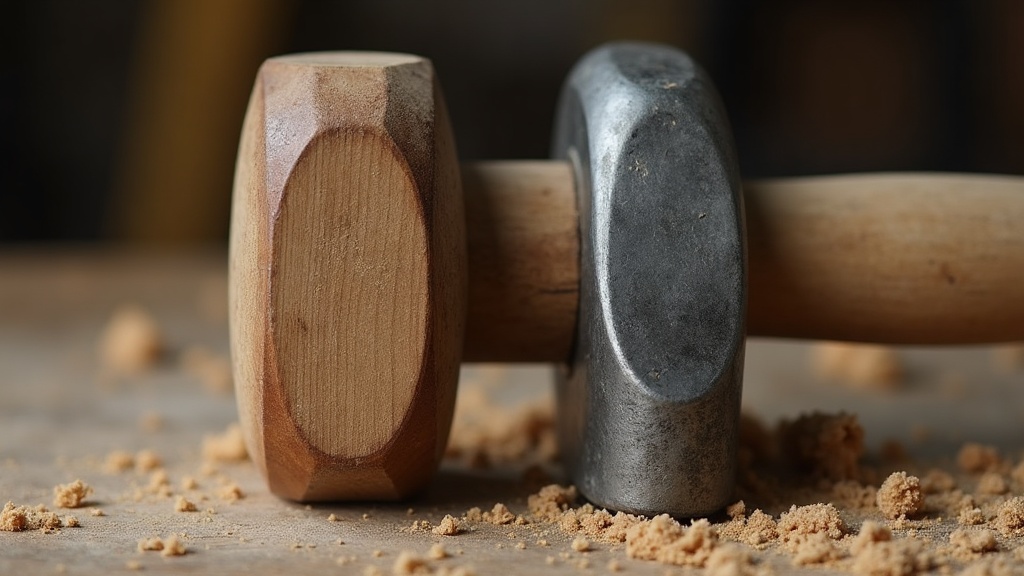
How do I choose the right mallet weight and face?
Weight and face material are chosen around the job, not around a single “correct” mallet. A heavier head moves more mass per strike and suits chopping deep mortises or heavy joinery; a lighter head suits fine paring cuts and delicate assembly work where control matters more than force.
- Wood mallet: traditional choice for chisel work; face wears predictably and can be re-trued if it gets battered.
- Rubber or rawhide mallet: for assembly and fitting where the surface must stay unmarked.
- Dead-blow (shot or sand-filled) mallet: for metalwork and situations where rebound would be a nuisance or a hazard.
- Round carving mallet: for carving and sculpting where the tool is struck from varying angles.
As with most hand tools, the manufacturer’s guidance on what a given mallet is designed to strike is worth following — a mallet built for wood chisels is not necessarily rated for striking metal punches or masonry chisels. For a broader look at how to compare hand tools by what they are actually built to do, the tool guide hub and the hand tools archive are useful starting points.
Is there a safety reason to use a mallet instead of a hammer?
Yes. Using the wrong striking tool can send a chisel handle splitting, a workpiece skittering, or a chip flying, all of which risk injury to hands and eyes. Eye protection is worth wearing for any striking work, since chips and splinters can come off the tool or the workpiece unexpectedly.
A mushroomed steel hammer face striking a chisel butt, or a chisel handle that has already begun to split from repeated hammer blows, can shed sharp fragments. Checking mallet and chisel handles for cracks before use, and replacing a handle rather than continuing to strike a damaged one, is a small habit that avoids a larger problem. For a wider view of how tool choice and handling connect to injury risk in the workshop, see the safety and PPE archive.
So when do I actually reach for the mallet over the hammer?
Reach for a mallet whenever the job is about controlled movement rather than driving something in — chopping or paring with a chisel, seating a joint, adjusting a plane iron, or freeing a stuck part without marking it. Reach for a hammer when the job needs a sharp, concentrated blow, such as driving a nail or striking a cold chisel on metal.
Most home workshops end up with at least two mallets alongside a hammer or two: a wooden or plastic-faced mallet for chisel work, and a soft-faced or dead-blow mallet for assembly and fitting. Neither replaces the hammer, and the hammer does not replace either of them.
For readers building out a basic kit and deciding what actually earns bench space, the buying tools guide hub covers how to weigh up hand tools by function rather than by price alone, and the buying guides archive has more on comparing tool categories before spending money.
Find Tool publishes general information, not professional advice. Power tools, mains electricity and workshop machinery are genuinely dangerous, and the safe settings, guards and procedures differ between models — always follow the manual and the markings on the tool in front of you rather than a general guide. Never remove or defeat a guard or safety feature. Anything involving fixed wiring, gas or structural work belongs to a qualified tradesperson. Wear the eye, ear and respiratory protection the task calls for.
Related reading
What Is a Combination Square, and Why Use It So Much?, Why Do Chisels Need a Flat Back? A Plain Guide.