A socket set’s drive size — usually 1/4″, 3/8″ or 1/2″ — refers to the square drive stud on the ratchet and the matching square hole inside each socket, not the size of the nut or bolt being turned. It tells you roughly how much torque the set is built to handle and how bulky each tool will feel in the hand.
What does “drive size” actually mean?
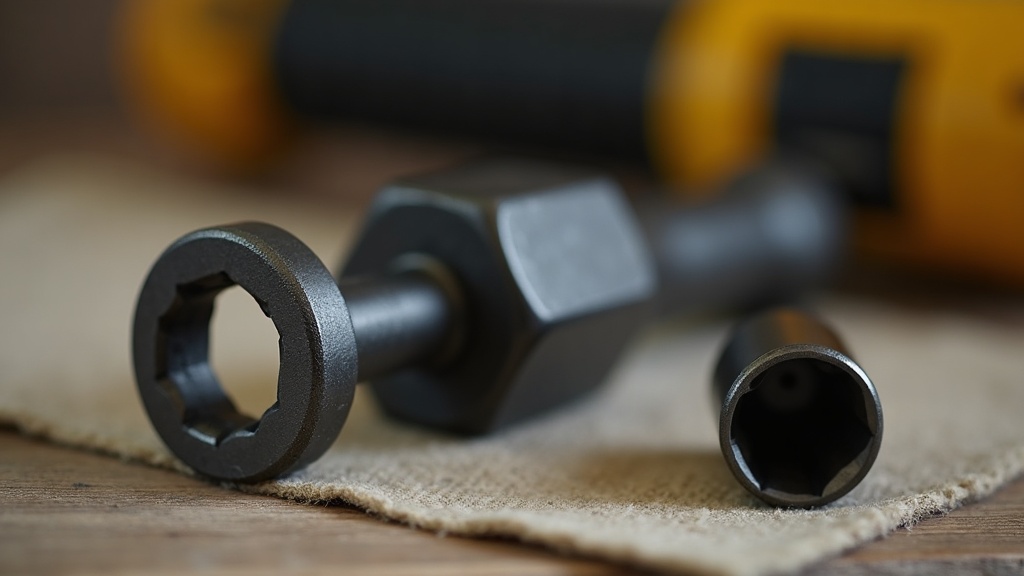
Every ratchet has a small square peg sticking out of its head, and every socket has a matching square recess at the back. That peg-and-recess connection is the “drive.” Drive size is simply the measurement across that square, and it has nothing to do with the hex size printed on the front of the socket that actually grips the fastener.
This is why a socket set is described by two separate numbers at once — for example, a 3/8″ drive set containing sockets from 8mm to 19mm. The drive size tells you which ratchets, extensions and breaker bars will physically connect to which sockets. The hex size tells you which fastener the socket fits.
Why do 1/4″, 3/8″ and 1/2″ exist at all?
These three sizes cover most of what a home workshop, car maintenance job or furniture assembly ever needs, and each one trades off compactness against strength.
- 1/4″ drive — the smallest common size, used for light fastening: electronics, small appliances, bicycle work, interior trim. Sockets and ratchets are compact enough to work in tight spaces.
- 3/8″ drive — the general-purpose middle ground. Most home mechanics and DIY toolkits are built around 3/8″ because it handles the bulk of automotive and household fasteners without being heavy to hold for long periods.
- 1/2″ drive — built for higher-torque work: suspension bolts, wheel nuts, larger structural fasteners. The sockets, ratchet head and drive stud are all noticeably thicker and heavier.
Less common sizes exist at both ends — 1/4″ mini sets for delicate electronics work, and 3/4″ or 1″ drive for heavy plant and industrial equipment — but they rarely appear in a home workshop.
Does drive size affect torque capacity?
Yes, in a general sense. A thicker square drive, a heavier-walled socket and a more substantial ratchet mechanism are all designed to handle more twisting force before something bends, rounds off or snaps. That is why 1/2″ drive sets are the default for wheel nuts and suspension work, where the fastener is torqued up tight and often needs real effort to break loose.
What drive size does not do is tell you the exact torque a specific fastener needs, or the exact torque a specific tool can safely deliver. Those figures come from the fastener manufacturer’s specification and, where relevant, the tool’s own documentation — not from the drive size alone. If a job calls for a torque wrench, follow the setting given for that fastener rather than guessing from the size of the drive.
Using a smaller drive size to save weight on a job that genuinely needs more leverage is a common way to strip a socket’s corners or snap an extension. If a fastener will not move with reasonable effort, the more sensible response is a bigger drive size or a proper breaker bar rather than more force applied to an undersized tool.
How does drive size relate to socket size (nut size)?
They are independent measurements that happen to be sold together. A 3/8″ drive socket can be a small 8mm socket or a larger 19mm one — the drive stays the same size while the hex opening changes to suit the fastener. Manufacturers choose a practical range of hex sizes to pair with each drive size, which is why 1/4″ drive sets top out at smaller hex sizes and 1/2″ drive sets start larger and go up further.
Fastener sizing itself comes in two competing systems — metric and imperial (AF) — and mixing them up on the same bolt is a separate and common source of rounded corners. The article on metric vs AF spanner sizes covers how to tell the two apart and why a close-but-wrong fit damages a fastener faster than an obviously wrong one.
Can you mix drive sizes with adapters?
Step-up and step-down adapters exist to connect a smaller drive ratchet to a larger drive socket, or the reverse, and they are genuinely useful for occasional odd jobs. They are not a substitute for owning the right drive size for regular work.
An adapter concentrates force through a smaller connection point than the socket it is feeding, so it becomes the weakest link in the chain. For a one-off nut that happens to need a bigger socket than the ratchet in hand, an adapter is a reasonable stopgap. For repeated heavy-torque work, it is better to use tools matched to that drive size throughout.
Which drive size should a home workshop start with?
For most home workshops, a 3/8″ drive set covers the largest share of jobs — general fastening, small engine and appliance work, furniture and fixture assembly. Adding a 1/4″ set for fine work and a compact 1/2″ set (or just a handful of large sockets on an adapter) for occasional heavier jobs like wheel nuts rounds out a practical collection without duplicating the same sizes three times over.
When comparing sets, the drive size is one of several specifications worth checking against how the set will actually be used — alongside socket depth (standard vs deep), drive type (6-point vs 12-point), and whether the set includes extensions and a breaker bar. The buying a tool guide hub covers how to weigh up specifications like these without chasing numbers that do not matter for the job at hand, and the wider hand tools archive has related pieces on choosing hand tools generally.
What about impact-rated sockets and drive size?
Impact wrenches deliver rapid hammering pulses of torque rather than a smooth steady turn, and ordinary chrome sockets are not designed to absorb that kind of shock loading — they can crack or shatter under it. Impact-rated sockets are made from a different, tougher material and are usually black rather than chrome for that reason.
Drive size still applies the same way with impact tools: a 1/2″ impact wrench needs 1/2″ drive impact sockets, matched to the fastener size in the same way as with a hand ratchet. Anyone deciding between an impact wrench, a standard drill or a hammer drill for a job can find the differences explained in the drill vs impact driver vs hammer drill comparison.
Because impact tools are loud with sustained use, ear protection is worth wearing for any extended run of fastening. Eye protection matters too — a socket, adapter or fastener under high shock load can fail suddenly, and fragments or a suddenly-released bolt can travel further than expected.
What PPE and safety points matter when using sockets?
Sockets and ratchets are simple hand tools, but the jobs they are used for still carry some risk. Eye protection is sensible whenever there is a real chance of a fastener shearing, a socket splitting under load, or debris being dislodged from a rusted joint. This applies especially to breaker bar work and anything powered by an impact wrench.
A socket or extension that is visibly cracked, rounded at the drive stud, or no longer seats squarely should be retired rather than pushed through “just one more job” — a slipping connection under load is how knuckles get hurt. The safety and PPE archive has further reading on matching protective equipment to the task rather than treating it as an afterthought.
For readers building out a fuller understanding of how hand tools and measuring kit fit together in a home workshop, the tool guide hub and the measuring and layout archive are useful starting points, alongside the buying guides archive for comparing specifications on other tool categories using the same kind of reasoning covered here.
Find Tool publishes general information, not professional advice. Power tools, mains electricity and workshop machinery are genuinely dangerous, and the safe settings, guards and procedures differ between models — always follow the manual and the markings on the tool in front of you rather than a general guide. Never remove or defeat a guard or safety feature. Anything involving fixed wiring, gas or structural work belongs to a qualified tradesperson. Wear the eye, ear and respiratory protection the task calls for.
Related reading
What Is a Strop and What Does It Actually Do?, What Is a Bench Hook? A Simple Woodworking Jig Explained.
Featured image: Photo by Pittigrilli, source, CC BY-SA 4.0
