A sharpening stone’s grit is a measure of how large or small the abrasive particles bonded into its surface are. Coarse grit has large, widely spaced particles that remove metal quickly but leave deep scratches. Fine grit has small, closely packed particles that remove less metal per stroke but leave a smoother, sharper edge.
What does “grit” actually mean on a stone?
Grit numbers describe particle size, and the relationship is inverted from what feels intuitive: a low number like 220 means large particles, and a high number like 8000 means very small ones. The number itself usually refers to the mesh size used to sort the abrasive during manufacturing — how many openings per inch a sieve has that lets particles of that size pass through.
Finer mesh openings only let through smaller particles, so a higher grit number always means smaller abrasive grains, a smoother resulting surface, and slower metal removal. This is the same logic used on sandpaper, and the numbering systems are related but not always directly comparable between manufacturers or countries.
Why do coarser grits cut faster but leave a rougher edge?
Each abrasive particle acts like a tiny chisel, scratching a groove into the steel as it passes over. Larger particles dig deeper grooves in fewer passes, which is why coarse stones remove metal quickly — useful for reshaping a damaged edge or changing a bevel angle.
But those deep grooves are exactly what makes the edge feel rough and cut poorly. A blade fresh off a coarse stone has a jagged, saw-like edge under magnification. It will cut, but not cleanly, and it dulls faster because the tips of those jagged peaks are thin and fragile.
What happens to the metal at each grit stage?
Sharpening works by progressively replacing the scratch pattern from one grit with the finer scratch pattern from the next. Each stage doesn’t erase the previous grooves instantly — it cuts new, shallower ones that gradually overwrite the deeper ones, until the surface is smooth enough that the edge holds together as a clean, straight line rather than a row of jagged points.
- Coarse grit: reshapes the bevel, removes chips or rounds, sets the basic geometry.
- Medium grit: removes the coarse scratches and refines the edge toward usable sharpness.
- Fine grit: polishes the bevel faces so they meet in a genuinely thin, continuous edge.
- Very fine or polishing grit: reduces microscopic roughness further, mainly affecting edge longevity and finish quality rather than raw cutting ability.
The sharpest point any edge can reach is where its two faces meet in a line with no gap and minimal jaggedness. Grit progression is the process of getting both faces smooth enough that they meet cleanly.
How many grits does a sharpening progression actually need?
There’s no fixed number that suits every tool or every user — it depends on how damaged the edge is to start with and how sharp the task genuinely requires it to be. A chisel that’s merely lost its edge after normal use may only need a medium and a fine stone. A chipped or badly rounded edge usually needs a coarse stone first to re-establish the bevel before moving up.
Many home sharpening setups use two or three stones spanning coarse to fine, sometimes with a final strop for polishing. Adding more intermediate steps can produce a marginally sharper result, but each extra stone also means extra time and extra equipment to store and maintain. Whether that trade-off is worth it depends on the tool and the work, not on a rule that applies everywhere.
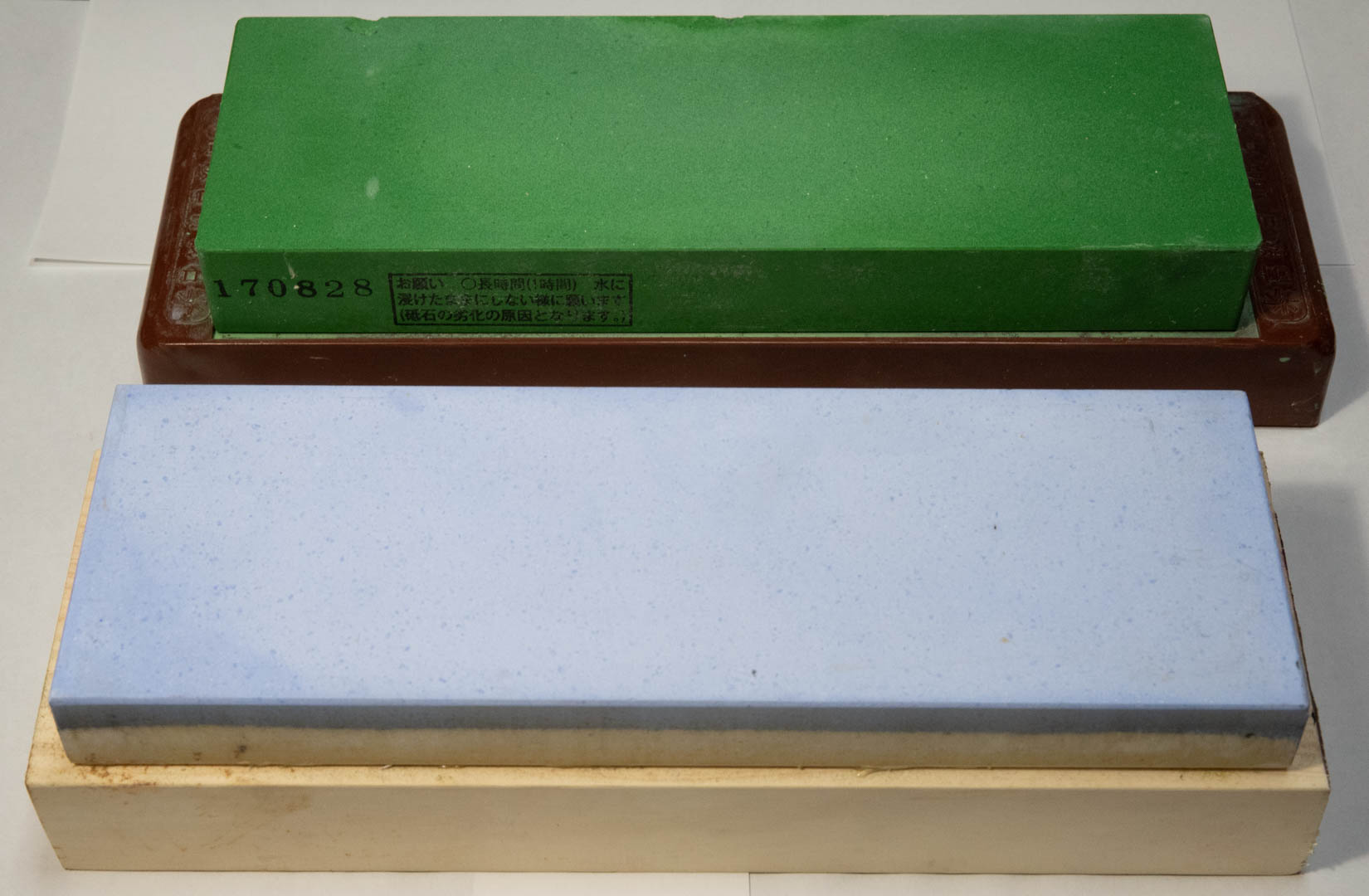

What’s the difference between oil stones, water stones and diamond plates?
The grit number tells you the particle size; the stone type tells you what holds those particles and how the stone behaves in use.
- Oil stones use a bonded abrasive lubricated with honing oil. They wear slowly and don’t dish out quickly, but they cut more slowly than water stones of a comparable grit.
- Water stones are softer, so they cut faster because fresh abrasive is constantly exposed as the surface wears — but that same softness means they dish (wear unevenly) and need flattening more often.
- Diamond plates hold abrasive particles on a hard, flat backing that barely wears at all. They stay flat for a long time and cut consistently, but they don’t refresh their surface the way a water stone does, so a worn diamond plate simply becomes duller rather than exposing new grit.
None of these is universally “better” — they’re different trade-offs between speed, flatness retention, mess and maintenance. Comparing them properly means thinking about which trade-off suits how often you sharpen, not chasing a single spec.
How do you know when to move to the next grit?
The practical test is feel and appearance rather than a fixed stroke count. On a coarse stone, work until the previous damage or the old bevel scratches are fully replaced by the new stone’s pattern — checking under a raking light makes the scratch pattern easier to see.
A small raised burr forming along the back edge of the bevel is a useful sign that the coarser stage has done its job and it’s time to move on. Chasing extra strokes on a coarse stone past that point wastes steel without improving the edge — the fine work happens at the next grit, not by grinding longer on the current one.
What actually dulls or damages a stone itself?
Stones wear unevenly with repeated use in the same spot, forming a dish or hollow that makes it hard to hold a consistent bevel angle. Oil and water stones both need periodic flattening against a flattening plate or a coarser abrasive surface to correct this.
A stone can also glaze — its surface loading up with swarf and spent abrasive until it stops cutting effectively and instead burnishes the metal without removing any. Regular cleaning, and using the amount of oil or water the stone type calls for, keeps the surface cutting rather than smearing. The same underlying idea — that a cutting surface needs fresh, exposed abrasive or edge to actually cut — shows up in what actually dulls a saw blade and in why drill bits stop cutting, even though the mechanisms differ.
How does grit interact with bevel angle?
Grit and angle solve different problems. The bevel angle sets how the edge geometry behaves in the cut — a shallower angle tends to be sharper but more fragile, a steeper one more durable but less keen. Grit determines how cleanly the two faces of that bevel meet.
Changing grit without holding the angle consistent produces a rounded or multi-faceted edge rather than a single clean bevel, which is one of the most common reasons a sharpening session doesn’t produce the expected result. A honing guide or a consistent hand position matters more here than which stone is in use. For more on how bevel angle itself is chosen, see what a chisel’s bevel angle is for.
What PPE and precautions matter when sharpening by hand?
Sharpening on oil or water stones is low-hazard compared with powered grinding, but a few basics still apply. Handle blades and chisel edges deliberately, always aware of where the cutting edge is relative to fingers, and keep the work area free of oil or water pooling that could cause a slip.
If sharpening is done on a powered wet grinder or bench system rather than by hand, eye protection is worth wearing because a powered wheel can throw debris and slurry, and any dry grinding stage that produces airborne dust calls for a respirator rated for fine particulates rather than assuming a dust mask is enough. Check the machine’s own manual for guard positioning and safe handling — that documentation, not general habit, should guide use of a powered sharpening system.
How does stone sharpening compare with powered sharpening systems?
Powered sharpening systems and belt or wheel grinders remove metal much faster than hand stones, which is useful for reshaping badly damaged edges but also makes it easier to overheat the steel or remove more than intended in a single pass. Hand stones trade speed for control, which is part of why many hobbyists keep both a coarse mechanical option for reshaping and a stone progression for the final edge.
Choosing between them, or deciding how many stones to keep in a home kit, comes down to how often edges need sharpening and how much control matters for the tools involved. That trade-off is covered in more general terms in the guide to choosing tools and comparing specs, and the broader mechanics of how hand tools work are covered in the tool guide hub.
For related sharpening and edge-tool reading, see the difference between a rasp and a file, what a card scraper is used for, and the wider hand tools archive. Stone care and storage habits are covered further in the tool care and maintenance archive.
Find Tool publishes general information, not professional advice. Power tools, mains electricity and workshop machinery are genuinely dangerous, and the safe settings, guards and procedures differ between models — always follow the manual and the markings on the tool in front of you rather than a general guide. Never remove or defeat a guard or safety feature. Anything involving fixed wiring, gas or structural work belongs to a qualified tradesperson. Wear the eye, ear and respiratory protection the task calls for.
Featured image: Photo by T-maru, source, CC BY-SA 4.0