A chisel’s bevel angle is the compromise between sharpness and strength. A shallower angle takes a finer, easier-cutting edge but chips more readily; a steeper angle is tougher and holds up to mallet blows but needs more force to push through wood. The “right” angle depends on what the chisel is doing.
What does the bevel angle actually control on the edge?
The bevel angle is the angle between the flat back of the chisel and the ground face that meets it at the cutting edge. That angle sets how thin the metal is right at the point of contact with the wood.
A thinner, more acute edge slices through wood fibres with less resistance, which matters when you are paring by hand and relying on control rather than force. A thicker, steeper edge has more metal behind it, so it resists rolling over, chipping, or folding when it meets harder wood, end grain, or the shock of a mallet strike. Every bevel angle is a trade-off between those two things — how easily it cuts, and how long it survives cutting.
Why do different jobs call for different bevel angles?
Because the forces on the edge change with the task. A chisel that only ever pares thin shavings by hand sees very different loads to one that gets struck repeatedly to chop out a mortise.
- Fine paring work — trimming dovetails, cleaning up a shoulder, slicing end grain — rewards a lower angle, because you’re controlling the cut with hand pressure and want minimum resistance.
- Chopping and mortising — driven with a mallet, often into harder or knottier wood — needs a steeper angle so the edge doesn’t chip out under repeated impact.
- General bench work sits in between, which is why most chisels ship with a middle-ground angle intended to cope with a bit of everything.
Softer, straighter-grained timber tolerates a lower angle better than dense hardwood or wood with a lot of interlocked or reversing grain, which tends to chip a fine edge faster regardless of how carefully it’s used.
What is a secondary bevel, and why bother with one?
A secondary bevel — sometimes called a micro-bevel — is a small, slightly steeper angle honed only at the very tip of the primary bevel. It exists so you don’t have to re-grind the whole bevel face every time the edge needs touching up.
Instead of flattening the entire bevel on a stone each time, you hone a narrow strip at a marginally steeper angle right at the edge. That strip is what actually meets the wood, so it behaves like a slightly steeper-angled chisel in use, while the bulk of the bevel stays at its original, lower angle. It’s a practical shortcut: less metal to remove on every sharpening session, and a slightly tougher edge where it matters most.
The trade-off is that the secondary bevel eventually widens as you re-hone it, and at some point the whole bevel needs regrinding back to a single angle before you start again.
Does a steeper bevel mean a stronger edge, full stop?
Not exactly — steeper helps resist chipping, but it isn’t automatically “better.” A very steep bevel cuts more slowly, needs more downward or mallet force to make the same cut, and can bruise or tear delicate work instead of slicing it cleanly.
Edge strength also depends on the steel itself, how it was heat-treated, and how well it’s supported by a flat, properly maintained back — not on angle alone. A well-sharpened chisel at a moderate angle in good steel will often outlast a poorly maintained one at a steeper angle. Bevel angle is one variable among several, not a single dial that makes an edge indestructible.
How do you choose a bevel angle for a chisel you already own?
Start from what the chisel is mostly used for, not from a single “correct” number. If it’s a paring chisel that never sees a mallet, a lower angle suits it. If it regularly gets struck into mortises, lean toward the steeper end of what’s reasonable for that blade and steel type.
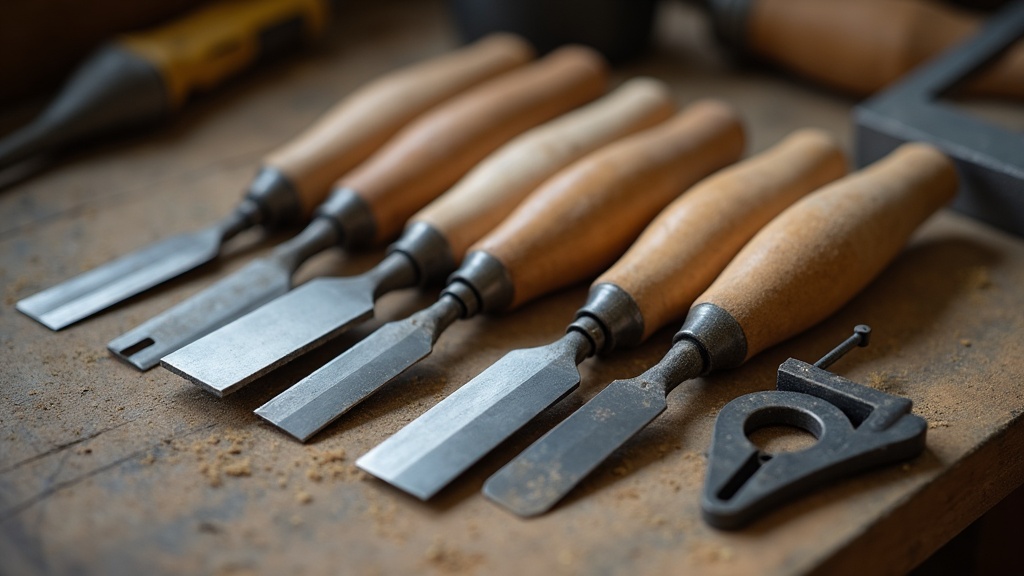
Honing guides make this practical, because they let you register a consistent angle stone after stone instead of relying on freehand feel. Some guides use a fixed roller position; others have an adjustable angle setting. Either way, the guide only repeats whatever angle you set it to — it doesn’t know what’s right for your chisel or your timber, so that judgement still rests with you.
If you’re building a small set of chisels for general home workshop use, it’s often more useful to think in terms of two working angles — one lower angle for chisels dedicated to fine paring, one steeper angle for chisels that take mallet blows — rather than hunting for one universal number.
What actually damages an edge if the angle is wrong for the job?
Using a low-angle paring bevel for heavy mallet work is the classic mismatch. The thin edge chips or rolls under impact, and you end up sharpening more often than the work should require. Going the other way — using a steep, tough bevel for delicate paring — just makes fine work harder than it needs to be, because the edge has to be pushed rather than allowed to slice.
Grain direction matters too. Chopping into end grain or knotty, interlocked timber stresses an edge far more than paring along straight grain, so the same chisel and the same angle can behave very differently depending on what it’s cutting.
What should you keep in mind when sharpening or reshaping a bevel?
Sharpening on stones by hand throws off very little in the way of hazards beyond fine metal swarf, but reshaping a bevel on a bench grinder is a different matter — it throws sparks and hot metal particles, so eye protection is worth wearing every time, and gloves should stay well clear of the wheel. Chisel work itself sends wood chips and slivers off the edge as you pare or chop, so eye protection is worth keeping on through that too, not just during grinding.
If you want to understand how angle and geometry show up on other edge tools and hand-plane specifications, the site’s guide to what the numbers on a hand plane mean covers similar ground from a different angle, literally and otherwise.
For a broader look at how hand tools are built and specified, the tool guide hub and the hand tools archive are useful starting points. If you’re weighing up which chisels or sharpening kit to add to a home workshop, the buying tools guide hub and the buying guides archive explain what to compare without pushing a specific product. General safe working habits around edge tools and workshop PPE are covered in the safety and PPE archive, and the comparisons archive is worth a look if you’re deciding between different chisel types or sharpening systems.
Do you need to worry about exact angle numbers?
Not obsessively. What matters more day to day is consistency — sharpening at roughly the same angle each time so the edge geometry stays predictable — and matching that general angle to the work the chisel actually does.
Manufacturers often supply a recommended sharpening angle or angle range for a specific chisel line, and that’s worth following as a starting point rather than guessing. Beyond that starting point, the real skill is noticing how an edge behaves — whether it’s chipping, rolling, or simply cutting well — and adjusting from there rather than chasing a number that isn’t specific to your steel, your timber, or your technique.
Find Tool publishes general information, not professional advice. Power tools, mains electricity and workshop machinery are genuinely dangerous, and the safe settings, guards and procedures differ between models — always follow the manual and the markings on the tool in front of you rather than a general guide. Never remove or defeat a guard or safety feature. Anything involving fixed wiring, gas or structural work belongs to a qualified tradesperson. Wear the eye, ear and respiratory protection the task calls for.
Related reading
What Is a Socket Set’s Drive Size Telling You?, Spanner Sizes: Metric vs AF — What’s the Real Difference?.
Featured image: Photo by Luke Milburn, source, CC BY 2.0
